Responsible Aquaculture is No Myth
This post is a response to a report from the U.S. group Farm Forward entitled “The Myth of ‘Sustainable’ Aquaculture.” This report called out five supposed ‘myths’ about fish farming which are addressed below.
Over the past five decades, the global aquaculture industry has become the leading supplier of seafood for human consumption, outpacing commercial fisheries in terms of annual production. Fish farming is a necessary component of modern food systems that is gaining efficiencies, lowering impacts and building consumer trust through regulation, technology, knowledge sharing and marketplace tools like traceability and certification.
Despite these transformative improvements, aquaculture remains the target of criticism based on environmental, nutritional or quality concerns that typically don’t hold up upon further inspection. The sector’s remarkable ascension has occurred despite widespread and coordinated efforts to degrade the industry and spread inaccuracies to sow consumer distrust.
This unfortunate tactic reoccurred in late January when U.S. group Farm Forward launched what it calls the Aquaculture Accountability Project. It referred to so-called sustainable seafood as a lie and spelled out five “myths” about farmed seafood – all five of their points lack merit and demand a response.
- Point #1: Fish farming reduces pressure on wild fisheries.
Global fisheries have plateaued since the 1970s and the consensus among fisheries scientists is that production is unlikely to increase again, given that roughly 90 percent of global fish stocks are fully exploited or overfished.
Aquaculture has provided an alternative and reliable source of seafood products that consumers want, at steady prices. Modern farm designs are reducing waste, mitigating escapes and preventing disease outbreaks. And with the emergence of novel feed ingredients (terrestrial ingredients like soy, algae, insects, single-cell proteins, etc.), the industry is rapidly adopting innovative products and practices to lessen its dependence on wild fish for feed.
Wild-capture fisheries cannot expand without serious negative impacts to the environment, while aquaculture can scale slowly and efficiently. The only way seafood production has increased in the past 50 years, or will increase in the future, is through aquaculture.
- Point #2: Fish farming meets a growing demand for seafood.
Given the outlook for global fisheries outlined above, aquaculture plays a vital role in meeting current and future demand for seafood. Demand for all proteins is rising globally and will rise even further as the global population is expected to reach 10 billion people by the year 2050.
Despite efforts to hinder its expansion, the global aquaculture industry has grown steadily and began outpacing commercial fisheries in annual production of seafood for human consumption starting in 2022. And for many low- and middle-income countries, aquaculture provides an affordable and accessible source of protein and employment.
- Point #3: Farmed fish is a healthy ocean protein.
The health benefits of seafood are well documented and are essentially the same, whether wild or farmed. Farmed fish is a high-quality protein loaded with essential vitamins, and oily species like salmon have an abundance of omega-3 fatty acids, which are crucial to heart, brain and eye health.
Leading markets like the United States, Europe and Japan have strict regulations to control antibiotic use and water quality to ensure that farmed seafood products are safe to eat. Additionally, aquaculture is rapidly adopting new techniques and protocols that recognize the importance of good animal welfare.
- Point #4: Farmed fish is a climate-smart food.
In terms of land use, water use, energy use and feed conversion, aquaculture compares favorably to other animal protein systems like beef, pork and even poultry. Fish farms are perhaps the most environmentally friendly protein production systems in the world, converting feed into edible protein efficiently and with far lower greenhouse gas emissions than terrestrial systems, the runoff of which can contaminate local waterways.
Fish have good meat yields as well. Because fish and shellfish live in neutral-buoyancy environments (low-gravity) underwater, their bodies use the energy from feed to build edible muscle, not sturdy skeletons that support the animal’s weight.
Aquaculture also boasts a multitude of production systems – nearshore, offshore and land-based – and can take advantage of renewable energy systems to reduce the sector’s environmental footprint.
- Point #5: Certifications and labels ensure sustainability.
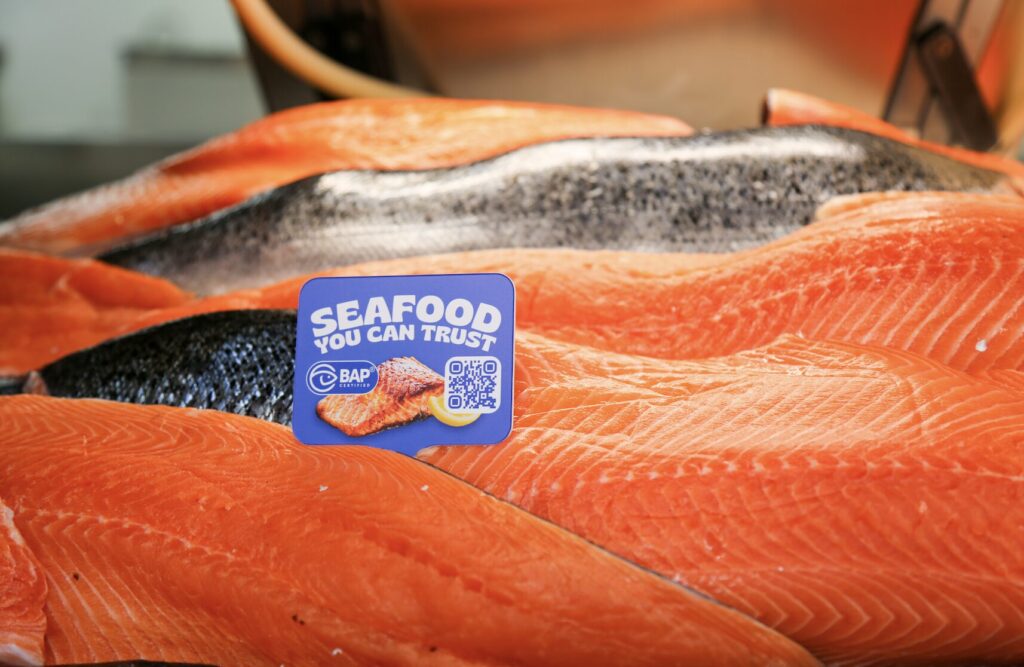
Aquaculture certification programs – like GSA’s industry-leading Best Aquaculture Practices – offer process claims. This means that any BAP certificate holder has proven, through a third-party audit, that its production systems and/or facilities meet or exceed a rigorous standard developed by a committee of experts comprising industry, academia and non-governmental groups (NGOs). Certified producers can then place the BAP logo on their seafood packages to convey to consumers that their process meets a high bar of responsibility.
Seafood certification is not a product claim, nor a guarantee; instead, think of certification as a useful tool that the global marketplace relies on to ask its suppliers to prove they are acting responsibly and in accordance with best practices.
Responsibly managed aquaculture is critical to global food systems, ocean health and vibrant coastal and inland communities around the world. The aquaculture industry is certainly not perfect but is clearly on the path of consistent improvement over time.
*The Farm Forward report can be viewed here.