BAP Spotlight Story: Cherrystone Aqua-Farms
This Best Aquaculture Practices (BAP) spotlight story features Cherrystone Aqua-Farms, a family-run shellfish producer based in Virginia who attained certification for their clam and oyster farms.
GSA: What inspired you to become involved in the seafood industry?
CAF: Seafood is a family legacy. Since 1895 the Ballards have worked the waterways of Virginia’s Eastern shore. Today the fifth generation, family-led Cherrystone Aqua-Farms continues blending tradition with innovation.
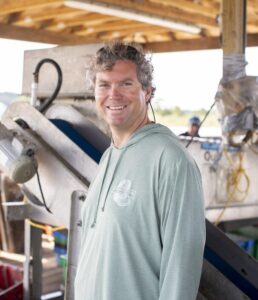
“We’re rooted in heritage and responsibility,” says Chad Ballard, President. “Watermen have witnessed firsthand the connection between healthy ecosystems and long-term shellfish and aquaculture viability.”
The decline of wild oyster populations in the Chesapeake Bay during the mid-20th century underscored that coupling stewardship with
innovation is essential. That period profoundly reshaped clam and oyster production in the mid-Atlantic, pushing towards farm-raised shellfish and reinforcing that sustainability isn’t optional if you value longevity.
From Chad: “In 1983, my grandfather closed the doors on his wild shellfish business and started what today is known as Cherrystone Aqua-Farms, which was a pioneer in farm-raising clams, then oysters. At 66, when other people were retiring, he started a new business which was largely academic and unproven at that point. They struggled to produce a marketable crop, but eventually succeeded. That experience shaped our company’s commitment to aquaculture as a sustainable path forward in seafood. Producing food responsibly, while preserving the waters that support it, is a driving factor behind what we do.”
GSA: Tell us a little more about your company.
CAF: From Tim Rapine, COO: Cherrystone Aqua-Farms is the largest producer of hard-shelled clams in the United States and a leading producer of farm-raised oysters on the East Coast. Operating across 9,000+ acres on Virginia’s Eastern Shore, our farms are designed to balance scale with accountability.
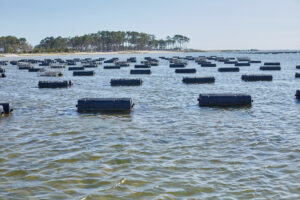
Our operations reflect decades of refinement in responsible aquaculture, from advanced farming practices to investments in quality-driven
infrastructure such as our proprietary wet storage system for grit-free clams. Across all species, sizes, and brands, we share a common approach: producing high-quality shellfish while protecting water quality, ensuring traceability, and operating with transparency throughout the supply chain.
GSA: How is your company involved in the local community?
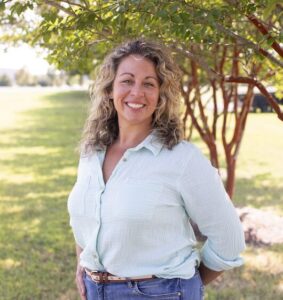
CAF: From Jessica Gray, Business Development: Our connection to the local community is inseparable from our connection to the water. Cherrystone Aqua-Farms employs and trains local watermen and aquaculture professionals, supporting working waterfronts that have defined the Eastern Shore for generations.
Beyond employment, we engage in educational outreach, support restoration-focused initiatives, and collaborate with partners who share a commitment to the Chesapeake Bay’s long-term health. Responsible aquaculture strengthens not only ecosystems, but also the communities that rely on them: economically, culturally, and environmentally.
Equally important is our commitment to grassroots philanthropy. We proudly sponsor local youth sports programs, contribute to volunteer fire departments which serve our rural communities, and support school and civic initiatives throughout the Eastern Shore. We work closely with our local Department of Social Services to help address food insecurity and respond to evolving community needs, providing both financial support, product donations, and volunteers when appropriate.
For Cherrystone Aqua-Farms, stewardship extends beyond the water. It includes showing up for communities that have supported our company for generations, reinforcing the idea that long-term sustainability applies to people and place just as much as it does to our farms.
GSA: Why did your company choose to attain BAP certification? Has it helped improve your business?
CAF: From Tim Rapine, COO: Pursuing Best Aquaculture Practices certification was a deliberate decision to align third-party verification with the standards we already uphold internally. BAP certification provides independent confirmation that our farming practices meet rigorous benchmarks across environmental responsibility, food safety, animal welfare, traceability, and operational integrity.
The certification process strengthened our internal systems, reinforced consistency across operations, and enhanced transparency for customers and partners. It also positions Cherrystone Aqua-Farms competitively in a global marketplace where verified, responsibly farmed seafood is increasingly essential. BAP certification affirms that sustainability and scalability are not mutually exclusive.
GSA: Why do you love working in seafood?
CAF: From Jessica Gray, Business Development: Seafood, and shellfish aquaculture in particular, offers a rare opportunity to produce food while
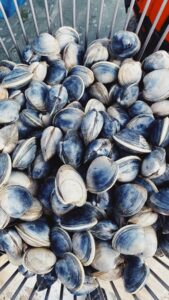
improving the environment in which it grows. Clams and oysters are natural filter feeders that contribute to cleaner water and healthier coastal ecosystems.
Working in this industry allows us to combine environmental stewardship with food production in a tangible, measurable way. It is deeply rewarding to know that our work supports healthy waterways, resilient coastal communities, and future generations who will depend on both.