


UN report warns declining migratory freshwater fish a threat to global inland fisheries

Assessment finds vital migratory freshwater fish populations have declined about 81 percent since 1970, putting inland fisheries at risk
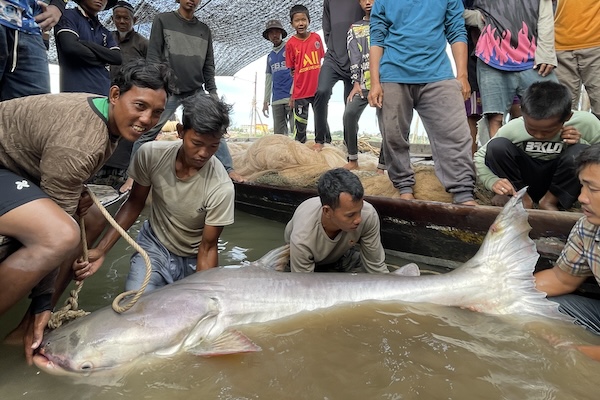
Migratory freshwater fish that support major inland fisheries around the world are declining rapidly, according to a new United Nations assessment.
The report warns that many of the longest fish migrations on Earth – which take place through river systems that sustain hundreds of millions of people – are collapsing as dams, habitat fragmentation, pollution and overfishing disrupt river connectivity.
The findings were released at the 15th Conference of the Parties to the Convention on the Conservation of Migratory Species of Wild Animals (CMS COP15) in Campo Grande, Brazil.
Migratory freshwater fish help maintain river ecosystems and underpin some of the world’s largest inland fisheries. But the new Global Assessment of Migratory Freshwater Fishes finds that these species are among the most imperiled wildlife on the planet.
![Ad for [membership]](https://www.globalseafood.org/wp-content/uploads/2025/07/membership_web2025_1050x125.gif)
According to the report, migratory freshwater fish populations worldwide have declined by roughly 81 percent since 1970. Nearly all – 97 percent – of the 58 migratory fish species already listed under the Convention on Migratory Species are threatened with extinction.
“Many of the world’s great wildlife migrations take place underwater,” said lead author Dr. Zeb Hogan. “This assessment shows that migratory freshwater fish are in serious trouble, and that protecting them will require countries to work together to keep rivers connected, productive, and full of life.”
The report identifies 325 migratory freshwater fish species as candidates for coordinated international conservation efforts, highlighting what scientists describe as a largely overlooked biodiversity crisis unfolding across shared river basins.
Can this breeding technique breathe new life into giant freshwater prawn farming?
Many of these species depend on long, uninterrupted river corridors linking spawning grounds, feeding areas and floodplain nurseries – routes that often cross multiple national borders. When dams, altered river flows or degraded habitats interrupt those pathways, populations can decline rapidly.
Priority river basins identified in the report include South America’s Amazon and La Plata-Paraná systems, Europe’s Danube, Asia’s Mekong, Africa’s Nile and the Ganges–Brahmaputra basin.
Prepared by CMS scientific experts using global datasets and International Union for Conservation of Nature (IUCN) assessments covering nearly 15,000 freshwater fish species, the report provides one of the most comprehensive overviews yet of migratory freshwater fish conservation needs.
It also outlines actions governments could implement immediately, including protecting migration corridors and environmental flows, developing basin-scale management plans and coordinating seasonal fisheries across national borders.
“This new assessment highlights a major priority for the conservation of migratory species and their habitats, that has not had adequate focus to date,” said CMS Executive Secretary Amy Fraenkel. “By aligning science, policy and international cooperation, governments can safeguard the world’s remaining great freshwater fish migrations and the communities and ecosystems that depend on them.”
The report also highlights South America’s Amazon Basin, which remains one of the last major strongholds for large migratory freshwater fish. A case study released alongside the assessment identifies 20 migratory fish species in the Amazon that meet criteria for potential listing under CMS Appendix II.
These large migratory species account for roughly 93 percent of fisheries landings in the basin and underpin regional fisheries valued at an estimated $436 million annually.
Among them is the dorado catfish (Brachyplatystoma rousseauxii), known for one of the longest freshwater migrations ever recorded. The species can travel about 11,000 kilometers (6800 miles) during its life span, moving between Andean headwaters and coastal nursery areas.
To strengthen conservation efforts, Brazil and other governments are proposing a multi-species action plan for Amazonian migratory catfish covering the period from 2026 to 2036.
Brazil has also proposed adding the spotted sorubim catfish (Pseudoplatystoma corruscans) to CMS Appendix II, citing pressures from dams, altered river flows and fishing activity in the La Plata Basin.
“Rivers don’t recognize borders – and neither do the fish that depend on them,” said Michele Thieme, vice president and deputy lead of freshwater at World Wildlife Fund U.S. “The crisis unfolding beneath our waterways is far more severe than most people realize, and we are running out of time. Rivers need to be managed as connected systems, with coordination across borders, and investments in basin-wide solutions now before these migrations are lost forever.”
Officials say the proposals reflect a central challenge in protecting migratory fish: Conservation measures must operate across entire river systems and require cooperation among countries that share them.
Now that you've reached the end of the article ...
… please consider supporting GSA’s mission to advance responsible seafood practices through education, advocacy and third-party assurances. The Advocate aims to document the evolution of responsible seafood practices and share the expansive knowledge of our vast network of contributors.
By becoming a Global Seafood Alliance member, you’re ensuring that all of the pre-competitive work we do through member benefits, resources and events can continue. Individual membership costs just $50 a year.
Not a GSA member? Join us.
Author

Related Posts
Responsibility
Scientists call for global conservation of wild seaweed at UN ocean summit
Wild seaweed must be protected like coral reefs, scientists argue, citing its role in climate, food security and ocean ecosystem health.

Fisheries
Fish are getting smaller as global food webs quietly reorganize, study finds
Study finds global fish food webs are shifting toward smaller species and fewer top predators, even where species counts stay stable.

Responsibility
Ocean temperatures hit record highs in 2025, underscoring need for climate action
Ocean temperatures hit record highs in 2025, signaling accelerating climate change and its growing influence on weather worldwide.

Fisheries
The ocean is getting darker. What could that mean for global fisheries?
As a darkening ocean threatens to reshape marine ecosystems, scientists explore risks for fisheries and how rewilding with restorative aquaculture could help.