


TNC-backed Edge AI seeks to streamline electronic monitoring in the ongoing effort to fight IUU fishing

AI-powered tool requires human checks to ensure accuracy of the models
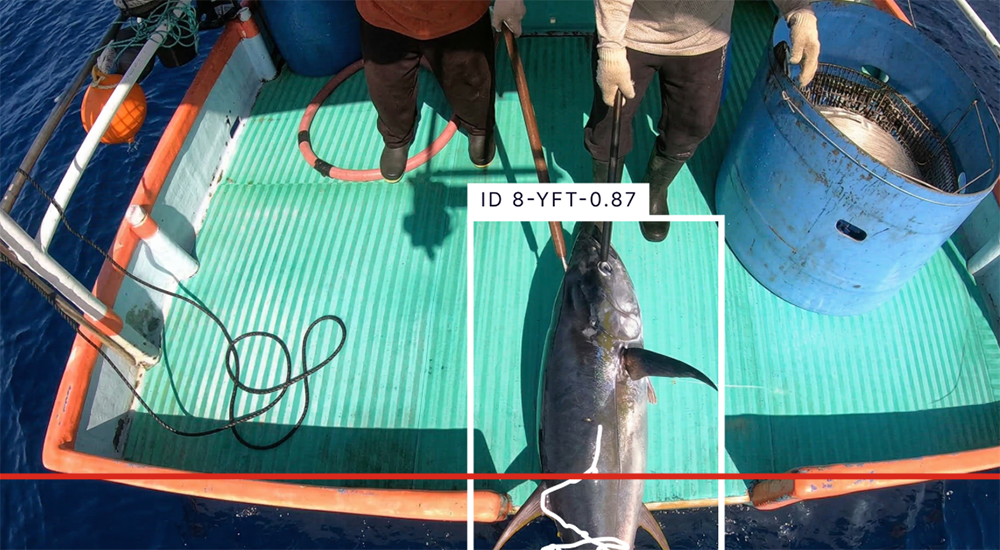
Until recently, efforts to curb illegal, unreported and unregulated (IUU) fishing have focused on electronic monitoring (EM), with vessels using cameras, GPS trackers and sensors to record fishing activity to a hard drive.
The hundreds of hours of footage logged require manual review after a vessel returns to port, and by the time that review has been completed, often months after the fact, the catch has long since disappeared into the supply chain. The high cost of that review has been a barrier to widespread adoption of EM.
But that’s about to change as a result of AI. This week, The Nature Conservancy (TNC) releases Edge AI, artificial intelligence modules with high-powered processors that are installed on vessels and work interoperably with the vessels’ EM software. The modules review video footage of a vessel’s catch in real time. They isolate distinct fishing moments that are independently humanly verified on shore, reducing footage review time from months to minutes. Edge AI’s bycatch identification can be compared instantly to a captain’s catch report, to detect and flag any human under-reporting of fish landed.
Valued at over U.S. $1 million, TNC and its partner, Tryolabs, are making the code available free of charge in order to accelerate global adoption of EM.
![Ad for [Aquademia]](https://www.globalseafood.org/wp-content/uploads/2025/07/aquademia_web2025_1050x125.gif)
Edge AI is an Nvidia processor that’s smaller than a shoebox, is interoperable with an existing EM system, and can run 200 trillion operations per second. In the future it will be able to run on smart cameras, bypassing the need for an extra computer, but for now vessels need a computer to run Edge AI and a way to move its predictions off the vessel to a secure cloud service. Trials to date have used Starlink’s maritime package.
“We use the term ‘predictions’ because we know that all models, AI or not, can have mistakes,” said Vienna Saccomanno, a senior scientist at TNC. “So we use ‘AI predictions’ to say, here’s what the AI thinks what was caught, based on the footage and what was seen.”
In trials, the system achieved catch counts with a miss rate of just 6 percent compared with expert human reviewers. “Our goal was a miss rate of anything below 15 percent, and we knew a miss rate below 15 percent was very ambitious, so we were very excited when we stress-tested the model and had a miss rate of just 6 percent,” she said.
Edge AI runs while fishing activity is happening and produces predictions on what was caught, how much and the species classification. It produces a summary report based on the footage and sends it over broadband satellite to a secure end-user for review. The data can be rapidly verified before the catch is processed.
“It’s a nice, clean report that articulates every catch event that the AI predicted, and the confidence of the model in its prediction, presented in a percentile,” Saccomanno said. “The reviewer just clicks play for that amount of footage to verify the fish species. By keeping a human in the loop, we ensure the ongoing accuracy of the models, because our goal is not to replace humans, just to make the job of human EM professionals more efficient and streamlined.”
Putting IUU fishing on the map: Global Fishing Watch intends to bring the invisible into view
Edge AI was developed by The Nature Conservancy in collaboration with Tryloabs. It received extensive funding from the Patrick J. McGovern Foundation, which funded the prototyping work on longline vessels fishing for tuna and tuna-like species in Costa Rica in 2025 and has continued to fund work in the western Central Pacific. In January 2026 it won $2 million from the Bezos Earth Fund’s AI for Climate and Nature Grand Challenge.
Over the past three years Edge AI trials focused on tuna in the eastern tropical Pacific. “We chose tuna because it’s a prized, popular fish with an annual catch of 5 million [metric tons] and a dockside value of $10 billion,” Saccomanno said. “But Edge AI can be used in other fisheries for target catch and bycatch, too. We just need the training data, a library of images and video, in order to train, test and validate the models.”
TNC’s 2024 Tuna Transparency Pledge, with the goal of achieving 100 percent on-the-water monitoring of all industrial tuna vessels by 2027, provides great incentive for vessels to adopt EM and Edge AI. As they seek to thwart illegal fishing, countries representing over 15 percent of the global tuna catch have signed on to the pledge, as have companies including Walmart, Carrefour and the Thai Union Group.
“There’s a groundswell of momentum for independent monitoring onboard vessels,” Saccomanno added. “TNC is focused on making a high-powered, efficient tech solution for this.”
Strengthening transparency at sea remains one of the most important opportunities for improving the sustainability of global tuna fisheries, added Susan Jackson, president of the International Seafood Sustainability Foundation.
“Electronic monitoring has already demonstrated its value, but scaling its full and effective use, particularly in longline fisheries, requires continued innovation to make systems more efficient, accessible, and actionable,” Jackson said. “Advancements that help close data gaps and support timely, independently verifiable information can play an important role in strengthening science-based management and efforts to deter illegal, unreported, and unregulated fishing.”
The Republic of Palau will be one of the first to mobilize Edge AI technology on its industrial tuna fishing vessels, with plans to complete installations on the first vessel in May.
Keith Mesebeluu Chief of Division of Oceanic, Bureau of Fisheries for the Republic of Palau’s Ministry of Agriculture, Fisheries & Environment, said: “By embracing AI tools in our electronic monitoring program, we are taking a bold step toward greater transparency, efficiency and scientific rigor. This technology empowers us to protect our resources, support our communities, and demonstrate that Pacific Island nations are not just participants in global fisheries management – we are pioneers shaping its future.”
Now that you've reached the end of the article ...
… please consider supporting GSA’s mission to advance responsible seafood practices through education, advocacy and third-party assurances. The Advocate aims to document the evolution of responsible seafood practices and share the expansive knowledge of our vast network of contributors.
By becoming a Global Seafood Alliance member, you’re ensuring that all of the pre-competitive work we do through member benefits, resources and events can continue. Individual membership costs just $50 a year.
Not a GSA member? Join us.
Author
-

Vancouver-based correspondent Lauren Kramer has written about the seafood industry for the past 15 years.
Related Posts
Fisheries
Can an underwater artificial intelligence bot detect IUU fishing?
A new underwater artificial intelligence bot could "revolutionize" ocean monitoring and IUU fishing identification, scientists say.
Fisheries
BBNJ treaty enters into force, strengthening governance of the high seas
The BBNJ treaty has entered into force, with FAO supporting countries in implementing the agreement to strengthen global ocean governance.
Fisheries
Defining and monitoring destructive fishing represents a new era in fisheries policy
Thanks to a new multistakeholder framework, researchers are a step closer to better understanding destructive fishing and addressing its impacts.

Intelligence
‘Traceability matters’: FAIRR on seafood, sustainability and the Blue Food Innovation Summit
FAIRR’s Laure Boissat discusses seafood traceability, sustainability and investor impact ahead of her panel at the Blue Food Innovation Summit.