


At Barcelona expo, a resilient seafood industry navigates global pressure and change

At Seafood Expo Global 2026, new technologies and products shared the spotlight with trade disruptions, rising costs and changing consumer expectations

For three days, the global seafood industry came together in Barcelona to connect, do business and take stock of where things are heading. Despite ongoing geopolitical and economic upheaval, this year’s Seafood Expo Global (SEG) drew more than 35,500 professionals – the largest edition to date.
There was no shortage of product on the exhibition floor. Fresh, frozen, value-added, packaged – alongside the full range of processing solutions, from equipment and logistics to refrigeration and quality control.
But the bigger story wasn’t just what was on display. It was the underlying context: an industry advancing innovation while dealing with rising costs, geopolitical uncertainty and shifting supply chains.
![Ad for [BSP]](https://www.globalseafood.org/wp-content/uploads/2025/07/BSP_B2B_2025_1050x125.jpg)
Innovation is moving fast – but not evenly

Innovation was front and center with the debut of the Aquaculture Innovation Zone, showcasing emerging aquaculture innovations, technologies and services. Companies showcased tools aimed at improving production – from AI-driven analytics to new ways of managing fish health.
Some tackled long-standing problems. LiceDefence, developed by Bergen-based Brage Innovation, presented a system to stop sea lice before they reach farmed salmon. The system uses light and traps to intercept parasites outside the pen, reducing the need for costly chemical treatments.
Others focused on rethinking the product itself. Dutch company Hybrid Fisherman introduced a hybrid fish product made from roughly 50 percent fish and 50 percent plant-based ingredients, using bycatch and processing leftovers that would otherwise go to waste.
There were also new brands entering the mix. Indonesian aquatech firm DELOS Aquaculture launched “Naughty Prawn,” a frozen shrimp brand aimed at international retail and foodservice markets. The brand is built on a highly automated farming system, with about 98 percent of operations managed through in-house software and AI tools.
DELOS says this helps improve survival rates to 85 to 90 percent, compared with an industry average closer to 70 percent. It also emphasizes tight control over handling and quality – shrimp are kept out of water for no more than 15 seconds before processing – alongside a broader push for traceability, animal welfare and more consistent product standards.
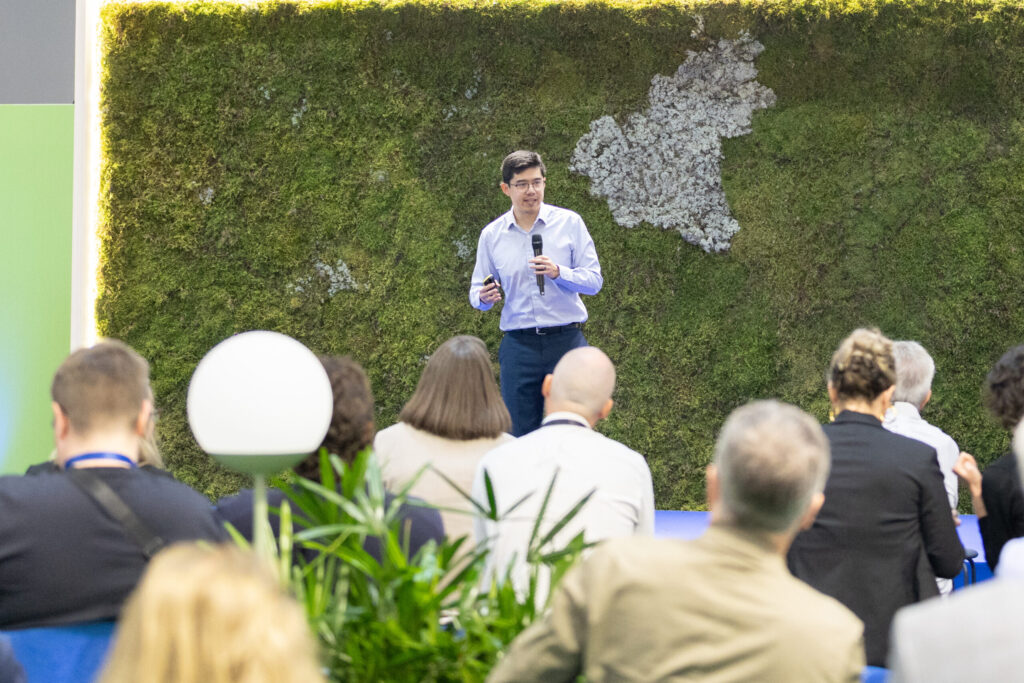
Artificial intelligence (AI) and machine-learning technologies were – not surprisingly – hot topics. In a talk at the Innovation Theatre, Tony Chen, co-founder and CEO of aquaculture data analytics firm Manolin, said the seafood industry is still exploring how AI can be applied in practice.
“Automation is going to be a big piece and seafood is set up well for this,” Chen said, pointing to increased investment in robotics and physical AI systems. “It seems a ton of the challenges that we haven’t been able to solve before are [now] potentially solvable.”
Chen said technology could support specific, repetitive tasks in the industry, such as automating the peeling of crabs. He also pointed to applications in biological modelling, noting that his company is monitoring around 20 different disease models in salmon farming to help predict fish health outcomes.
“We’re helping farmers predict when these challenges are going to happen,” Chen said. “In the same way that an AI system takes in a lot of context and information, we’re doing the same for fish health outcomes – understanding when fish are going to die or when you’re going to have outbreaks – and training systems to process that information in a world where there are many different factors at play.”
Still, Chen was clear-eyed about the limits. Training advanced AI systems can cost billions, which could make widespread adoption sluggish, he said.
Trade is getting more complicated
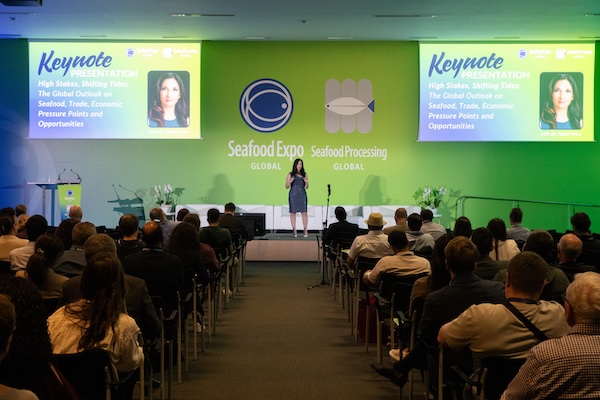
If the exhibition floor focused on what’s next, conference sessions focused on what’s now.
The threat of tariffs, fuel costs and geopolitical instability are rapidly reshaping how seafood moves around the world. The industry’s reliance on international trade leaves it particularly exposed to disruption.
“The up-and-down nature of it, and the uncertainty that generates, is crippling for businesses,” said Robert DeHaan, executive VP and chief counsel for U.S.-based National Fisheries Institute (NFI) on a panel about the impact of tariffs on seafood trade. “It’s harder to innovate, to expand your payroll, to know what’s going to happen in six to nine months.”
Global attention has focused on oil, with roughly 20 percent of supply moving through the Strait of Hormuz. But as keynote speaker Dr. Nomi Prins said, seafood has its own version of that problem.
“The issue with seafood is different,” said Prins, noting that shipments are often rerouted to avoid instability in the region. “For some exports, that could mean taking 10 to 14 days longer, with additional fuel and storage costs and potential issues with refrigeration to keep the seafood fresh.”
Consumers want more – but not at any price
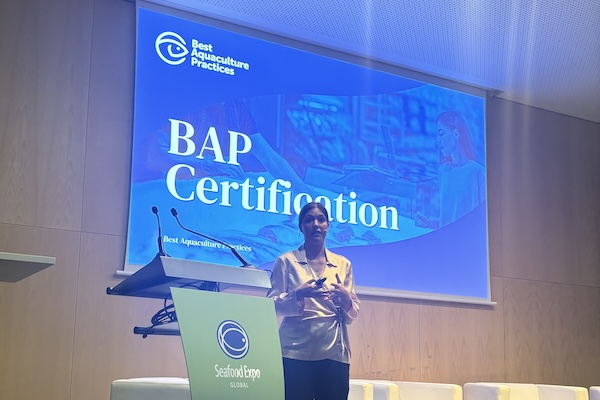
Meanwhile, global pressures are colliding with shifting consumer expectations, particularly in Europe, one of the world’s most important seafood markets.
“In Europe, seafood is a staple,” said Eva Casadevall Ayats, who works in the Global Seafood Alliance’s market development department. “Eighty-six percent of consumers say they enjoy eating seafood, and 70 percent eat it at home at least once a week.”
According to research findings on consumer attitudes from GlobeScan, seafood preferences vary – fresh in France, frozen in the UK and more flexible in Spain – but one thing is apparent: Europeans care more about responsible practices.
“Consumers say this is not a niche – it’s an expectation,” said Casadevall Ayats. “Forty-three percent said they buy certified products because that reflects their values, and 42 percent are willing to pay more for products that have been certified.”
That shift is pushing companies to invest more heavily in transparency, certification and product differentiation, even as margins come under pressure.
“At ALDI, we are dependent on scalable tools that can apply to all markets and give us a broad overview and baseline of our sourcing,” said panelist Moritz Konz, manager of corporate responsibility at ALDI South Group. “That’s where certification comes in, and it’s really important for us.”
Still, there’s a growing tension between those consumer expectations and economic realities.
“Responsible practices matter, but price is also key,” she said. “We are in a context of rising cost of living, and responsible practices often come with extra costs.”
Labor issues remain a critical challenge

A session on worker engagement highlighted a persistent conundrum for the seafood industry: closing the gap between policy and practice when it comes to labor rights. Many worker engagement systems – from company hotlines to reporting tools – are still underused or not trusted.
“Upholding labor rights is a critical issue, and the industry is not doing very well in this space,” said Dave Martin, global supply chains director at Sustainable Fisheries Partnership. “It’s going to take work to get the seafood industry up to speed.”
Barriers include language, anonymity and fear of retaliation. And even when systems exist, workers may not believe anything will change.
“There are a lot of worker engagement mechanisms being propped up that are just not used,” said Lisa Rende Taylor, founder and executive director of the Issara Institute.
Cost is part of the problem. Certification and compliance can be expensive, and those bills often fall on producers. Rende Taylor pointed to other industries, like coffee and cocoa, where buyers help cover those costs through shared funding models.
“None of these models are perfect, but other sectors – like coffee, cocoa and cotton – are developing impact funds to invest in producing communities and help cover the high costs of ethical recruitment and labor practices,” Rende Taylor said.
Nothing about us, without us
At the Chile pavilion, an Indigenous fisherman pointed to another tension – land and water rights as aquaculture expands.
“They are saying that the communities are against development,” said Elias Colivoro Ciguay, spokesperson for the Cocauque community and a member of the Indigenous Territorial Council of the Commune of Quellon. “But that is not true.”
Colivoro Ciguay raised concerns over potential changes to Chile’s Lafkenche Law, which allows Indigenous communities to manage marine and coastal areas based on traditional use. The issue, he said, is not opposition to development, but a lack of collaboration – and concern that communities could lose control over how those resources are used.
“We want to be part of the modern world, while also conserving our ancestral knowledge and practices,” he said. “We want to protect the resources and ensure future generations can access them.”
Still a people business
For all the talk of innovation, trade and policy, one thing stood out: Seafood is still a relationship-driven industry.
Some of the most valuable moments happened informally – on the show floor, at receptions or over quick conversations between meetings. Networking events, like the Connecting Women in Seafood and Aquaculture Meet-Up, were packed, bringing together people from across the value chain to catch up, compare notes and clink glasses.
Some were also there to celebrate. The Seafood Excellence Global Awards featured 35 finalists from 16 countries, with Vičiūnai Group winning Best Retail Product and Frais Embal taking Best HORECA Product.
“The energy and high level of engagement across the exhibition floor highlighted the value of in-person connections for the industry as a whole,” said Wynter Courmont, group VP-seafood at Diversified. “Participants took advantage of the event to reinforce existing relationships, explore new business opportunities and stay ahead of the trends shaping the future of the seafood industry.”
Now that you've reached the end of the article ...
… please consider supporting GSA’s mission to advance responsible seafood practices through education, advocacy and third-party assurances. The Advocate aims to document the evolution of responsible seafood practices and share the expansive knowledge of our vast network of contributors.
By becoming a Global Seafood Alliance member, you’re ensuring that all of the pre-competitive work we do through member benefits, resources and events can continue. Individual membership costs just $50 a year.
Not a GSA member? Join us.
Author
-

Lisa Jackson is a writer based in Hamilton, Canada, who covers a range of food and environmental issues. Her work has been featured in Al Jazeera News, The Globe & Mail and The Toronto Star.
Related Posts
Innovation & Investment
‘They know better than men how to protect their environment and people’: How focusing on women farmers is boosting food security in India
GOAL 22: The Government of Odisha and WorldFish collaborate to boost income and food security in India by teaching women’s groups to raise carp.
Responsibility
‘Walk in like you own the place’: How inequality continues to impact women in aquaculture and the obstacles to change
The Women in North American Aquaculture Summit examined equal opportunity for women in aquaculture, barriers to participation and inequality solutions.

Innovation & Investment
SeaWeb Seafood Summit: Can impact investment ‘save’ aquaculture?
Impact investment, which seeks environmental and social returns in addition to profits, was examined during a SeaWeb Seafood Summit panel.
Fisheries
‘A wake-up call’: Nearly half of key fisheries for marine ingredients now poorly managed, SFP report warns
With nearly half of key fisheries for marine ingredients now rated as poorly managed, Sustainable Fisheries Partnership calls for action.