


Can this ‘bio-inspired’ robotic fish improve aquaculture monitoring and animal welfare?

Bio-inspired robotic fish uses sensors and fish-like movement to monitor aquaculture systems while improving animal welfare
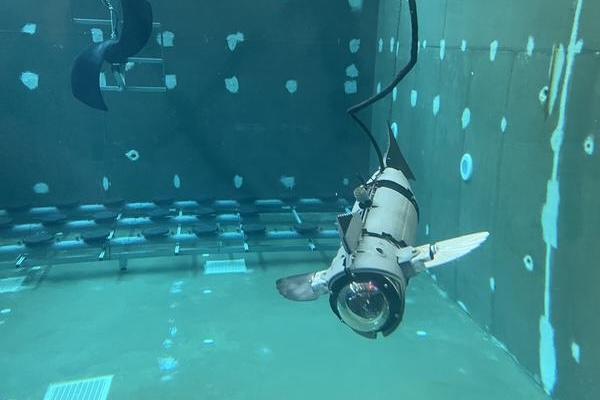
Researchers at the Universitat Jaume I in Spain have developed a bio-inspired robotic fish for aquaculture, aimed at reducing fish stress during monitoring and inspection and improving animal welfare.
The prototype, known as UJIFISH, was developed by the university’s Centre for Research in Robotics and Underwater Technologies (CIRTESU) and is designed for tasks including inspection, teleoperation and sensor deployment. Unlike conventional underwater robots, the system avoids propellers and high-intensity lighting, which can disturb fish.
Initial tests have shown the prototype can achieve high maneuverability and reliable target detection, supporting its potential use in aquaculture environments.
The robot is designed to move like a real fish (or “bio-inspired” undulatory propulsion), using a smooth, wave-like motion instead of propellers. This reduces noise and water disturbance, helping limit stress for nearby fish.
![Ad for [Aquademia]](https://www.globalseafood.org/wp-content/uploads/2025/07/aquademia_web2025_1050x125.gif)
It’s equipped with sensors and cameras that can collect and transmit data in real time. The system can be controlled remotely using a cable or acoustic signals and includes a wide-angle camera with a 180-degree field of view.
The prototype can operate at depths of up to 20 meters and be controlled from distances of up to 150 meters vertically and 500 meters horizontally.
Ocean noise: How the changing sea soundscape can stress fish
The robotic fish is equipped with sensors to measure water temperature and depth continuously and can be fitted with additional sensors to monitor conditions such as salinity, pH and dissolved oxygen.
It can also be used to inspect net structures and track environmental conditions around fish, and includes a system to carry and release small devices at specific locations. Its size and movement are designed to resemble adult fish, allowing it to move smoothly through the water while reducing noise and disturbance.
Tests showed the prototype can move with high precision and reliably detect targets during tasks such as net inspection, remote operation, data collection and sensor deployment.
The researchers said its flexible design is important for aquaculture, where monitoring needs vary depending on species, infrastructure and environmental conditions.
Now that you've reached the end of the article ...
… please consider supporting GSA’s mission to advance responsible seafood practices through education, advocacy and third-party assurances. The Advocate aims to document the evolution of responsible seafood practices and share the expansive knowledge of our vast network of contributors.
By becoming a Global Seafood Alliance member, you’re ensuring that all of the pre-competitive work we do through member benefits, resources and events can continue. Individual membership costs just $50 a year.
Not a GSA member? Join us.
Author

Related Posts
Health & Welfare
Researchers use environmental RNA to detect fish stress and disease in aquaculture
Researchers are developing eRNA-based tests to detect fish stress and disease from water samples, offering faster, noninvasive monitoring.
Health & Welfare
Study calls for animal welfare improvements in global aquaculture
New study measures fish suffering during slaughter, offering data-driven, cost-effective solutions to improve animal welfare globally.
Health & Welfare
Handbooks help salmon farmers improve fish welfare during crowding
A new resource from Nofima and the Institute of Marine Research aids salmon farmers in monitoring and improving fish welfare during crowding.
Aquafeeds
Can farmed salmon retain flesh color under stress? Research points to a nutritional solution
Stress reduces the color intensity of farmed salmon fillets, but adding high levels of vitamin A and astaxanthin in feed may help maintain pigmentation under pressure.