


Growth, diversification and resilience dominate Global Shrimp Forum discussions

Three-day event examines production leaders Ecuador and India, the changing balance between growth and demand, and the impact of tariffs, geopolitics and logistics

The fifth annual Global Shrimp Forum brought the global shrimp industry together in Utrecht, the Netherlands, from 1–3 September, with discussions reflecting a sector undergoing rapid growth while confronting increasingly complex market, biological and geopolitical challenges.
Across the three-day event, speakers examined the resilience and investment potential of major producing countries including Ecuador and India, the changing balance between production growth and market demand, the need to diversify trade and export formats, and the impact of tariffs, geopolitics and logistics on global shrimp flows.
Other sessions explored feed sustainability and the tightening supply of marine ingredients, advances in genetics, farm technology and artificial intelligence (AI), shrimp gut health and disease management, while consumer and retail experts highlighted the need to make shrimp more accessible and relevant to younger consumers.
Underpinning many of the discussions was a broader question: How can an industry capable of producing more shrimp continue to build demand, value and resilience across the global supply chain?

Ecuador shrimp exports could reach 1.6 million MT as global supply continues to expand
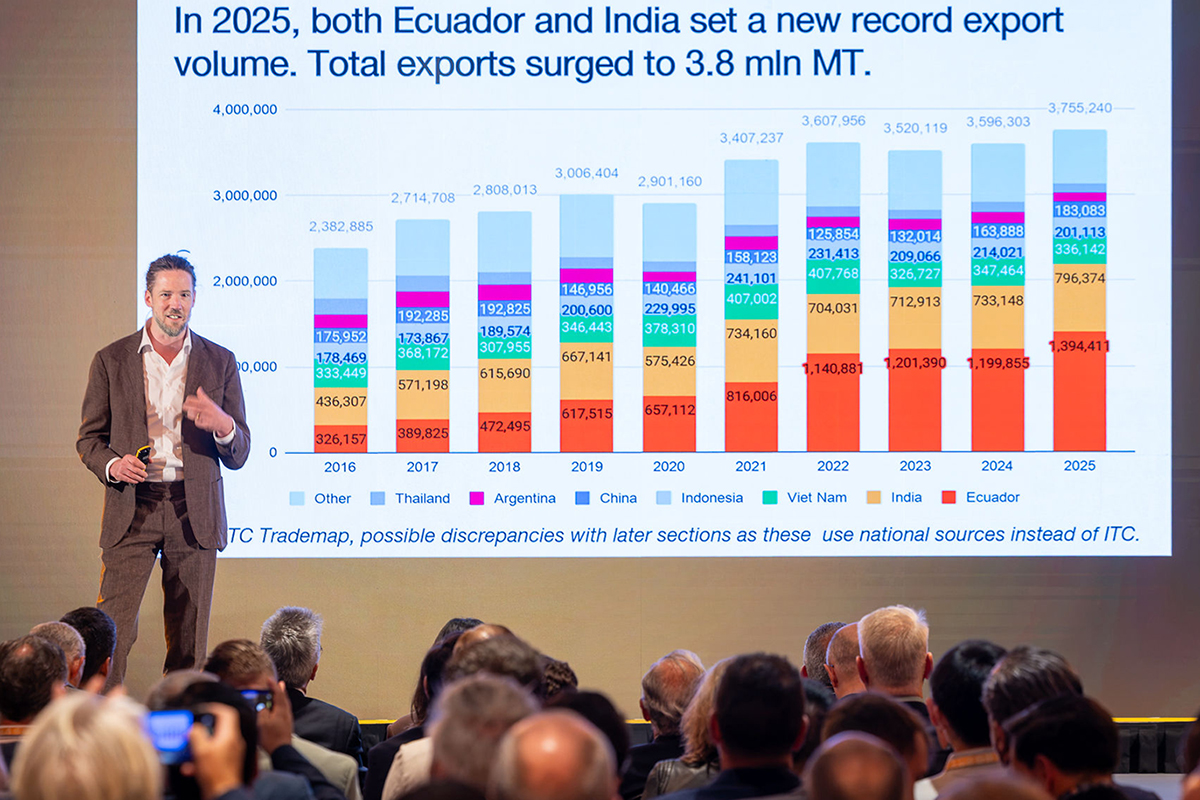
Ecuador’s shrimp exports could reach as much as 1.6 million metric tons (MT) this year if the country’s recent growth rate continues, according to Shrimp Insights Co-Founder and Global Shrimp Forum Managing Director Willem van der Pijl.
Ecuador had recorded another export record in the second-quarter, he confirmed, with shipments approaching 450,000 MT. July subsequently delivered a new all-time monthly record, exceeding 160,000 MT.
However, he stressed that the country’s weather conditions over the coming months would be an important factor. July’s combination of high temperatures and limited rainfall could represent an early effect of El Niño, he added.
However, the continued expansion raises questions about where additional Ecuadorian production will be absorbed. China remains the country’s dominant market, taking around 50 percent of exports, but the U.S. market is increasingly important and could take approximately 360,000 MT this year, according to Van der Pijl.
India is also expected to maintain a high export volume, potentially reaching around 800,000 MT. Disease pressure in Andhra Pradesh has constrained growth, but stronger farmgate prices in rupee terms and favorable exchange-rate conditions are supporting farmer sentiment and second-crop stocking.
Vietnam’s shrimp exports could reach approximately 340,000 MT if the improvement in disease conditions seen during the first five months continues. Van der Pijl highlighted the country’s highly diversified product mix, with value-added products accounting for almost half of exports.
Vietnam also relies heavily on imported shrimp for processing, illustrating the importance of distinguishing export volumes from domestic production.
Indonesia, meanwhile, has been affected by U.S. market-access difficulties but is expected to recover towards approximately 200,000 MT of exports.
The figures underlined an increasingly important challenge for the global shrimp sector: Production capacity continues to expand across major origins, making market diversification and the development of new consumption opportunities increasingly critical.
As Van der Pijl noted during the discussion, Ecuador’s growth is unlikely to slow significantly in the short-term, with investment continuing across farming, feed and processing. Longer-term, profitability rather than production capacity could ultimately determine where the country’s expansion reaches its limit.
Global shrimp industry navigating sustainability, innovation and shifting trade dynamics
China shrimp imports surge despite weak consumption growth as global markets diverge
China’s shrimp imports surged by around 22 percent in the first-half of 2026, despite relatively weak growth in underlying consumer demand, highlighting an increasingly complex relationship between global shrimp supply, inventories and consumption.
The figures were presented to the conference by Van der Pijl, who said China could exceed 1 million MT of shrimp imports for the first time this year if the current trend continues.
Ecuador has been a major driver of the increase, with exports to China up 21 percent and approaching 500,000 MT in the first half. India also recorded significant growth, approaching 100,000 MT.
Van der Pijl said the timing of Chinese New Year had contributed to the strong early-year import figures, while falling shrimp prices had encouraged Chinese buyers to purchase and hold more frozen product.
However, Kelly Wang, director of overseas business at the Optimize Integration Group, cautioned that import growth should not be confused with equivalent growth in consumption. Retail sales rose only around 1.3 percent in the first half, while catering revenue increased 2.8 percent.
China is also producing substantial volumes domestically, creating additional supply pressure.
The contrast with Europe is stark. E.U. shrimp imports fell 3 percent year-on-year in Q1 and 30 percent in Q2 after strong growth in 2025. Van der Pijl nevertheless said underlying European consumption appeared more resilient, with demand recovering during the previous two to three months.
The U.S. market is also being reshaped around Ecuador and India. Ecuadorian exports to the States increased 28 percent in 2025, while India has lost ground this year. Van der Pijl highlighted Ecuador’s rapid penetration of the U.S. peeled-shrimp segment, where it accounted for 52 percent of imports in the first six months of the year.
Japan remains comparatively stable at around 200,000 MT annually, with Ecuador gaining ground in peeled shrimp while India remains strong in peeled and breaded products.
Across the major markets, the message was increasingly one of product-market fit rather than simply volume growth. European buyers are prioritizing the right specification, format and consistency, while Asian markets continue to differentiate between raw, cooked and highly value-added products. It was also noted the figures reinforce the industry’s growing need for diversification as production expands – not only by finding new consumers, but potentially by extracting greater value from every shrimp produced.
Aquafeed markets face accessibility risk despite ample grain supplies

Global supplies of key plant-based feed ingredients remain relatively comfortable, but geopolitical disruption, logistics and timing are emerging as bigger risks for aquaculture feed buyers, according to Rabobank Senior Commodity Analyst Charles Hart.
Speaking about the outlook for corn, soybeans and wheat, Hart said the exceptionally strong production seen in 2025-26 had given way to a more normal supply situation in 2026-27.
Global grain stocks are declining, but the reduction is principally concentrated in China, while stocks-to-use ratios among major exporting countries remain broadly in line with recent historical levels.
“Availability is there. Availability is not the risk,” Hart said. “Accessibility, timing and those logistical costs are the risks, and will be for the season ahead.”
Geopolitical developments are adding volatility to otherwise relatively balanced fundamentals, with Hart highlighting disruption linked to the U.S.-Iran war and renewed hostilities around the Black Sea, with physical trade routes and Ukrainian and Russian wheat exports particularly affected.
Corn supplies also remain comfortable following record U.S. production and near-record output in Brazil, although weather-related deterioration in the current U.S. crop is tightening projected stocks and providing greater price support.
For soybean meal, Hart said changing crush economics were becoming increasingly important as demand for soybean oil, driven by biofuel markets, reshapes production incentives. Rather than crushing primarily for meal with oil as a byproduct, processors are increasingly driven by oil demand, leaving meal markets more dependent on underlying demand from livestock and aquaculture.
Wheat presents the clearest example of the distinction between availability and accessibility. Despite a global surplus of around 20 million MT in 2025-26, disruption to Black Sea exports means buyers may struggle to access supplies from traditional origins.
For aquafeed manufacturers, Hart’s message was therefore less about an impending global ingredient shortage and more about the need to manage sourcing, logistics and geopolitical exposure in an increasingly volatile trading environment.
El Niño adds pressure to marine ingredients as feed industry seeks alternatives
The aquafeed industry faces growing pressure to reduce its dependence on fishmeal and fish oil as El Niño disrupts marine ingredient production and longer-term supply gaps emerge, advised DSM-Firmenich Head of Business Intelligence Adolfo Pino de B. Fontes.
Speaking at the conference, Pino de B. Fontes said Peru’s fishmeal and fish oil production fell by around 50 percent against historical levels during the strong 2023 El Niño, while official projections point to a further 20 percent decline in 2026.
He said the current El Niño conditions could persist into the first quarter of 2027, adding uncertainty to already volatile marine ingredient markets.
The pressure comes against continued growth in aquaculture. While aquafeed production increased by around 230 percent between 2000 and 2025, marine ingredient production rose by only around 40 percent, reducing their inclusion in aquafeed from approximately 25 percent to 10 percent.
Pino de B. Fontes said recent studies indicated a potential 400,000 MT fishmeal supply gap by 2028, alongside a 100,000 MT fish oil gap by 2030.
“This is the reality, and we need to face it and find solutions,” he said.
Potential alternatives include single-cell protein, insect meal and algal oil. Single-cell protein production was estimated at around 40,000 MT in 2025, with current producers potentially capable of reaching 100,000–150,000 MT. Around 35 percent could potentially be directed towards aquaculture.
Insect meal production was estimated at around 15,000 MT in 2024, although Pino de B. Fontes cautioned that the sector’s potential remains uncertain. Algal oil production could increase from around 20,000 MT in 2025 to an estimated 36,000 MT by 2030.
“In the short-term, fishmeal and fish oil will probably continue to be very volatile, with upside price risk,” he said, reaffirming that reducing dependence on marine raw materials remains a strategic priority for the industry.
Marine ingredient pressure a ‘wake-up call’ for aquafeed industry
Rising marine ingredient prices and growing supply risks should be viewed as a “wake-up call” for the aquafeed industry to accelerate the development of more sustainable feed formulations, according to Pino de B. Fontes.
Speaking on a panel moderated by U.S. Grains Council Regional Aquaculture Consultant Ronnie Tan, Pino de B. Fontes said the industry could reduce marine ingredient inclusion further, but not through a single replacement.
“We truly believe this is not a short-term issue,” he said. “This is actually a signal that the industry needs to accelerate toward a more sustainable and more efficient feed formulation.”
He said alternative proteins such as single-cell protein and insect meal offered promise but would take time to reach sufficient scale. Functional ingredients including prebiotics, probiotics and phytogenics could therefore form part of the solution in the shorter term.
The panel also examined wider risks to feed ingredient supply chains, with Hart highlighting geopolitical and logistical disruptions affecting global trade.
Black Sea disruption could affect major wheat and corn flows, while restrictions around the Persian Gulf could increase fuel and fertilizer costs. Low water levels on the Danube and Rhine are also adding pressure to European logistics.
Hart said feed mills would need to assess inventory requirements according to their individual exposure and risk tolerance. However, he argued that marine ingredients were likely to become the first-order supply concern, rather than accessibility alone.
For Pino de B. Fontes, the combination of marine ingredient constraints, weather volatility and geopolitical uncertainty reinforces the need for a broader approach to feed formulation.
Reiterating the core message in his earlier presentation, he said: “Let’s face this as a wake-up call and let’s work towards a more sustainable and efficient feed formulation.”
Shrimp gut health emerges as overlooked driver of farm performance

Gut health could be a major but under-recognized driver of shrimp farm performance, with 60 percent of shrimp examined in a new Asian industry survey showing compromised or critical gut health.
Presenting the findings at the Global Shrimp Forum, Jean-Benoit Darodes de Tailly, Global Business Developer – Shrimp at Phileo by Lesaffre, said the collaborative study covered more than 110 farms across four Asian countries and generated around 5,000 images and 170,000 data points.
The study found that gut health is particularly important given feed accounts for around 60 percent of shrimp production costs, yet research into shrimp gut health has lagged significantly behind work on shrimp nutrition.
“Knowledge gaps are actually opportunity gaps,” Darodes de Tailly said.
Ninety-five percent of farmers surveyed considered gut health critical or important to farm success, while around half said they experienced gut health problems during a production cycle. Problems were concentrated mainly around the mid-cycle.
Water quality was identified by 57 percent of farmers as a potential root cause of gut disorders. However, while 93 percent said they checked water quality daily using objective tools, assessment of gut health was much more dependent on visual observation.
The microscopy study indicated that 90 percent of sampled shrimp had at least one external sign of compromise, while microscopic assessment revealed a more complex picture involving factors including gut tubule integrity and lipid reserves.
Crucially, the research found a link between gut condition and animal performance. Shrimp achieving a gut health score above 2.9 showed 20 percent higher body weight at the study’s measurement point.
Darodes de Tailly said the findings demonstrated that gut health was not simply a nutrition issue but reflected the wider production environment. However, he acknowledged that conventional microscopy assessment remains highly dependent on the observer, with the same samples receiving different scores from different assessors.
Phileo by Lesaffre is therefore working with industry partners to develop an AI-driven diagnostic tool using the survey dataset. Combined with a pocket microscope and smartphone application, the technology is intended to provide faster and more consistent gut-health assessment. The objective is to help shrimp producers move from reactive responses to disease and performance problems towards proactive health optimization.
India’s producers eye further growth despite disease risks
India’s shrimp industry is positioned to sustain production growth in the second-half of 2026, with higher farm-gate prices, strong seed availability and expanding production regions providing a positive backdrop, despite continuing disease risks.
Ravi Kumar Yellanki, CEO of Vaisakhi Biomarine, told the conference that India’s shrimp production had reached around 1.25 million MT in 2025-26, including approximately 1.1 million MT represented by exports and 150,000 MT of domestic consumption.
Andhra Pradesh remains overwhelmingly dominant, producing around 989,000 MT, with the Krishna and Godavari delta regions accounting for approximately 64 percent of India’s total production. Odisha, West Bengal, Tamil Nadu and Gujarat are also contributing, while inland production in northern India is emerging as a new growth area.
Yellanki said first-half exports in 2026 were broadly comparable with the previous year at around 346,000 MT, while stronger broodstock imports in May and June pointed to healthy farmer interest ahead of the second half.
Farm-gate prices have also risen, providing an additional incentive to stock ponds.
However, disease remains the biggest uncertainty. Yellanki highlighted the interaction between Vibrio and White Spot Syndrome Virus (WSSV), with elevated temperatures potentially increasing disease pressure.
He expects Indian production in 2026 to fall within a range of 1.2 million to 1.3 million MT, depending largely on second-half conditions.
Longer term, he sees significant scope for expansion through species diversification, intensive farming and development of currently underused brackish-water and inland areas.
Black tiger production is also gaining interest because of its reported tolerance to Vibrio, while intensive farming is beginning to emerge in states including Tamil Nadu and Karnataka. Additionally, India has substantial potential to expand domestic shrimp consumption through value-added products aimed at its young, increasingly affluent population.
“The immediate challenge is to sustain Indian shrimp production,” Yellanki said. “The long-term opportunity is to expand the production environment.”
Industry guide reveals how full utilization can unlock value of shrimp byproducts
Study: Shrimp needs to become an ‘affordable indulgence’ to unlock EU demand
Shrimp must move beyond heavy promotion and special-occasion positioning if the category is to unlock its potential in European retail, according to Circana Senior VP and industry advisor Ananda Roy.
Presenting research commissioned by the Global Shrimp Forum, Roy identified four opportunities for shrimp demand growth: increasing penetration, driving purchase frequency, targeting younger consumers and addressing where additional volume will come from within an increasingly competitive protein market.
The research shows shrimp remains a premium, highly price-sensitive category. In France, Germany, Spain and the Netherlands, its volume price is almost twice that of poultry. In France and Germany, higher shrimp prices have been accompanied by declining volumes.
At the same time, shrimp is heavily promoted, with almost 24 percent of fresh seafood volume sold on promotion, compared with 15 percent for the wider fresh category.
Roy warned that simply cutting prices or increasing promotions would not provide a sustainable route to growth.
“Reducing prices is a lazy strategy,” he said. “It will get you some volume, but it won’t be sustainable, good-quality volume.”
Instead, the industry should make shrimp more relevant to everyday consumption, particularly among younger people, he said, noting that ready-to-eat meals, meal kits, quick-cook recipes, new snacking occasions and chef collaborations could all help increase penetration and purchase frequency.
Roy also argued that the category needs to communicate more effectively the attributes underpinning shrimp’s premium positioning, including nutrition, traceability, sourcing and sustainability.
The ultimate challenge, however, is determining which proteins will lose volume as shrimp gains share.
Roy suggested the category should aim to become an “affordable indulgence” – retaining its premium credentials while becoming relevant enough to feature more regularly in consumers’ everyday diets.
Ecuadorian shrimp – the other seafood superpower
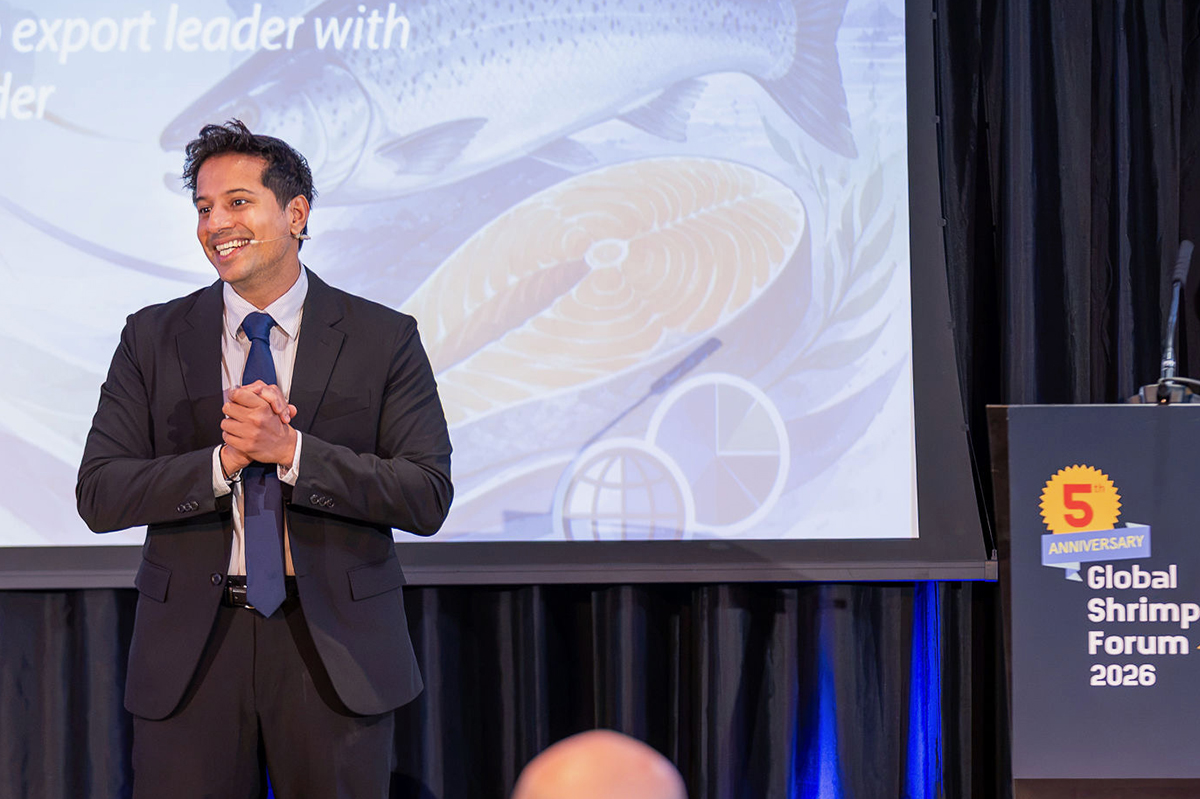
Ecuadorian shrimp has developed into an aquaculture powerhouse increasingly comparable with Norwegian salmon in scale, although fundamental differences in supply elasticity give the two industries very different risk and profitability profiles, according to Rabobank Analyst Novel Sharma.
Speaking at the Forum, Sharma described Norway as the “Michael Jordan” of aquaculture but said Ecuadorian shrimp was emerging as the sector’s “LeBron” James, a sly reference to two professional basketball giants.
Ecuadorian shrimp exports grew at a compound annual rate of 14 percent over the past decade, compared with 4 percent for Norwegian salmon, with both reaching around 1.3 million MT of exports in 2025.
However, the industries’ supply dynamics are markedly different. Norwegian salmon can take more than two years to reach harvest and faces structural constraints including licenses, sites and biomass limits. This low supply elasticity can support tighter markets, higher margins and profitability, but also greater price volatility.
Ecuadorian shrimp, by contrast, can be harvested after around three to four months and has considerable capacity to expand production.
“That same ability that allows them to react quickly and increase production also allows them to reduce and react to market signals in a matter of a few months,” Sharma said.
The trade-off is potentially lower pricing power and profitability when rapid production growth creates oversupply.
Sharma also highlighted Ecuador’s growing corporate scale, with its largest shrimp companies increasingly comparable with established salmon players.
He questioned whether the next stage could see Ecuadorian producers develop into vertically integrated global seafood platforms similar to Norway-based Mowi.
“The question is: what will be the pathway for the Ecuadorian shrimp industry?” he said. “Will it be vertical integration? Will it be more diversification?”
Rabobank is also increasing its appetite for Ecuador, with Sharma describing the country as the bank’s “next phase of growth” in Latin America.

Ecuador’s shrimp growth built on genetics, low density and technology: CNA
Ecuador’s shrimp industry has transformed repeated disease shocks into sustained growth through genetics, low-density farming, nutrition and technology, explained José Antonio Camposano, president of the Cámara Nacional de Acuacultura (CNA).
Speaking at the Forum, Camposano described Ecuador’s development as a “proven business case” rather than a promise, built over several decades of adapting the production system.
A pivotal change came after white spot devastated production in the late 1990s, when farmers shifted from specific pathogen-free (SPF) shrimp to specific pathogen-resistant (SPR) animals.
The change initially came at a heavy cost: Production fell to around one-third of its pre-outbreak level in 2000 and took five years to recover.
“Definitely, SPR turned sanitary volatility into sustained growth,” Camposano said. “Essentially, what Ecuador did was solve biology with biology.”
The industry has subsequently combined resistant genetics with low stocking densities, performance nutrition and increasingly sophisticated technology, including big data, the Internet of Things and artificial intelligence.
“Every technology available for shrimp production is already working in Ecuador,” he said.
Camposano also highlighted the sector’s vertically integrated structure, modern fisheries and aquaculture legislation introduced in 2020, and a public sanitary system covering traceability, health surveillance and export certification.
The CNA represents around 350 companies across the value chain and provides a platform for coordination and dialogue with regulators and international markets.
With production, processing and export access increasingly consolidated, Camposano said the role of new capital “could be, or should be, downstream distribution and market presence abroad,” inviting investors to engage directly with Ecuadorian shrimp companies. “The growth in Ecuador is proven,” he said.

Ecuador’s ‘Darwinian’ shrimp breeding helps drive production and export transformation
Continuing the story of Ecuador’s shrimp growth, GLuna Shrimp owner Gabriel Luna explained that the industry has combined a Darwinian approach to disease resistance with sustained investment in farming technology and processing capacity to more than double production over successive five-year periods.
Luna said Ecuador’s production in 2009 had finally returned to the level recorded before the white spot crisis, meaning it took around 10 years to recover from the disease shock.
He attributed that recovery partly to what he called the “Darwin method” based on survival of the fittest, with shrimp that survived disease challenges being retained and used to build subsequent generations.
From 2010 to 2025, stocking densities increased from around eight to 20 shrimp per square meter, while growth rates improved from roughly 1.2 grams per week to around three grams, with the best-performing farms reaching higher levels, he said.
Advances in feed formulation and efficiency, pond aeration and automatic feeding have supported those gains. Luna said combining aeration with automatic feeding had produced particularly strong results.
Meanwhile, Ecuador has invested heavily in processing to reduce its dependence on China’s head-on shrimp market. The proportion of exports shipped head-on fell from 74 percent in 2019 to around 44 percent in 2025/26, while the volume of raw material entering peeling operations tripled between 2020 and 2025.
That shift has supported growth in North American and European markets, with value-added formats increasingly replacing whole shrimp exports.
Luna said the next challenge was to match the industry’s growing production capability with stronger global consumer demand.
He called for a unified international shrimp-industry campaign to promote consumption across borders.
“The whole industry. A united industry, one industry, no flag. It’s shrimp, we’re shrimp. Wild shrimp too – we all have the same nutritious properties, and we can promote it as the same,” he said.
Now that you've reached the end of the article ...
… please consider supporting GSA’s mission to advance responsible seafood practices through education, advocacy and third-party assurances. The Advocate aims to document the evolution of responsible seafood practices and share the expansive knowledge of our vast network of contributors.
By becoming a Global Seafood Alliance member, you’re ensuring that all of the pre-competitive work we do through member benefits, resources and events can continue. Individual membership costs just $50 a year.
Not a GSA member? Join us.
Author
-

Jason Holland is a London-based writer for the international seafood, aquaculture and fisheries sectors. Jason has accrued more than 25 years’ experience as a B2B journalist, editor and communications consultant – a career that has taken him all over the world. He believes he found his true professional calling in 2004 when he started documenting the many facets of the international seafood industry, and particularly those enterprises and individuals bringing change to it.
Related Posts

Intelligence
Bangladesh seeks more buck for its ‘bagda’
As more than 80 percent of Bangladeshi shrimp exports already go to EU markets, a consultation meeting involving buyers from the bloc and Bangladesh industry stakeholders and authorities was held at the end of last month in Utrecht, the Netherlands.

Innovation & Investment
Aquaculture Exchange: Flavio Corsin, IDH
IDH Vietnam Manager Flavio Corsin speaks passionately about the importance of controlling disease and getting all stakeholders to put competition aside and pull on the same end of the rope. Improvement initiatives for pangasius, shrimp and tilapia are among the Dutch sustainable trade organization’s priorities.

Intelligence
European indoor shrimp farming – investment vacuum or viable, high-end enterprise?
Investors are “on the fence” regarding indoor shrimp farming as no clear winner has emerged between RAS and biofloc, one analyst explains.
Aquafeeds
Study examines the positive and negative environmental impacts of using fishmeal alternatives in aquafeeds
Study finds EU aquaculture’s shift from fishmeal to plant feed cut marine use but increased emissions, land and water impacts.