


At the 2026 Responsible Seafood Summit, growth comes with harder questions about risk and responsibility

Market volatility, climate change, trade and social responsibility drive opening day discussions at the 2026 Responsible Seafood Summit

Earlier this year, when the global seafood industry gathered in Barcelona for Seafood Expo Global, trade disruptions, rising costs and shifting consumer demand were among the issues shaping conversations across the show floor.
Five months later, many of those same issues were the primary concerns in Bangkok, at the Global Seafood Alliance’s Responsible Seafood Summit.
The global seafood industry is no stranger to uncertainty. But as industry leaders echoed throughout the summit, the pressures shaping the sector are increasingly interconnected – from shifting trade patterns and tariffs to climate change, labor conditions and the search for new markets.
Those challenges – and the opportunities emerging alongside them – took center stage on the opening day of the annual event, co-hosted by GSA and The Center for Responsible Seafood. Bringing together seafood executives, producers, researchers and other industry stakeholders, the summit focused on a question facing businesses throughout the seafood supply chain: How do companies plan for growth when volatility itself has become part of the operating environment?

Opening the event, GSA CEO Mike Kocsis welcomed attendees and set the stage for two days of conversations about the future of responsible seafood. Collaboration was at the center of his opening remarks.
“What makes this gathering so exciting is the people in this room – leaders from different regions in the world, different sectors of the seafood industry, and with different skills, abilities and life experiences,” said Kocsis. “We need it – no single person or organization can create the future of seafood alone.”
Ingorn Panyakit, chief inspector-general of Thailand’s Ministry of Agriculture and Cooperatives, welcomed delegates to a country she described as “a vital hub for seafood production and trade,” pointing to Thailand’s role not only in processing and exports but also in global food security.

Seafood confronts a more volatile global market
For seafood executives, adapting to uncertainty increasingly means reconsidering where products are sold as well as what consumers want.
Tam Nguyen, CEO of Vietnam-based Vinh Hoan Corporation, described an export environment complicated by tariffs and long-running trade pressures in the United States, the company’s largest export market.
“This year has been quite challenging,” Nguyen said, pointing to tariffs and other trade measures affecting Vietnamese seafood exports – a sector worth more than $10 billion.
Those pressures have reinforced the importance of diversification. Japan, once considered a difficult market for Vietnamese freshwater fish like pangasius, has become a source of growth, with pangasius exports increasing at double-digit rates in recent years and finding new applications in premium products, including sushi.
Vinh Hoan has also invested across its value chain, from hatcheries and feed to farming and processing, while finding more uses for the fish it produces. The company promotes pangasius as a “zero-waste fish,” using byproducts in higher-value products such as collagen.
For Nguyen, sustainability is increasingly part of that broader business strategy. “It’s not only about the environmental element of sustainability; it’s about risk management,” she said. “So that motivates us to keep trying and testing different things.”
Daisuke Yasuda, representative director and president of Umios, approached the changing market from the consumer side. The Japanese seafood company, formerly Maruha Nichiro, changed its name to Umios in March as part of a broader repositioning around food, health and environmental solutions.
“What I feel most strongly about is the need to shift to a consumer-centric approach,” Yasuda said. “Until now, we have tended to operate with a product-out mindset – the idea that if we make a good product, it will sell.”
That approach, he said, can leave companies prioritizing factory utilization even when products are out of step with consumer demand, pushing businesses into price competition.
“Changing the business dynamic is one of the biggest areas where we need to learn,” Yasuda said.
He also sees an opportunity in how the industry communicates seafood’s health benefits, particularly in Japan, where fish has long been part of the everyday diet.
“We need to shift our mindset from simply selling fish to delivering health benefits,” Yasuda said. “I believe our industry is still only halfway in making that transition.”
‘A tough one’

Seafood markets have always moved with changing seasons, supply and prices. What is different now, Kontali Chief Analyst Ragnar Nystøyl said, is the number of disruptions hitting the industry at the same time.
“Volatility is not new to seafood markets,” Nystøyl said. But wars, geopolitical unrest, tariffs and climate-related disruptions are increasingly overlapping, pushing up costs and reshaping established trade flows.
“There is one major result of many of these shocks, and that’s increased costs,” he said. “The costs need to be covered by someone.”
Kontali’s analysis showed the gap between producer and retail prices widening by 65 percent compared with the period before 2022. Nystøyl said much of that difference reflected higher costs rather than expanding margins.
“For the vast majority of this, this is really a result of increased costs, and not so much that someone is running away with the margin,” he said.
Those pressures are also reshaping trade. U.S. seafood flows to and from Europe and Asia have been particularly affected, while alternative supplying regions, including parts of South America, have gained ground. China, meanwhile, has gained across several trade flows.
Climate-related disruptions add another layer. Nystøyl pointed to tighter supplies of the key marine ingredients fishmeal and fish oil, weaker fishing seasons in key producing regions and declining availability of several North Atlantic species. But he cautioned that the effects of warming waters are not uniform.
“The impact is not always black and white,” he said, pointing to parts of northern Europe where milder conditions have supported farmed salmon and trout even as other fisheries and aquaculture sectors have struggled.
“Seafood sectors are used to dealing with volatility,” Nystøyl said. “But this is a tough one.”
Climate change as ‘an amplifier’ for risks
Market volatility is only one part of the seafood industry’s changing risk landscape. Ben Belton, senior fishery officer with the Food and Agriculture Organization of the United Nations (FAO), argued that climate change is no longer simply a future risk for seafood producers.
“Climate change has already impacted the sector in lots of ways,” Belton said. He pointed to flooding, drought, warming waters and coastal erosion, including the remains of a shrimp pond about 22 miles south of Bangkok where rising seas have eaten away at the surrounding land. Those impacts can also ripple through seafood markets. Belton used the current El Niño to show how climate shocks can affect both production costs and demand.
“As El Niño contributes to higher temperatures [and] less rainfall, that’s also going to likely impact rice production [and] wheat production,” he said. “So cereal prices will go up. That means higher aquafeed prices.”
Higher food prices can create another pressure point.
“Lower-middle-income consumers will increasingly have to spend more of their food budgets on staple foods [and] less on […] luxury foods like seafood,” Belton said. “So, we have higher input prices for farmers at the same time as lower demand.”
That is likely to create lower incomes and perhaps lower production, Belton said. For him, that interaction is central to understanding the risk.
“It’s really important to understand that climate change acts as an amplifier for other environmental as well as economic stresses,” he said.
Producers are already adapting. Belton pointed to tilapia hatcheries using shade netting and sprinklers to lower water temperatures, farmers deepening ponds or adding aeration, and operations in flood-prone areas raising dikes or changing stocking schedules.
“There’s lots of examples of adaptation already taking place on the ground,” he said.
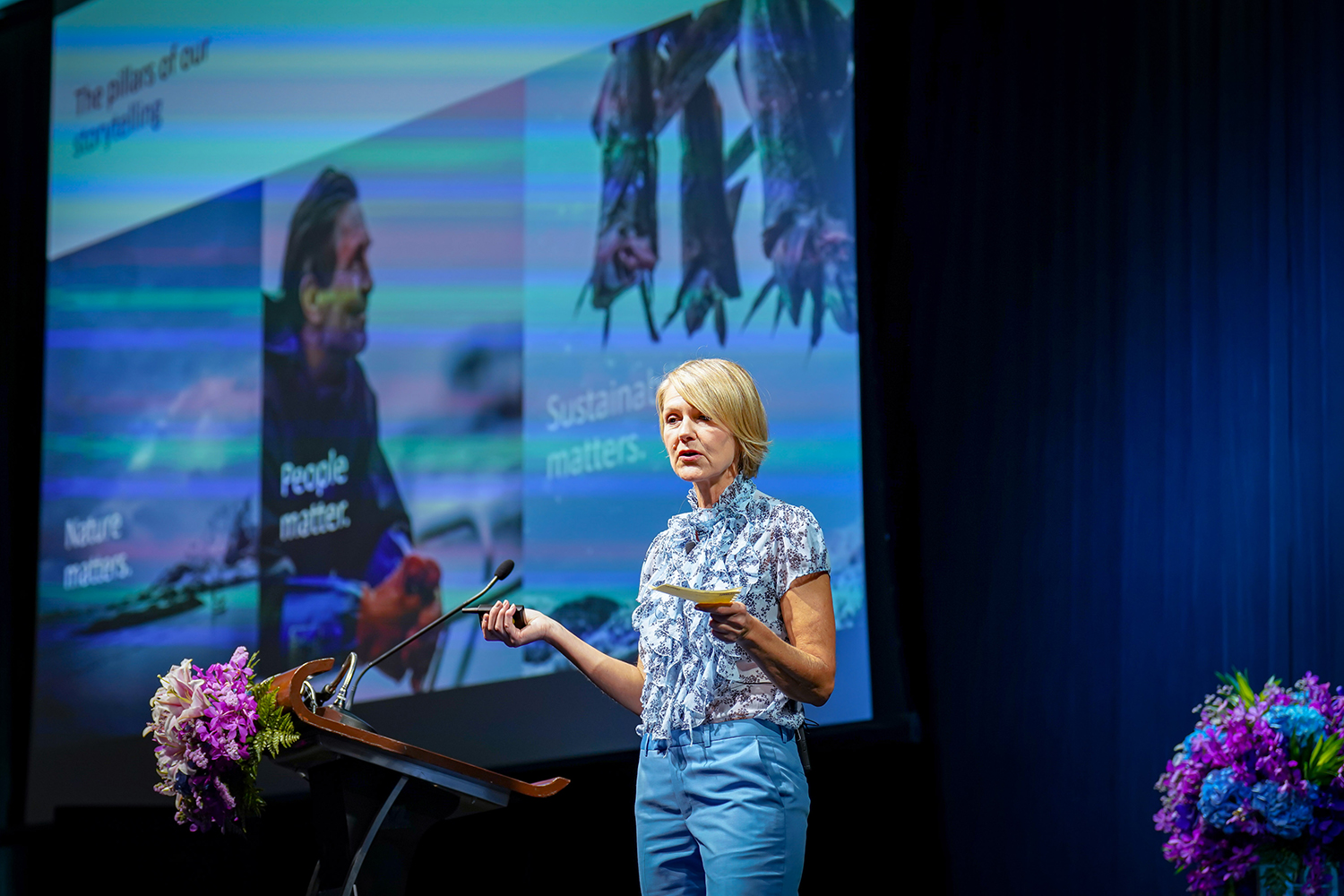
Different markets, different opportunities
For exporters looking beyond established markets, Asia presents opportunities – but not a single strategy, said Åshild Nakken, country director for Thailand and South-East Asia at the Norwegian Seafood Council.
“Asia is not just one seafood market,” Nakken said. “It’s a portfolio of markets, cultures, price points and channels.”
Rising incomes are helping expand demand for higher-value seafood across the region. Nakken pointed to China as a benchmark for how markets can develop as middle-income populations grow, with Thailand and the Philippines roughly a decade behind China in reaching similar income levels.
The opportunities also look different from market to market. In Thailand, Norwegian salmon is moving beyond sushi and Japanese restaurants into Thai dishes and other consumption occasions. Vietnam, meanwhile, is developing as a premium seafood market alongside its established role as a processing hub, supported by a young population and rapid urbanization.
“Japan helped us create acceptance. China has created scale. South Korea has created a retail-driven model, and Thailand and Southeast Asia are creating diversification,” Nakken said.
Growth raises a bigger question: What about seafood’s workers?
Market volatility is only one part of the seafood industry’s changing risk landscape. Ben Belton, senior fishery officer with the Food and Agriculture Organization of the United Nations (FAO), argued that climate change is no longer simply a future risk for seafood producers.
“Climate change has already impacted the sector in lots of ways,” Belton said. He pointed to flooding, drought, warming waters and coastal erosion, including the remains of a shrimp pond about 22 miles south of Bangkok where rising seas have eaten away at the surrounding land.
Those impacts can also ripple through seafood markets. Belton used the current El Niño weather phenomenon to show how climate shocks can affect both production costs and demand.
“As El Niño contributes to higher temperatures [and] less rainfall, that’s also going to likely impact rice production [and] wheat production,” he said. “So cereal prices will go up. That means higher aquafeed prices.”
Higher food prices can create another pressure point.
“Lower-middle-income consumers will increasingly have to spend more of their food budgets on staple foods [and] less on […] luxury foods like seafood,” Belton said. “So, we have higher input prices for farmers at the same time as lower demand.”
That is likely to create lower incomes and perhaps lower production, Belton said. For him, that interaction is central to understanding the risk.
“It’s really important to understand that climate change acts as an amplifier for other environmental as well as economic stresses,” he said.
Producers are already adapting. Belton pointed to tilapia hatcheries using shade netting and sprinklers to lower water temperatures, farmers deepening ponds or adding aeration, and operations in flood-prone areas raising dikes or changing stocking schedules.
“There’s lots of examples of adaptation already taking place on the ground,” he said.
Bringing responsibility back to production
The day’s final discussion brought several of those threads back to the business of production. Thai Union executives examined how one of the world’s largest seafood companies is navigating changing markets while working to embed sustainability more deeply into production and commercial strategy.
Paul Christian Herholz, president of frozen at Thai Union, framed the challenge with a different question: “How do we make sustainability sustainable?” Responsible seafood, he argued, can only scale if producers, customers and supply-chain partners see value in it. And that becomes harder as costs rise throughout the supply chain.
“Consumers are not necessarily willing to pay significantly more, nor should they, nor can they,” Herholz said. “Who absorbs the cost? Because that’s the elephant in the room.”
For Thai Union, he said, sustainability cannot operate as a separate agenda. It must be embedded in the business and create enough value to support continued investment in responsible production. “It only works when everybody participates,” Herholz said. “If one part of the chain carries all of the burden, it won’t work.”
Adam Brennan, Thai Union’s chief sustainability and communications officer, offered examples of how the company is putting that approach into practice. Under SeaChange 2030, Thai Union has expanded its sustainability commitments into shrimp. Brennan said 68 percent of the shrimp Thai Union sources now comes from responsibly managed farms, while a farming model tested in Thailand has reduced the carbon footprint of production by about 30 percent.
Brennan said sustainability is about protecting people and the planet, but also about business resiliency. “If there are no healthy oceans, there is no seafood,” he said.
Despite that progress, Brennan said significant risks remain, particularly around labor conditions, aquaculture feed and climate adaptation. The industry, he said, needs to move faster to safeguard seafood workers, while strengthening feed standards around issues including deforestation and aquatic welfare. He also pointed to the challenge of preparing suppliers and small-scale farmers for a warming planet.
“We have come a long way,” Brennan said. “But we are far from finished.”
Now that you've reached the end of the article ...
… please consider supporting GSA’s mission to advance responsible seafood practices through education, advocacy and third-party assurances. The Advocate aims to document the evolution of responsible seafood practices and share the expansive knowledge of our vast network of contributors.
By becoming a Global Seafood Alliance member, you’re ensuring that all of the pre-competitive work we do through member benefits, resources and events can continue. Individual membership costs just $50 a year.
Not a GSA member? Join us.
Author
-

Lisa Jackson is a writer based in Hamilton, Canada, who covers a range of food and environmental issues. Her work has been featured in Al Jazeera News, The Globe & Mail and The Toronto Star.
Related Posts
Fisheries
‘A revolution in the making’: How a solar-powered ice maker is transforming an Indonesian tuna fishery
A solar-powered ice maker has transformed an Indonesian community's tuna fishery, boosting incomes and slashing waste and emissions.
Responsibility
‘I worked across every department.’ One woman’s journey within Thailand’s aquaculture sector
Aquatic veterinarian Jessica Kaye Turner discusses her career path and reflects on women’s evolving role in Thailand's aquaculture industry.
Responsibility
‘It’s not something new’: Addressing human rights due diligence in seafood sourcing at Seafood Expo North America
Fishermen, NGOs and industry representatives share tales of human rights due diligence work in seafood procurement at Seafood Expo North America.
Intelligence
Hurricane Fiona was a ‘historic, extreme event’ for Atlantic Canada – and hit the seafood sector hard
As the clean-up from Hurricane Fiona begins, Atlantic Canada communities survey the damage caused to fisheries and aquaculture operations.