


Responsible Seafood Summit: Rabobank provides a mixed outlook for global aquaculture

Rabobank’s Gorjan Nikolik: Expect slower salmon growth and uneven shrimp supply
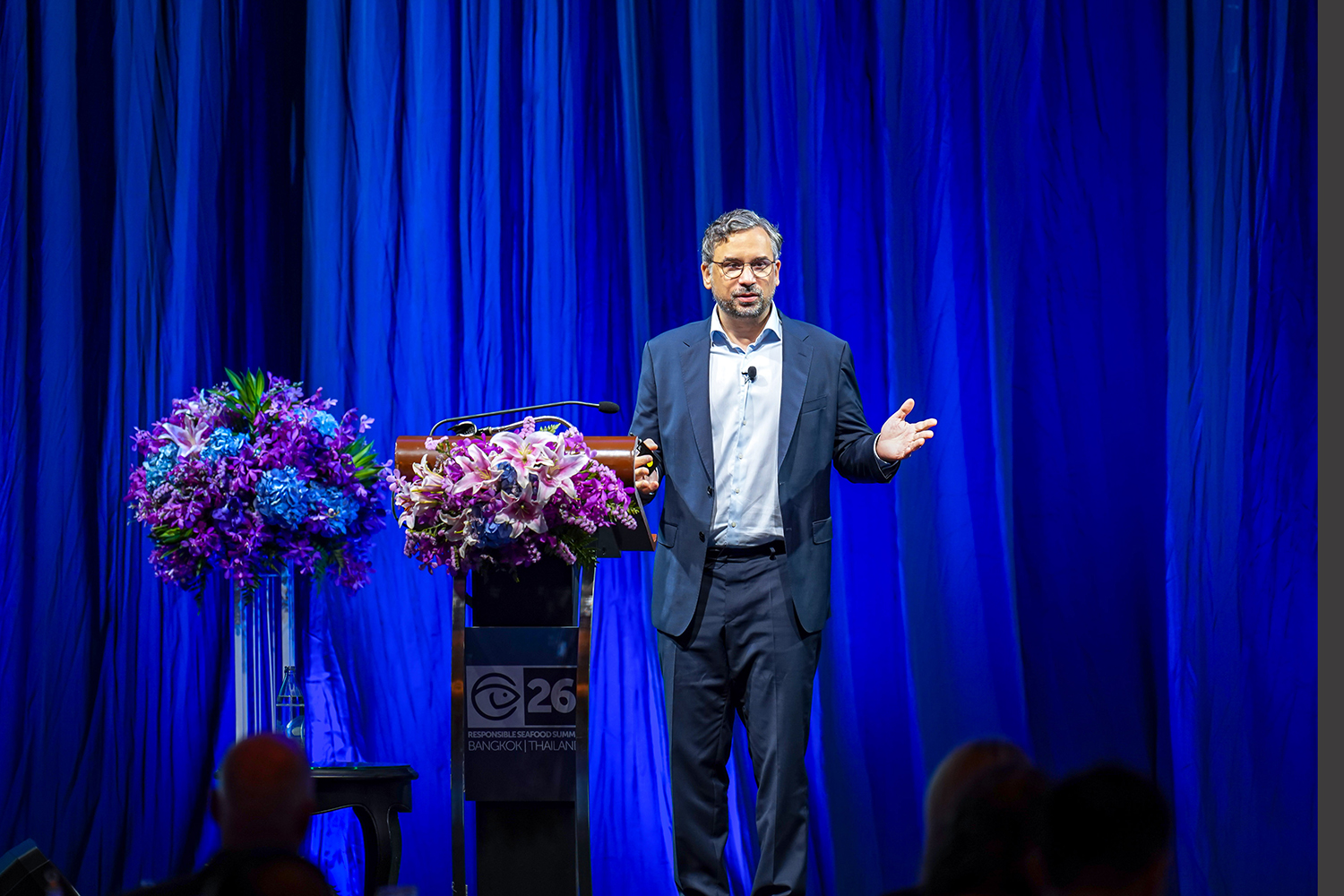
After an extraordinary year for salmon, the next phase of aquaculture growth may be less dramatic – and more widely distributed. Production forecasts presented at the 2026 Responsible Seafood Summit in Bangkok last week pointed to continued expansion across many of the industry’s largest farmed species, even as some of the exceptional growth seen in 2025 begins to ease.
Gorjan Nikolik, senior global specialist for seafood at Rabobank, opened the day with the annual Global Finfish Aquaculture Production Survey and Forecast, offering a wide-ranging look at salmon, tilapia, pangasius and other major farmed species.
The outlook was encouraging. Rabobank’s outlook shows growth continuing across much of global aquaculture despite a challenging operating environment, although the pace and sources of that growth are changing.
After salmon’s ‘tsunami,’ growth slows
Atlantic salmon was the standout story of 2025, when global production jumped nearly 12 percent after several comparatively weak years. However, that pace is unlikely to continue.

“We had an absolute tsunami of salmon in 2025,” Nikolik said. “Norway, the biggest producer, grew by 12 percent, and Chile by 15 percent. The two countries grew for slightly different reasons, but it was largely biology related. It was better growth, lower mortality, better performance, better climate.”
Rabobank expects Atlantic salmon production growth to slow to about 3.1 percent in 2026 and 1.7 percent in 2027, marking a sharp slowdown from last year’s supply surge.
“Basically, the forecast is normalization,” said Nikolik.
‘Pockets of growth’
Some of the more interesting growth is occurring elsewhere. Tilapia production is forecast to increase 2.9 percent this year, pushing an already massive industry past another milestone.
“We should be crossing the 8 million metric tons in 2026,” Nikolik said. “Almost all of it [is] driven by local markets. This is not a sector that’s very dependent on international trade.”
China remains the largest global producer, and even in a mature market, Nikolik said, production continues to edge higher.
“I’m pretty impressed with the Chinese because it’s a big industry,” he said. “In the past, they used to rely quite heavily on U.S. demand, but by now the United States exports is a much lower percentage of their total industry. They’ve continued to grow, almost unimpacted by this.”
Pangasius is moving faster. Global production is forecast to increase 5.3 percent this year and another 5.9 percent in 2027, bringing the industry close to the 4 million metric ton (MT) mark. Vietnam remains dominant, but India has quietly emerged as a major producer and is forecast to reach roughly 1 million MT by 2027.
“We’ve always talked about Vietnam in the past, but silently India has emerged as a major producer,” Nikolik said, adding that unlike Vietnam’s export-oriented industry, much of India’s production is serving its domestic market. “Many people often question: Is India going to become a major seafood-consumer nation? Well, they already are.”
Smaller producers are also gaining ground. Nikolik pointed to expansion in Malaysia and Myanmar, while Thailand appears to be reversing a longer period of decline.
“Here in Thailand, too, it looked for a long time that the industry was declining,” he said. “It seems that there’s growth again.”
Marine finfish adds another layer to the outlook. Chinese production is forecast to increase 7.7 percent this year, while Nikolik highlighted barramundi as a species with export potential. Norway’s farmed Atlantic cod industry is also staging a comeback as tighter wild cod supplies in Europe support prices.
Against a backdrop of tariff uncertainty, geopolitical tensions and broader market volatility, Nikolik said the breadth of expansion across species and regions stood out.
“How do you summarize a plethora of species? It’s very difficult,” he said. “I would say that I’m really impressed by the resilience of this.”
His takeaway: “Overall, I would say pockets of growth and interesting stories across our whole industry.”
Rabobank: Seafood industry faces ‘prolonged instability’ as tariffs, tensions reshape trade
Shrimp growth continues, but not everywhere
Global shrimp production is still expanding, but the pace is slowing – and growth is becoming increasingly concentrated in a handful of markets
The GSA-Rabobank survey forecasts global shrimp supply growth of 2.8 percent in 2026, down from 6.3 percent in 2025, before recovering to 4.7 percent in 2027. Even then, that would remain well below the industry’s 8.2 percent compound annual growth rate from 2014 to 2024.
Ecuador is the clearest exception to that slowdown. The survey initially put 2026 production growth at 10.3 percent, but more recent data suggest the increase could reach 15 to 16 percent. Exports through July were already up 13 percent by volume.
“I would argue this is the fastest-growing large aquaculture industry of the last two decades – not even the last two years,” Nikolik said.
That comes on top of an estimated 14.7 percent increase in 2025. Another 6.9 percent gain is currently forecast for 2027, but what stood out to Nikolik was how long Ecuador has been able to sustain that pace.
“We rarely see something of this scale last this long in [the] aquaculture industry without major correction,” he said.
Beyond Ecuador and India, however, the picture softens considerably. China is expected to grow just 1 percent this year, Vietnam 1.9 percent and Thailand less than 1 percent, while Indonesia is forecast to contract 5.8 percent.
That uneven growth is playing out alongside a changing global market. Kontali Chief Analyst Ragnar Nystøyl pointed to higher supply-chain costs and shifting trade flows, particularly around the United States. Lower producer prices have not necessarily translated into lower consumer prices, he said, leaving less room for margins elsewhere in the supply chain.
“Somebody needs to cover that cost,” Nystøyl said.
But Nystøyl also cautioned against treating the U.S. as the measure of global shrimp demand. The market accounts for roughly 10 percent of global vannamei consumption and only 2 to 3 percent of monodon consumption, meaning most global demand lies elsewhere.
“I think there’s too much focus on the U.S. market when it comes to market potential,” Nystøyl said.
Now that you've reached the end of the article ...
… please consider supporting GSA’s mission to advance responsible seafood practices through education, advocacy and third-party assurances. The Advocate aims to document the evolution of responsible seafood practices and share the expansive knowledge of our vast network of contributors.
By becoming a Global Seafood Alliance member, you’re ensuring that all of the pre-competitive work we do through member benefits, resources and events can continue. Individual membership costs just $50 a year.
Not a GSA member? Join us.
Author
-

Lisa Jackson is a writer based in Hamilton, Canada, who covers a range of food and environmental issues. Her work has been featured in Al Jazeera News, The Globe & Mail and The Toronto Star.
Related Posts

Intelligence
10 takeaways from GOAL 2019 in Chennai, India
The Global Aquaculture Alliance held its GOAL conference in Chennai, India, and recruited a host of experts in various fields to share their expertise.
Innovation & Investment
Aquaculture is winning, Rabobank analyst explains
Aquaculture is the “winning protein,” according to a new Rabobank report that its author, Gorjan Nikolik, said is intended to draw the bank’s agro-industry clients to opportunities in the fish farming business.
Intelligence
‘The power of impact is in all of us’: Day one of 2025 Responsible Seafood Summit charts a more sustainable future for a global industry
The 2025 Responsible Seafood Summit explored how to make seafood’s global impact more sustainable, transparent and equitable.
Aquafeeds
Talent show: Aquafeed companies show off at F3
Aquafeed manufacturers and alternative feed ingredient suppliers from all over the world gathered in Silicon Valley for F3, the Fish Free Feed contest. In the hub of innovation, solutions to a global problem were on full display.