


Can the carbon-removal potential of seaweed match climate-driven kelp loss?

Study: Climate-driven loss of kelp forests strips away their sequestration role 1,000 to 10,000 times faster than restoration or farming can put it back
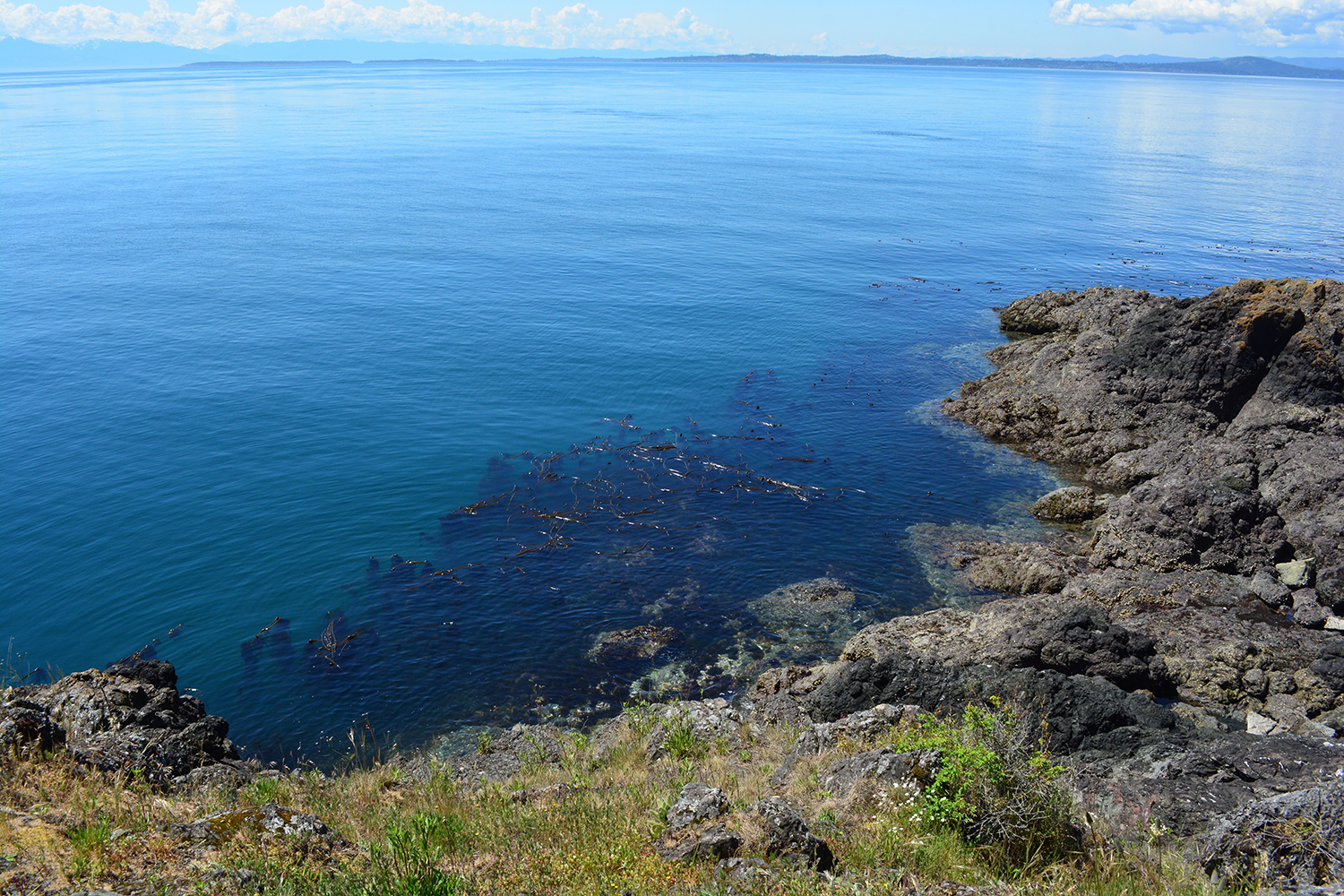
Scientists from Australia and Canada recently reported that restoring seaweed forests can be a local answer to a global problem and it helps people reconnect with nearby coasts. Even a small kelp project can lift local biodiversity and shore function and it can supply other services as well. Farming seaweed is also a strong way to grow food and materials with a light footprint and to replace high-carbon goods with low-carbon ones such as biodegradable plastics and biochar.
However, in a new study, researchers argue that climate change is already stripping seaweed forests of their “carbon sink” role far faster than restoration or farming can put carbon back. And they want research and policy to treat lost natural sequestration – and the risk that damaged forests become sources – as the first-order problem, not future carbon-dioxide removal (CDR) credits.
The study – authored by Dr. Karen Filbee-Dexter and colleagues at the University of Western Australia (Australia) and the Bedford Institute of Oceanography (Canada) – indicates that is unrealistic to expect that seaweed restoration and farming can remove enough carbon fast enough to offset rising emissions, at today’s emission rates, and with seaweed forests already shrinking under climate stress.
“Seaweed forests can certainly be part of the climate solution, but we need to be realistic about what they can deliver to mitigate climate change given the pace of our emissions and scale of seaweed forest loss,” Dr. Karen Filbee-Dexter, corresponding author of the study, told the Advocate. “We have already seen this with forests on land: ecosystems that were once reliably absorbing carbon can become carbon sources when they’re pushed beyond their limits. We need to take that lesson seriously in the ocean. And ultimately, reducing greenhouse gas emissions remains a critical solution to prevent the continued loss of the ecosystems we depend on.
![Ad for [Aquademia]](https://www.globalseafood.org/wp-content/uploads/2025/07/aquademia_web2025_1050x125.gif)
“Instead of asking how much carbon we can remove with seaweeds, we should be asking how much carbon we can stop from being released as these ecosystems are damaged by climate change.”
Land forests still absorb about a third of fossil emissions each year, and that service is built into climate pathways. Emerging evidence shows that this drawdown is weakening as primary producers are hit by accelerating climate change. Forests can flip from sink to source after fire, drought, or heat, and the same pattern is now visible underwater: climate-driven losses of coastal vegetated habitats already add to land-use emissions.
Seaweeds are often cast as the marine analogue of those forests: highly productive systems that could offset emissions if restored and farmed at scale. They fix about one billion metric tons of carbon a year in growth and cover more sunlit coast than any other vegetated marine habitat. Fragments and rafts can leave the coast and reach deep water, where carbon may be isolated for decades to centuries. Seaweeds also release dissolved organic carbon; a refractory fraction (rDOC) can persist for millennia and contribute to ocean sequestration. Most seaweed-carbon research has therefore asked how that sequestration might be harnessed as CDR.
The study argues that this approach ignores the other side of the same process. When a forest dies in shallow, well-mixed water, roughly half the carbon in living tissue can return to the atmosphere, and exports of particulate organic carbon (POC) and rDOC also decrease. Habitats that replace kelp, such as turf algal reefs, do not perform the same export job, and warming can further cut carbon storage even where the forest still stands. The study also suggests that seaweed forests are in the same class as drought- and fire-hit land forests: the sinks that climate change itself is weakening.
How large is the imbalance?
The authors compare three interventions – wild-forest restoration, afforestation, and farming –with climate-driven loss. Verified wild kelp restoration since 1958 is only about 4,200 hectares (ha). The largest documented projects are on the order of tens of hectares (for example ~70 ha in northern Norway and ~32 ha in Santa Monica Bay). Against that, global kelp extent is estimated at about 641,000 square kilometers, declining at roughly 1.8 percent a year. Six marine heatwaves in 25 years removed about 97,000 hectares and the equivalent of about 8.2 million metric tons of carbon dioxide. A conservative climate projection is 15.7 percent loss by 2100, and the area lost by 2050 at about 25 million hectares, or more than 6,000 times the area restored over a much longer period.
On carbon, the study estimates climate-driven kelp loss releases or forgoes about 13 million metric tons (MT) of carbon dioxide a year. Cumulative figures run to about 155 million MT by 2030 and, on a time-series path, up to about 2.5 billion MT by 2050, and sublethal warming is additional. Restoration to date is credited with only tens of thousands of MT of carbon dioxide in total, and about 28,000 MT a year of ongoing drawdown. That is the 1,000–10,000-fold gap reported: loss of sink capacity outruns intervention gains by three to four orders of magnitude, and seaweed farming does not close this gap
Seaweed aquaculture now occupies about 4,000 square kilometers, still only a fraction of the kelp area lost in a single year. Life-cycle numbers the authors use place farm operations at about 93 kg of carbon dioxide per tonne of cultivated seaweed, against a median burial of about 7 kg of carbon dioxide per MT. In nine of eleven farms assessed, operations emit more than the farm buries. Farming can still be a low-impact way to grow food and materials and to replace high-carbon products, but it is not a climate-scale CDR method.
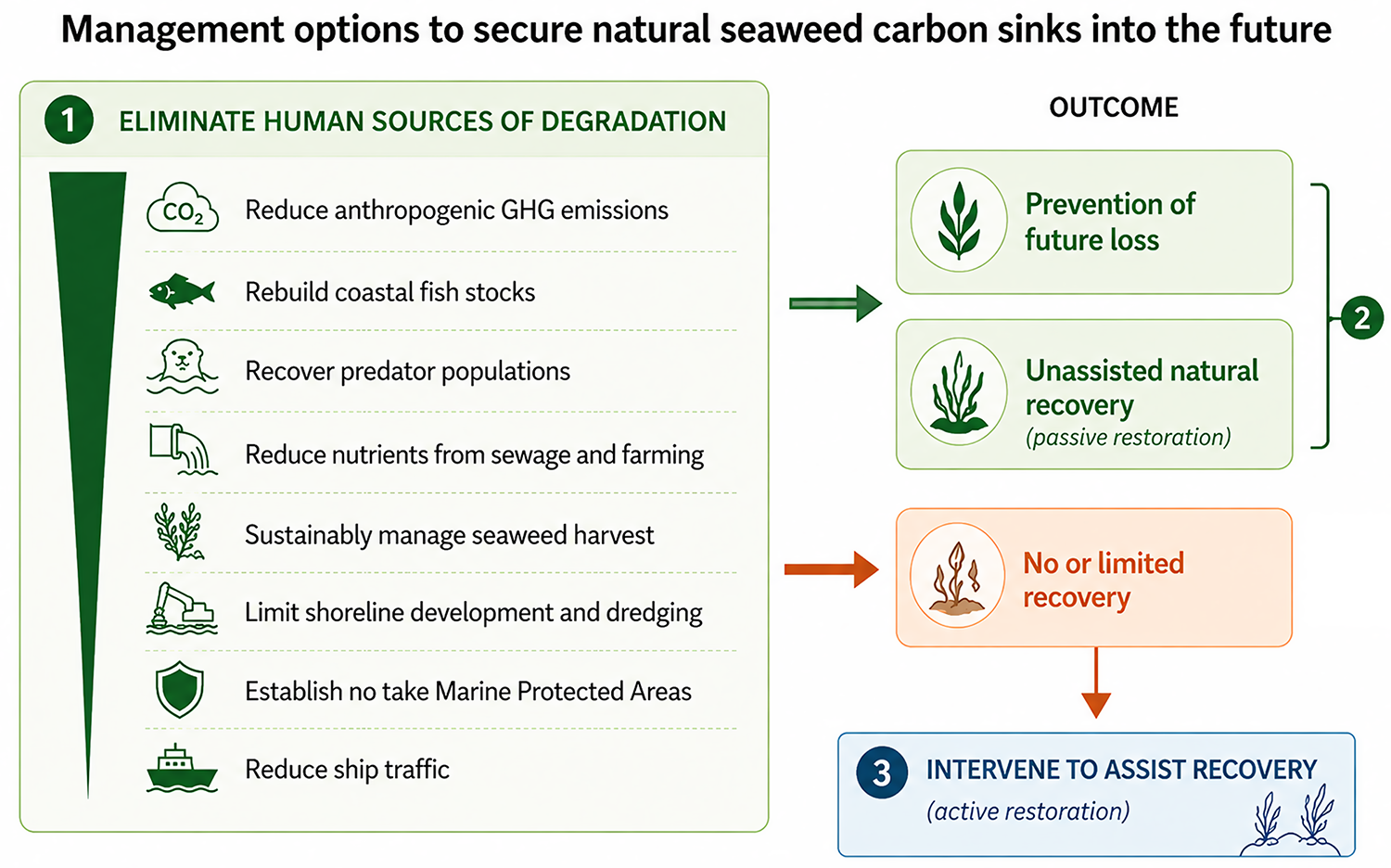
Protection is cheaper than repair
Less than 2 percent of kelp forests are in fully protected marine areas, and restoration is priced at U.S. $10,000–$707,000 per hectare, with protection at $650–$1,300. Matching the current annual loss rate with restoration would cost tens to hundreds of billions of dollars a year. The findings report protection and stressor reduction as an efficient carbon strategy, and restoration as a local ecological tool rather than a global offset machine.
The study also strongly states that restoration and farming remain worth doing. Rebuilt kelp can restore biodiversity, coastal function, and a public connection to nearby shores, and farming can supply food, feed, biodegradable materials and biochar. But an issue is the expectation that these activities can remove carbon at the scale and speed needed to cancel rising emissions. With emissions still high and forests already shrinking, that expectation is not realistic, as selling offsets against weak CDR could stimulate and license further fossil emissions.
The proposed shift
The change suggested is from “how much extra carbon could be sequestered?” to “how much sink are we losing, and how much carbon may be released as forests fail?” Priority questions include rates of area and biomass loss, warming effects on carbon fate, emissions at collapse, and the carbon behavior of replacement habitats. Conservation questions include whether protection raises resilience, where climate refugia are, and which local stressors can still be cut. Method questions include the fate of allochthonous (carbon arriving from outside: drift kelp, river organic matter, fragments, other forms) and dissolved carbon, which is still the weak joint in seaweed blue-carbon accounting.
Overall, the findings posit that intervention cannot outrun climate damage on a mitigation timetable. If natural sinks are weakening while emissions stay high, the implication is extreme cuts in fossil carbon, not a larger seaweed-offset market. Conserving the forests that still stand is the intervention that scales with the problem, while planting new ones is not.
“The idea that seaweed forests are a scalable climate solution can actually distract us from a more immediate problem: We’re losing the seaweed forests we already have,” concluded Dr. Filbee-Dexter. “Seaweed restoration and farming is unlikely to be a major climate-change solution in itself. But that doesn’t mean it is not worthwhile. Re-establishing kelp forests is an on-the-ground response to a global challenge and is critical to connect people with their local ecosystems, and successful kelp restoration improves biodiversity and coastal function. Growing seaweed is a promising way to produce food and materials sustainably and with relatively low emissions.”
Now that you've reached the end of the article ...
… please consider supporting GSA’s mission to advance responsible seafood practices through education, advocacy and third-party assurances. The Advocate aims to document the evolution of responsible seafood practices and share the expansive knowledge of our vast network of contributors.
By becoming a Global Seafood Alliance member, you’re ensuring that all of the pre-competitive work we do through member benefits, resources and events can continue. Individual membership costs just $50 a year.
Not a GSA member? Join us.
Author
-

Editor Emeritus
Related Posts
Responsibility
Are giant kelp forests carbon sinks? Environmental DNA technology offers clues
Researchers in New Zealand use environmental DNA to track carbon from giant kelp and assess its potential for carbon sequestration and climate solutions.
Responsibility
Can kelp farming fix the planet? Experts weigh in on promises and pitfalls
How can kelp farming help solve global challenges? A panel of seaweed experts discussed promises, pitfalls and knowledge gaps.
Responsibility
Can ranching ‘zombie urchins’ boost uni, save kelp forests?
With Norwegian knowledge and a partnership with Mitsubishi, Urchinomics aims to turn worthless empty urchins into valuable seafood while restoring kelp forests and creating jobs.
Responsibility
Lean and green, what’s not to love about seaweed?
Grown for hundreds of years, seaweed (sugar kelp, specifically) is the fruit of a nascent U.S. aquaculture industry supplying chefs, home cooks and inspiring fresh and frozen food products.