
Hatchery production of spiny lobsters
Spiny lobsters are a premium seafood whose culture has depended on wild-caught seedstock. An Australian company is helping shift the farming paradigm to more sustainable hatchery production.
Animal manures, grasses and other organic matter have been widely used as fertilizers in aquaculture ponds. The fertilizers decompose and release nutrients that promote the growth of phytoplankton and enhance the base of the food web.
Spiny lobsters are a premium seafood whose culture has depended on wild-caught seedstock. An Australian company is helping shift the farming paradigm to more sustainable hatchery production.
To support projected food demands, production must rise an estimated 70 percent above current values. Aquaculture can play a key role in raising food in limited space for feeding a growing population.
Liming materials neutralize acidity and increase pH in pond bottom soil and water. They also react with carbon dioxide to form bicarbonate and release calcium and magnesium, increasing both alkalinity and hardness concentrations in water.
Alkalinity and acidity in pond water and soil interact and can result in unhealthy culture conditions. Ion exchange occurs between soil and water until an equilibrium is reached.
Blue Archipelago’s re-engineering of a large shrimp farm to a modular, biosecure facility set a benchmark for future shrimp culture projects in Malaysia.
Cage aquaculture in hydroelectric reservoirs has great potential for expansion in Brazil, but there are concerns of negative environmental impacts. Careful climate zoning can assist proper siting.
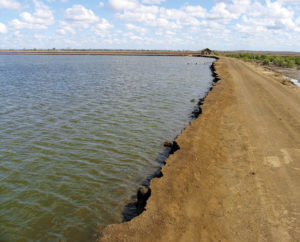
The control of external inputs of suspended soil particles to ponds and internal erosion of embankments and bottoms should begin at the design and construction stage.
The adoption of polyculture systems with controlled carbon:nitrogen ratios and substrates for periphyton development can improve utilization of the aquatic food webs in stagnant ponds.
Pond pH had a strong effect on the effectiveness of a product applied to remove excess phosphate to control algal blooms in eutrophic aquaculture ponds.
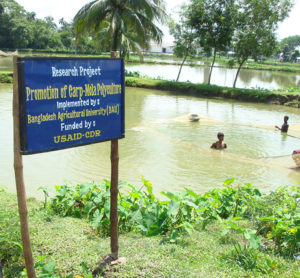
While Bangladesh's prawn industry is based on pond culture, a feasibility study was conducted to establish prawn cage culture to benefit resource-poor fishers and landless people.
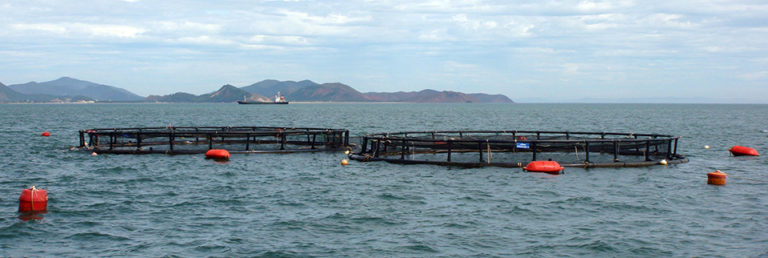
Farm cages should be sited where water quality is good and water velocity is adequate. The size, shape and position of cages should be selected to favor rapid flushing.
The most promising microcystin control in aquaculture is flocculation and sedimentation of harmful algal blooms with clay.
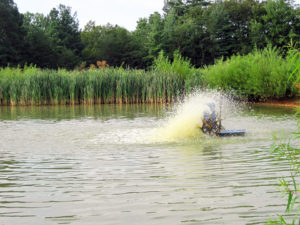
Aerator designs and mixing are key components of biofloc production systems. Diffuser aerators work primarily in smaller systems by moving deeper waters to the surface and creating constant mixing.
A low-volume, high-density culture technology developed through the Soy-In-Aquaculture Program helped show farmers that extruded floating feeds can be used in the cage culture of high-value marine fish.
Culture cages should be installed in areas with good water circulation and not placed in embayments with narrow openings or very shallow water.