


Responsible Seafood Innovation Award finalist: How upcycling plastic bottles could help small-scale fisheries cut dolphin bycatch

GEMARS is a 2026 Responsible Seafood Innovation Award finalist for a low-cost solution that cut dolphin bycatch by 88 percent without affecting target catches
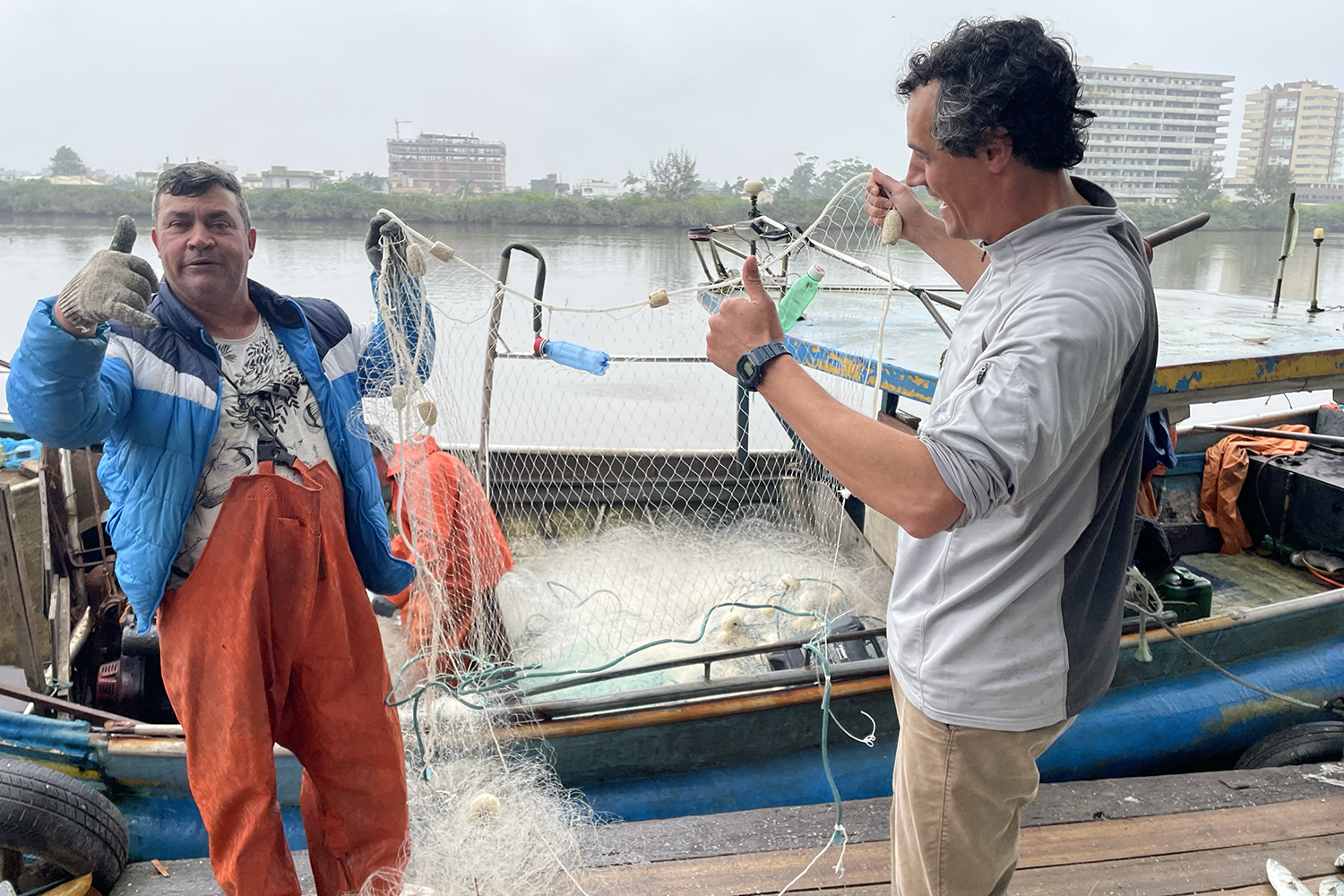
For small-scale fishers, technologies designed to reduce bycatch can be difficult to adopt. Electronic deterrent devices, for instance, frequently require significant investment, power and maintenance, while measures such as closed areas can directly restrict fishing activity.
For Dr. Federico Sucunza and his colleagues at Brazilian marine conservation and research organization GEMARS (Grupo de Estudos de Mamíferos Aquáticos do Rio Grande do Sul), those barriers were a key consideration as they searched for a viable way to minimize the large number of Franciscana dolphins unintentionally trapped in southern Brazil’s gillnet fisheries.
Their solution turned out to be remarkably simple: upcycling plastic bottles.
Attached at regular intervals along the headline of the gillnets, the bottles make the otherwise difficult-to-detect nets more acoustically conspicuous to an approaching dolphin. This bycatch reduction method requires no electricity or specialized equipment and can be assembled, deployed and replaced by fishers themselves.
![Ad for [BSP]](https://www.globalseafood.org/wp-content/uploads/2025/07/BSP_B2B_2025_1050x125.jpg)
The innovation protects the at-risk dolphins, while remaining practical for those fisheries workers setting and hauling the nets.
Field trials in a commercial small-scale fishery recorded an 88 percent reduction in the Franciscana bycatch, with no apparent effect on target catches. The project has since progressed, with GEMARS exploring wider adoption and applications in a number of fisheries.
For this achievement, GEMARS has been named a finalist for the 2026 Responsible Seafood Innovation Award in the fisheries category.
Finding a way to make nets more visible
The Franciscana is the most endangered dolphin species in South America. Known locally as toninha, gillnet bycatch represents a major threat to its survival.
GEMARS’ involvement began with beach monitoring, said Sucunza. Researchers were finding large numbers of stranded dolphins and began investigating why so many animals were dying. When the early work identified bycatch as a major cause of mortality, reducing accidental capture became an urgent priority.
At the same time, the team recognized that any conservation measure couldn’t be developed in isolation from the people who would ultimately have to use it – the fishers.
“There are various methods to mitigate bycatch,” he said. “Some involve removing the nets, others establish closed areas or use measures that are subsidized. But what we needed was to find an approach that could reduce dolphin mortality without undermining the fishing activities.”
Sucunza had previously encountered research that explored using plastic bottles as acoustic reflectors in fisheries in Africa and Peru. Although those earlier trials had not produced results, he saw enough potential to investigate the concept in Brazil.
The principle is simple. It isn’t the plastic itself that makes the gillnets more detectable, but the air trapped inside the bottles.
“The air causes a strong echo, so the animal can detect the net,” he said.
Putting the idea to the test
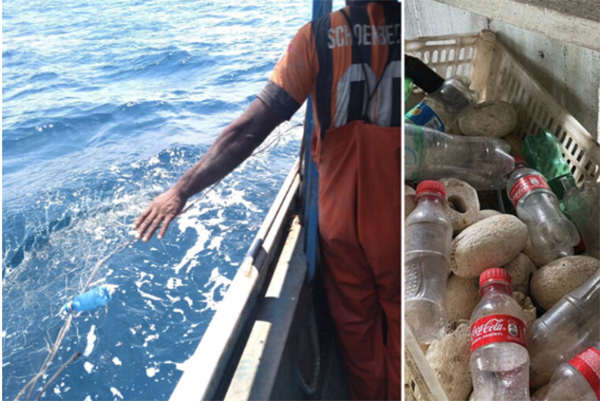
Having settled on a working concept, GEMARS sought to answer a more practical question: Could fishers actually use it?
That meant bringing them into the development process. Through this on-the-ground, collaborative effort, some important lessons were learned and adjustments made.
The original design called for 500-milliliter (mL) bottles, but fishers pointed out that bottles that large would create too much buoyancy – stretching the net and potentially affecting its ability to catch fish. As a result, the design was changed to smaller 200- to 250-mL bottles.
Fishers also helped determine how the bottles should be attached, how far apart they should be positioned and how the modified nets could be deployed and hauled. The bottle spacing was progressively refined, eventually settling at around 50 meters along 3,000 meters of net.
This wasn’t simply a matter of obtaining feedback from fishers, Sucunza said.
“Their practical knowledge became part of the development process itself,” he said.
The project’s first milestone was demonstrating efficacy. Nets equipped with bottles were compared with conventional nets, allowing the researchers to assess differences in dolphin bycatch under commercial fishing conditions, while onboard-observer data helped ensure the quality of the evidence.
The end result was a bycatch reduction method designed around the realities of a working small-scale fishery – rather than a technology developed first and adapted afterward.
The simplicity of the final bycatch reduction device belies the rigor of the research behind it. The 88 percent reduction in Franciscana bycatch was established through five years of fieldwork using data collected by onboard observers, with no apparent effect on target catches. The findings were subsequently published in a peer-reviewed scientific journal, providing independent validation of the results.
Could these high- and low-tech approaches help curb fisheries bycatch?
From local trials to wider potential
With a very positive response from the original study’s three participating fishers, GEMARS has now expanded the work to a broader group. The organization is also continuing to monitor and assess the technology as adoption grows.
That ongoing evaluation has already identified some limitations. GEMARS has found that the bottles need periodic replacement. After approximately six months of use, they can become worn, perforated or begin taking on water, requiring replacement.
The researchers are also using cameras to monitor fishing operations as the approach expands, replacing the need to rely entirely on onboard observers.
One key question is whether the reduction in bycatch seen during the original research will continue as adoption becomes more widespread.
“We are not just saying, ‘Use bottles – this is the idea that will solve all our problems,’” Sucunza said. “We’re expanding, but also monitoring.”
This measured approach is also informing GEMARS’ wider, overseas work, with projects underway or in development in Africa and Latin America. But the objective isn’t simply to export the Brazilian solution and tell other fisheries to use plastic bottles as deterrents. It’s to establish whether the underlying principles can be adapted to different fishing practices, net configurations and species while maintaining effectiveness.
According to Sucunza, this makes the project as much about how innovation is transferred as it is about the technology itself.
Researchers are also investigating exactly how the bycatch reduction method performs with different types of fishing gear. In this regard, one important distinction has already emerged: previous work in Peru involved surface-set nets, while the Brazilian trials use bottom-set nets. This difference could affect the way dolphins respond to the bottles, Sucunza said.
He also explained that while the trapped air creates an acoustic reflection, the pressure of the water column also causes the bottles to change shape. GEMARS is studying whether this deformation could contribute to the animals’ response by creating additional acoustic variation or prompting greater caution.
While the precise behavioral mechanisms remain under investigation, observations so far imply that dolphins approach the nets, increase their echolocation activity and then move away rather than becoming entangled, he said. The team is now exploring whether altering the shape or positioning of the bottles could make the method effective with different net configurations.
Conservation by collaboration
Meanwhile, GEMARS’ international work has underscored another lesson from the project: Fishers need to be directly involved in conservation.
Sucunza saw this firsthand on a trip to Cameroon, where he traveled with a Brazilian fisher to introduce the bottle concept to local fishing communities. Despite language differences, the fishers quickly recognized similarities in their experiences. Both were working in small-scale fisheries, using gillnets and confronting the accidental capture of endangered dolphins.
“They recognized the same problem occurs in very far apart places,” he said.
For Sucunza, this exchange illuminated the value of fishing communities sharing solutions with each other rather than treating them as recipients of conservation measures.
The same concept has shaped the Brazilian project. Fishers weren’t just told to adopt new technology – they helped determine how it would work in their fishery.
The project has also demonstrated that innovation in small-scale fisheries doesn’t necessarily depend on sophisticated technologies, and that when properly implemented, even a basic solution can sometimes have far-reaching impacts, Sucunza said.
For an endangered species like the Franciscana dolphin, this progress could prove crucial. The approach has the potential to deliver several benefits at once: reducing mortality, avoiding disruption to target fishing activity, upcycling a readily available waste material and giving fishers a practical role in the conservation process.
Their involvement has also changed how some fishers see that role.
“They are also starting to understand that they can contribute to conservation,” Sucunza said, adding that this is a “mindset shift that really matters” because fishers can otherwise find themselves characterized as contributors to the problem of dolphin mortality.
“Now they’re no longer seen as the bad guys. Through this work, they’re starting to be seen as people who want to do something different and positive.”
GSA’s 2026 Responsible Seafood Innovation Awards in the aquaculture and fisheries categories will be presented at the Responsible Seafood Summit in Bangkok, Thailand.
Now that you've reached the end of the article ...
… please consider supporting GSA’s mission to advance responsible seafood practices through education, advocacy and third-party assurances. The Advocate aims to document the evolution of responsible seafood practices and share the expansive knowledge of our vast network of contributors.
By becoming a Global Seafood Alliance member, you’re ensuring that all of the pre-competitive work we do through member benefits, resources and events can continue. Individual membership costs just $50 a year.
Not a GSA member? Join us.
Author
-

Jason Holland is a London-based writer for the international seafood, aquaculture and fisheries sectors. Jason has accrued more than 25 years’ experience as a B2B journalist, editor and communications consultant – a career that has taken him all over the world. He believes he found his true professional calling in 2004 when he started documenting the many facets of the international seafood industry, and particularly those enterprises and individuals bringing change to it.
Related Posts
Fisheries
Beyond bait: Fisheries innovators use light, behavior and biology to reduce impact
Fisheries innovators are exploring “baitless” systems using visual stimuli, species-specific responses and gear design to draw in target species.
Fisheries
Can light-guided shrimp fishing reduce the impact of bottom trawling?
A Swedish project is testing whether light-guided shrimp fishing can reduce the environmental impacts of bottom trawling.
Fisheries
Could an electric-pulsed device help mitigate shark bycatch in longline fisheries?
Research shows that SharkGuard, an electric-pulsed device that attaches to longline fishing rigs, can significantly reduce shark bycatch.
Fisheries
Responsible Seafood Innovation Awards finalist: The on-board innovation set to improve animal welfare – and life on deck – for the U.K. scampi industry
A new on-board machine that stuns and tails nephrops could transform UK scampi fishing with better animal welfare, safer crews and higher value.