


Taiwan will phase out fish arching in markets over animal welfare concerns

New measures aim to end fish arching and strengthen animal welfare protections in Taiwan, but nationwide legal ban remains unconfirmed
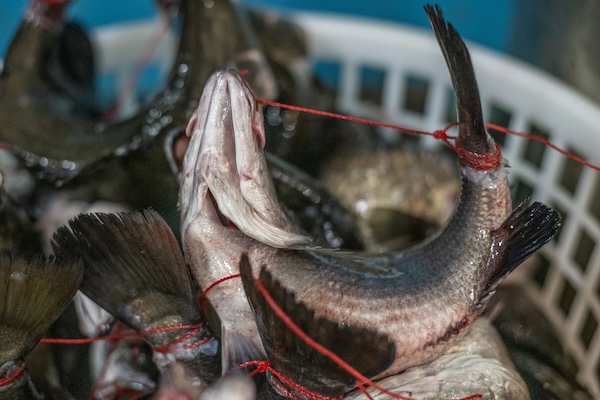
Taiwan’s Ministry of Agriculture has announced measures to phase out the practice of binding live fish for display and sale, including restrictions at wholesale fish markets and increased inspections.
The measures address a practice known as fish arching (or Gong-yu), in which a nylon cord is threaded through the lip of a live barramundi (Lates calcarifer) and pulled toward its tail, bending the fish into a U-shape. According to the Aquatic Animal Alliance (AAA), fish can remain bound and out of water for eight to 12 hours while displayed for sale.
The ministry has confirmed that wholesale fish markets are required to prohibit the practice and incorporate the restriction into their market management regulations, according to an October 28 statement from AAA.
Taiwan’s Fisheries Agency has also committed to issuing a directive to all 13 wholesale markets that trade barramundi, outlining the government’s policy of phasing out fish binding.

“Taiwan’s commitments are an important step toward strengthening the enforcement of existing animal protection legislation and advancing meaningful protections for fish,” said Catalina Lopez, director of the Aquatic Animal Alliance. “Ending harmful handling practices in live animal markets must be a global priority, with clear prohibitions and effective enforcement to ensure that fish welfare is protected in practice.”
The measures include coordination between the Fisheries Agency, the Ministry of Economic Affairs and local governments to address the practice across wholesale and retail markets. Local authorities have been asked to conduct on-site inspections, while government agencies plan to continue engaging with market operators and other stakeholders.
However, the ministry has not established a categorical prohibition on fish binding under Taiwan’s Animal Protection Act. Potential violations will continue to be assessed individually, while the announced measures focus on wholesale market restrictions and discouraging the practice in other markets.
The commitments follow a campaign by Environment and Animal Society of Taiwan (EAST) and a recent letter to the Office of the President from 179 Aquatic Animal Alliance member organizations, working in partnership with EAST and the Aquatic Life Institute.
California bans octopus farming and sales, citing animal welfare concerns
“For more than six years, EAST has documented the practice, engaged agencies and supported awareness campaigns alongside the Fisheries Agency,” said Wu Hung, chief executive of EAST. “These commitments mean that the practice of binding (fish arching) itself is no longer considered a necessity of handling, but instead literally an act of animal cruelty.”
EAST estimates that approximately three million barramundi are subjected to fish binding annually in Taiwan. According to the release, research funded by Taiwan’s Fisheries Agency found that all tightly bound fish in the study died within six hours, with more than half dying within three hours. The research also found elevated cortisol and blood lactate levels, which the release linked to severe acute stress.
The release further states that these physiological responses can accelerate meat deterioration and increase the risk of bacterial contamination.
“Binding live fish for display and sale raises serious animal welfare concerns, as it forces fish into an unnatural body position, restricts movement and causes severe physical injury and physiological stress,” Lopez said. “This practice must end.”
The release did not provide a timeline for completing the phaseout or figures on how many markets have implemented the restrictions. EAST said it would continue working to ensure the measures are implemented locally.
Now that you've reached the end of the article ...
… please consider supporting GSA’s mission to advance responsible seafood practices through education, advocacy and third-party assurances. The Advocate aims to document the evolution of responsible seafood practices and share the expansive knowledge of our vast network of contributors.
By becoming a Global Seafood Alliance member, you’re ensuring that all of the pre-competitive work we do through member benefits, resources and events can continue. Individual membership costs just $50 a year.
Not a GSA member? Join us.
Author

Related Posts
Health & Welfare
Mexican senator proposes nationwide ban on octopus farming over animal welfare concerns
Bill would prohibit breeding or growth stages of any cephalopod species in the country, following legislation introduced in Chile in 2025.
Fisheries
Report spotlights emerging technologies to improve animal welfare in capture fisheries
An ALI report outlines emerging technologies and practices to improve animal welfare in fisheries, including AI monitoring.

Health & Welfare
Lidl GB bans eyestalk ablation for farmed prawns, joining nine other U.K. retailers
Lidl GB bans eyestalk ablation in farmed prawns and plans electrical stunning to advance animal welfare standards in U.K. shrimp supply chains.
Health & Welfare
Study calls for animal welfare improvements in global aquaculture
New study measures fish suffering during slaughter, offering data-driven, cost-effective solutions to improve animal welfare globally.