


Can removing carbon from seawater cut ocean acidification risk for shellfish farms?

Researchers test a chemical-free system to remove CO2 from seawater, helping reduce ocean acidification and support shellfish aquaculture
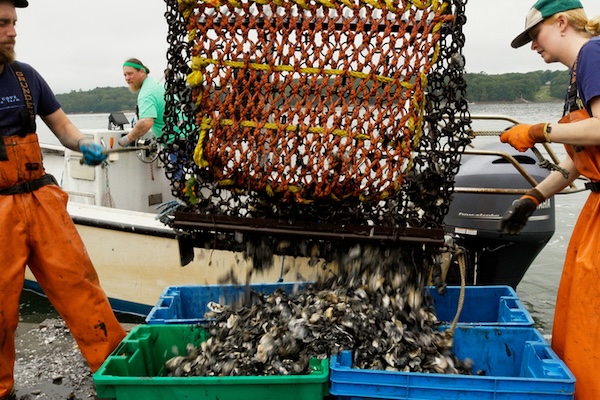
A research collaboration between the Massachusetts Institute of Technology (MIT) and the University of Maine is testing a new approach to remove carbon dioxide from seawater to reduce ocean acidity and support shellfish aquaculture.
Oceans absorb roughly 25 to 30 percent of global carbon dioxide emissions. As CO2 dissolves in seawater, it forms carbonic acid, lowering pH and reducing the availability of carbonate ions that shellfish need to build shells.
“As the oceans absorb more CO2, the chemistry shifts – increasing bicarbonate while reducing carbonate ion availability – which means shellfish have less carbonate to form shells,” said Kripa Varanasi, professor of mechanical engineering at MIT. “These changes can propagate through marine ecosystems, affecting organism health and, over time, broader food webs.”
The project uses an electrochemical process to remove dissolved carbon dioxide and return water to a more alkaline state, without adding chemicals. Researchers are working with the University of Maine’s Darling Marine Center to test the system in hatcheries.
![Ad for [BSP]](https://www.globalseafood.org/wp-content/uploads/2025/07/BSP_B2B_2025_1050x125.jpg)
Early-stage shellfish are particularly vulnerable to these changes.
“One might think, ‘this [depletion] could happen in 100 years or something,’ but what we’re finding is that they are already affecting hatcheries and coastal systems today,” Varanasi said. “Without intervention, these trends could significantly alter marine ecosystems and the coastal economies that rely on them over time.”
At Mook Sea Farm in Maine, hatchery losses have already been linked to low pH in incoming seawater.
“The way we farm oysters, we spawn them in special tanks and rear them through about a two-week larval period…until they’re big enough so that they can be transferred out into the river as the water warms up,” said founder Bill Mook, adding that around 2009, he began to see major losses in early-stage larvae. “It was a catastrophe. We lost several hundred thousand dollars’ worth of production.”
While farms often add buffering agents such as sodium bicarbonate, the new system avoids chemical inputs.
“A lot of researchers are studying direct air capture, but very few are working in the ocean-capture space,” said T. Alan Hatton, professor of chemical engineering at MIT. “Our approach is to use electricity, in an electrochemical manner, rather than add chemicals to manipulate the solution pH.”
The system uses electrodes to release and recover protons, converting dissolved carbon into carbon dioxide gas that can be removed, while returning treated water to the ocean in a less acidic state. The process produces no waste products, according to the researchers.
Initial trials showed the approach is compatible with oyster larvae and may improve outcomes compared with traditional buffering methods.
“The scientific underpinning of our hypothesis was that these bivalve shellfish, including oysters, need calcium carbonate in order to form their shells,” said Simon Rufer. “By alkalizing the water, we actually make it easier for the oysters to form and maintain their shells.”
The work is being tested in Maine’s Damariscotta River Estuary, which produces about 70 percent of the state’s oysters. Researchers say the site offers an opportunity to evaluate how engineering solutions perform in working aquaculture systems.
Damian Brady, a professor of oceanography at the University of Maine, said the region’s shellfish industry is closely tied to local communities. The Damariscotta area has “grown into an oyster-producing powerhouse … [that is] not only part of the economy, but part of the culture,” he said. “There’s actually a huge amount that we could learn if we couple the engineering at MIT with the aquaculture science here at the University of Maine.”
Ocean acidification isn’t just a carbon story – it’s also about nitrogen
Researchers say the project could also contribute to broader efforts to remove carbon dioxide from marine environments.
“It pushes a new technology for removing carbon dioxide from ocean environments forward simultaneously,” Brady said. “If they can be coupled, aquaculture and carbon dioxide removal improve each other’s bottom line.”
The team is now working to improve the durability of the system and scale the technology.
“It’s also about jobs,” said Varanasi. “It’s about supporting the local economy and coastal communities that rely on aquaculture for their livelihood. We could usher in a whole new resilient blue economy. We think that this is only the beginning. What we have developed can really be scaled.”
Mook said the collaboration highlights the importance of applied research.
“It means that we benefit hugely from being connected and plugged into academic institutions that are doing research very relevant to our livelihoods,” said Mook. “Without science, we don’t have a prayer of continuing this industry.”
Now that you've reached the end of the article ...
… please consider supporting GSA’s mission to advance responsible seafood practices through education, advocacy and third-party assurances. The Advocate aims to document the evolution of responsible seafood practices and share the expansive knowledge of our vast network of contributors.
By becoming a Global Seafood Alliance member, you’re ensuring that all of the pre-competitive work we do through member benefits, resources and events can continue. Individual membership costs just $50 a year.
Not a GSA member? Join us.
Author

Related Posts
Fisheries
Climate vulnerability and uncertainty due to monitoring data gaps, using a case study of ocean acidification and deoxygenation in coastal California
Findings provide an actionable framework to prioritize targeted enhancements and sustained funding of oceanographic monitoring recommendations.
Responsibility
Study: Ocean acidification research is robust despite ebbs and flows
A study of almost 25 years of ocean acidification research concludes that experts in the field can have confidence in their research.
Intelligence
Can seagrass and mangrove restoration help mitigate ocean acidification and climate change?
Researchers suggest seagrass and mangrove restoration could also remove carbon through a novel pathway while combating ocean acidification.
Responsibility
Study: Ocean acidification and ocean warming hinder juvenile Atlantic sea scallop growth
Researchers find that ocean acidification conditions projected between now and 2100 would hinder the growth of juvenile Atlantic sea scallops.