


Rubbish to revenue: How scientists are upcycling seafood waste into biofuel and roads

From algae and oyster shells to abandoned fishing nets, research shows how seafood waste can be upcycled into fuel and infrastructure
The seafood industry has a waste problem – one that could quickly become a wasted opportunity if it goes untapped.
As global pressure mounts to reduce waste and build more sustainable food systems, attention is increasingly turning to what has often been overlooked: the vast volumes of byproducts and debris generated by the seafood sector.
According to the Food and Agriculture Organization of the United Nations (FAO), roughly 35 percent of global fish and seafood production is lost or wasted across the supply chain. In capture fisheries and aquaculture alike, significant portions of each harvest – from shells and trimmings to processing residues – are often discarded or underutilized.
At the same time, millions of tons of marine debris, including discarded fishing gear, continue to accumulate in oceans and coastal environments. Recent studies indicate ghost fishing gear makes up to 70 percent of all macroplastics in the ocean by weight.
![Ad for [membership]](https://www.globalseafood.org/wp-content/uploads/2025/07/membership_web2025_1050x125.gif)
For decades, much of this material has been treated as an unavoidable cost – something to dispose of, not develop. But that assumption is starting to shift.
Across labs, coastlines and processing plants, researchers and industry leaders are beginning to ask a different question: What if waste isn’t the end of the value chain, but the beginning of another one?
From Louisiana bayous to Hawaiian roadways, new research is showing how materials once written off — algae blooms, oyster shells, abandoned fishing nets — could be turned into fuels, infrastructure materials and industrial inputs. The implication is clear: The industry may be throwing away more value than it realizes.
Turning bayou waste into biodiesel
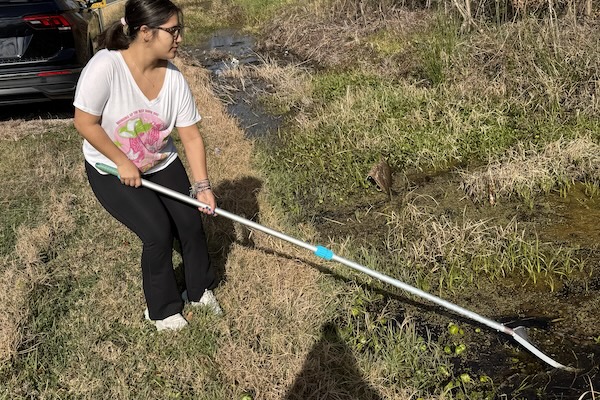
In Louisiana, the answer may lie in a ditch. Researchers at Nicholls State University have developed a low-cost method for producing biodiesel using two local materials that are abundant, overlooked, and until now, largely unwanted: algae and oyster shells.
Biodiesel is widely used as a renewable alternative to petroleum fuels, but its production often relies on crops such as soy and rapeseed, which require swaths of land and can compete with food production. Costs are also driven up by expensive catalysts used in the conversion process.
Seeking more sustainable and affordable approaches, the researchers looked closer to home for solutions.
“As a chemist, I sat down and started thinking about projects I could do with my students,” said Bello Makama, lead researcher and assistant professor at Nicholls State University. “Looking at southern Louisiana, where you have an abundance of algae growing in the ditches and the bayou, we wondered what if we could take something that poses an environmental and logistical issue and add value to it?”
The process they developed is straightforward in concept, if not execution. Algae collected from local waterways are crushed to extract oil, which is then combined with methanol and a catalyst under heat to produce biodiesel and glycerin. Instead of relying on expensive commercial catalysts, the team turned to another local waste stream: oyster shells.
By heating and processing the shells, they convert calcium carbonate into calcium oxide — creating a viable, low-cost catalyst. Makama’s initial cost modeling suggests the approach could reduce catalyst costs by 70 to 85 percent. But economics is only part of the equation.
“One of my colleagues at Louisiana State University told me that energy balance is one of the things killing biodiesel,” said Makama. “You put in more money than you get out.”
The team is now working with an industry partner to test the fuel’s performance under real-world conditions, including cold-weather use and flammability – key hurdles for any alternative fuel.
“Where we live, we have all these renewable resources that are not being taken advantage of,” said Samia Elashry, an undergraduate researcher in Makama’s lab. “Going out into the field, collecting the algae and seeing the algae become biodiesel showed me how we need to work more towards bettering our environment and creating more sustainable resources.”
The model, Makama argues, is not unique to Louisiana.
“Algae grow in almost every corner of the globe,” he said. “It has a high lipid content, and it does not compete with arable lands.”
Seafood’s best friend: Once wasted fish byproducts are now a bounty for cats and dogs
Recycling plastics into roads
Thousands of miles away, a different kind of waste problem is playing out.
Hawaii is awash in plastic — much of it imported, much of it difficult to recycle and a significant portion of it drifting in from the Pacific in the form of abandoned fishing gear.
Rather than trying to remove the problem entirely, researchers are asking a more pragmatic question: Can it be built into something useful?
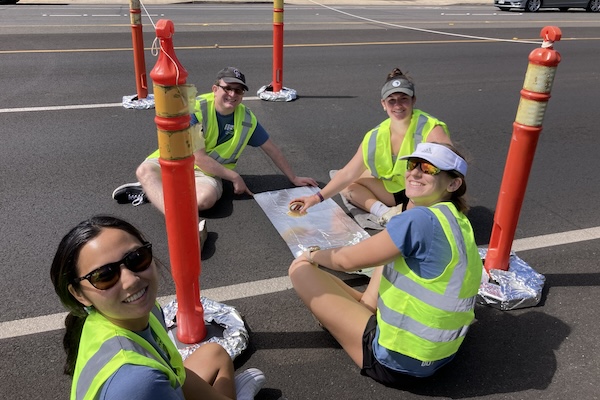
At Hawaiʻi Pacific University, scientists working with the Hawaii Department of Transportation (HDOT) are testing whether discarded plastics – including derelict fishing nets – can be incorporated into asphalt for road construction.
“This work investigates whether it’s responsible to use recycled plastics in Hawaii’s roads,” said Jeremy Axworthy, a researcher at the Center for Marine Debris Research (CMDR) at Hawaiʻi Pacific University. “By reusing plastic waste that is already in Hawaii, we can reduce the environmental and economic impacts of transporting waste plastics from the islands, incinerating it or dumping it in Hawaii’s overflowing landfills.”
The idea builds on a material already in widespread use. Since 2020, Hawaii has relied heavily on polymer-modified asphalt, which incorporates synthetic polymers to improve durability in a hot, humid climate. The question is whether those polymers can be replaced – or supplemented – with recycled plastics.
To test that, researchers worked with state agencies and industry partners to produce experimental road sections on Oahu using three different mixes: conventional polymer-modified asphalt, asphalt containing recycled household plastics and asphalt incorporating polyethylene from fishing nets.
At the same time, they were asked to answer a more complicated question: Would embedding plastic in roads simply create a new source of microplastic pollution?
“Foreign plastic derelict fishing gear is the largest contributor to Hawaii’s marine debris problem,” said Jennifer Lynch, CMDR director and team lead. “To date, CMDR’s Bounty Project, which pays a financial reward to licensed commercial fishers for marine debris removal, has removed 84 tons of large, derelict fishing gear from the Pacific Ocean.”
After the waste materials were processed into a form suitable for asphalt production, test sections of road were laid on Oahu using three different formulations: standard polymer-modified asphalt, asphalt containing recycled polyethylene from municipal waste and asphalt incorporating polyethylene from fishing nets.
Following approximately 11 months of regular traffic use, researchers collected road dust samples from each section to analyze potential microplastic shedding.
“CMDR’s laboratory is equipped with state-of-the-art chemical instrumentation for quantifying and characterizing microplastics in environmental samples,” explains Lynch. “This capability is incredibly unique and impactful, especially when coupled to our marine debris-removal project and our mission to recycle the debris into long-term, locally necessary infrastructure products.”
Using pyrolysis gas chromatography – mass spectrometry, researchers were able to identify the origin of particles found in the dust — separating signals from asphalt polymers, recycled plastics and tire wear.
What they uncovered was a plot twist.
“In our initial Py-GC-MS data, we saw tire wear swamps the signal of polyethylene by orders of magnitude, like gigantic peaks!” said Lynch. “We had to search the weeds of the chromatogram to find signs of polyethylene.”
In other words, while microplastic-sized particles were present, recycled plastics in the asphalt were not a dominant source. Tire wear — already an unavoidable feature of road transport — appeared to contribute far more.
Additional testing is still needed, particularly on long-term durability. But early results suggest that repurposing plastic into roads may not carry the environmental trade-offs some critics fear.
“Some people think plastic recycling is a hoax – that it doesn’t work; it’s too challenging,” Lynch shares. “But this work demonstrates that recycling can work when society prioritizes sustainability.”
Now that you've reached the end of the article ...
… please consider supporting GSA’s mission to advance responsible seafood practices through education, advocacy and third-party assurances. The Advocate aims to document the evolution of responsible seafood practices and share the expansive knowledge of our vast network of contributors.
By becoming a Global Seafood Alliance member, you’re ensuring that all of the pre-competitive work we do through member benefits, resources and events can continue. Individual membership costs just $50 a year.
Not a GSA member? Join us.
Author
-

Lisa Jackson is senior editor at the Responsible Seafood Advocate. She lives in Hamilton, Canada.
Related Posts
Responsibility
No more landfills: Great Lakes region commits to full utilization of fish byproducts
Most Great Lakes commercial fish waste is no longer landfilled, as companies commit to full utilization and new markets for byproducts.
Aquafeeds
For many island fish farmers, aquafeed sourcing and costs requires new thinking
New approaches could enable aquafeeds made from local ingredients to reduce reliance on feed imports and support aquaculture.
Intelligence
Brazilian researchers develop biodegradable food packaging film from fish skin
Brazilian scientists create biodegradable food packaging film from tambatinga fish skin as a potential alternative to plastics.

Intelligence
Industry guide reveals how full utilization can unlock value of shrimp byproducts
A new report explores how the global shrimp industry can eliminate waste by transforming processing byproducts into valuable products.