
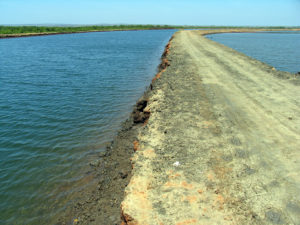
Settling basin design, operation
To design a settling basin, know the size distribution of particles, estimated rate of inflow and determination of the smallest particle size to be removed.
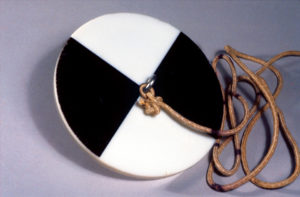
Multiple methods for phytoplankton assessment
The simplest tool for assessing phytoplankton abundance in aquaculture ponds is the Secchi disk. An electronic turbidimeter can be used to measure the amount of light scattered by a water sample.
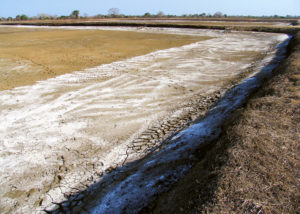
Liming materials for aquaculture
Liming materials neutralize acidity and increase pH in pond bottom soil and water. They also react with carbon dioxide to form bicarbonate and release calcium and magnesium, increasing both alkalinity and hardness concentrations in water.
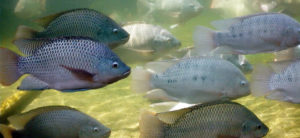
Dissolved oxygen requirements in aquatic animal respiration
Although carbon dioxide is not highly toxic, high levels in the blood have many negative physiological consequences. As carbon dioxide increases, higher dissolved oxygen tension is necessary to load hemoglobin with oxygen.
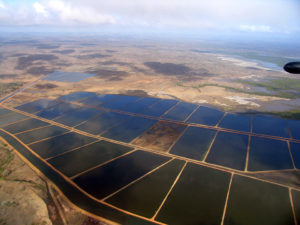
Aquaculture ponds hold carbon
Although 16.6 million metric tons of carbon are annually buried in aquaculture ponds, estimated carbon emissions for culture species have approached several metric tons of carbon per metric ton of aquaculture product.
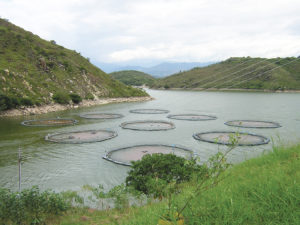
Cage design, placement affect water quality
Farm cages should be sited where water quality is good and water velocity is adequate. The size, shape and position of cages should be selected to favor rapid flushing.
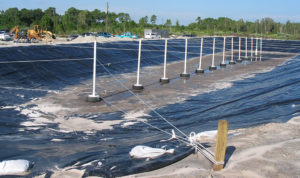
Assessing, reducing pond seepage
Ponds constructed on sandy or permeable soils are most likely to have high seepage rates. Ponds built in any soil can seep if improperlty constructed.
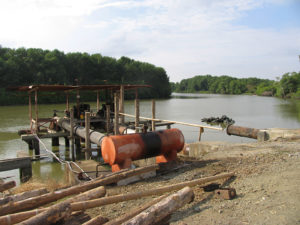
Trace metals toxic at high concentrations
Excessive concentrations of trace metals, especially copper, are toxic to phytoplankton and other aquatic plants. The ionic forms of trace metals are toxic to fish and other aquatic animals, but soluble, chelated trace metals are relatively non-toxic.
Oxygen demand of aquaculture feed
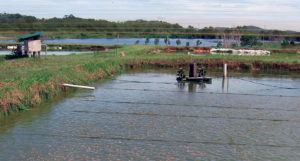
The oxygen demand of feed represents the dissolved oxygen removed by the respiration of culture animals, microbial decomposition of uneaten feed and feces, and oxidation of ammonia nitrogen by nitrifying bacteria.
Water temperature in aquaculture
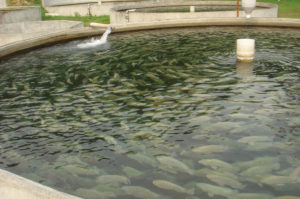
In general, water temperature cannot be controlled, so aquaculture operations must be timed to correspond to temperature. Measurements are critical for efficient operations.
Temperatura del agua en acuacultura
En general, la temperatura del agua no se puede controlar, por lo que las operaciones acuícolas deben programarse para que correspondan a la temperatura. Las mediciones son críticas para operaciones eficientes.
Nitrogen a limiting factor in aquaculture production
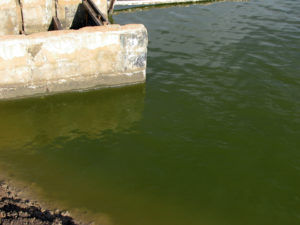
Improved feeds and feeding practices increase the proportion of nitrogen recovered in fish and shrimp and lessen the amount of ammonia excreted by the culture animals.
Carbon dioxide: Waste, nutrient
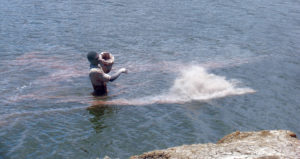
Carbon dioxide is both a nutrient and a waste product in aquaculture. Some pond managers feel that application of organic matter to provide additional carbon dioxide can reduce pH and control blue-green algae.
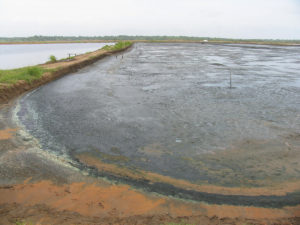
Shrimp pond preparation crucial for production, disease prevention
Preventing diseases is a major concern in shrimp farming. Pond preparation focuses on avoiding the carryover of disease organisms from one crop to the next.
La preparación del estanque de camarones es crucial para la producción y prevención de enfermedades
La prevención de enfermedades es una preocupación importante en el cultivo de camarón. La preparación de estanques se enfoca en evitar el arrastre de organismos de enfermedades de un ciclo de cultivo al próximo.
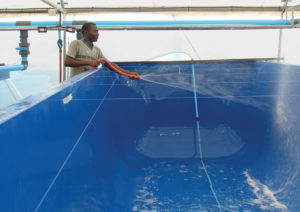
Chlorine an effective disinfectant in aquaculture
Ponds should be fertilized a few days after chlorine application to encourage the regrowth of natural food organisms before introducing postlarvae.
Total alkalinity and total hardness
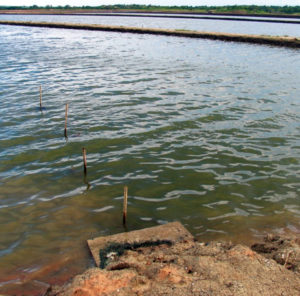
Alkalinity is an index of the capacity of water to neutralize acidity. Hardness represents the sum of calcium and magnesium concentrations. Both values vary greatly in freshwater sources.
Nitrification an important process in aquaculture
In the water of aquaculture systems, certain bacteria transform potentially toxic ammonia to nontoxic nitrate through nitrification.