


Overlooked sea lice structure may hold clues to how parasites infect salmon

Studying how the rostral spike helps sea lice infect salmon could lead to new ways to disrupt attachment and control the parasite
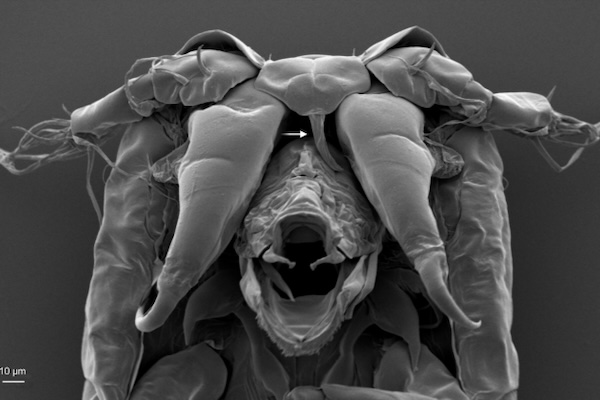
A Nofima researcher is investigating whether a little-studied structure on salmon lice helps the parasites detect and attach to salmon, potentially offering a new target for sea lice control.
The structure, called the rostral spike, is a small projection at the front of the salmon louse during its copepodid stage, when the parasite is free-swimming and searching for a host. Although the structure was briefly described as a “filament duct” in a 1991 scientific paper, its potential role in host detection and attachment has received little attention.
In a recent study published in Parasitologia, Nofima fish health researcher Amritha Johny examined the structure using microscopy and electron microscopy. She observed the rostral spike in every salmon louse she examined and found that it appeared to be highly active as the lice sensed, probed and penetrated salmon skin.
“The fact that it moved made me curious, and I wanted to find out what it was,” said Johny.

Johny studied wild salmon lice collected from farmed salmon as well as laboratory strains. Egg strings were hatched and developed into copepodids at Nofima’s laboratory in Ås before samples underwent further analysis using electron microscopy at the Norwegian University of Life Sciences Imaging Centre.
Microscopy showed that the rostral spike is flexible and moves in coordination with the rest of the louse’s body. It can also extend from or retract into the body shell, and researchers observed a pore-like opening near the point where the spike attaches to the body.
The observations have prompted researchers to investigate whether the structure plays a role in how salmon lice detect and attach to their hosts, although its precise function has not yet been established.
“If the salmon louse’s ability to detect and infect a host depends on specialized structures such as this rostral spike, it may be possible to disrupt the process before the louse has time to attach to its host,” said Johny.
Johny said further research is needed to determine exactly how the rostral spike functions and whether it could ultimately be targeted as part of new salmon lice control measures.
“There are many ‘mysteries’ to solve about how salmon lice find and interact with their host,” said Nick Robinson, a senior researcher at Nofima who leads CrispResist, an international research project investigating the mechanisms underlying differences in sea lice resistance among fish species. “Amritha Johny draws attention to an appendage on the lice that could play an important role.”
Now that you've reached the end of the article ...
… please consider supporting GSA’s mission to advance responsible seafood practices through education, advocacy and third-party assurances. The Advocate aims to document the evolution of responsible seafood practices and share the expansive knowledge of our vast network of contributors.
By becoming a Global Seafood Alliance member, you’re ensuring that all of the pre-competitive work we do through member benefits, resources and events can continue. Individual membership costs just $50 a year.
Not a GSA member? Join us.
Author

Related Posts
Health & Welfare
German biotech company targets sea lice via aquafeed treatment
German biotech AquaNab is developing a treatment delivered through aquaculture feed to help salmon farmers control sea lice.
Health & Welfare
Study: AI model identifies salmon lice larvae faster and more accurately than biologists
An AI model identified 97.5 percent of salmon lice larvae in seawater samples, outperforming biologists in both speed and accuracy.

Innovation & Investment
Mind the gap: Smart cameras are pushing aquaculture performance into a new phase
Norway’s salmon sector is rapidly adopting smart cameras and the performance gap between farms with and without these systems is becoming harder to ignore.
Health & Welfare
Are salmon lice most vulnerable in their earliest stage?
New research finds larval salmon lice produce unique proteins that may help them evade immune defenses, offering new targets for parasite control.