


Artificial intelligence system counts fish in real time for aquaculture farms

Researchers in Australia develop artificial intelligence system that accurately counts fish in real time, helping farmers monitor stock and feeding
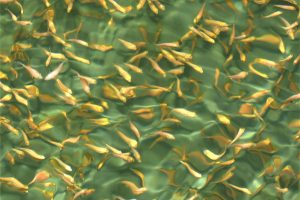
Researchers at Australian Catholic University (ACU) have developed an artificial intelligence (AI) system that can count fish in real time, a technology they say could help aquaculture producers monitor stock more efficiently while reducing labor and improving fish welfare.
The system uses artificial intelligence to count fish in real time while maintaining high accuracy in challenging conditions, including murky water and changing light levels.
The researchers evaluated two object-detection models, YOLO11 and YOLOv8, using 6,500 images collected from aquaculture operations. Both models achieved a mean average precision of more than 0.99, demonstrating a high level of detection accuracy.
To improve performance, the team exported the selected model to the ONNX format, increasing processing speed by 25 percent while maintaining nearly the same level of accuracy. According to the researchers, the improvement allows the system to run on low-cost edge computing devices commonly used on fish farms.
![Ad for [BSP]](https://www.globalseafood.org/wp-content/uploads/2025/07/BSP_B2B_2025_1050x125.jpg)
Field trials conducted in commercial tanks showed the AI system could reliably count fish and generate early alerts, providing farmers with continuous monitoring of stock levels and feeding behavior.
“Aquaculture is expanding rapidly, and farmers need affordable, automated monitoring tools to reduce labour, improve welfare, and prevent losses,” said Niusha Shafiabady, professor at ACU, in a press release. “This system is designed for real-world use, not just lab performance.”
The researchers said automating fish counting could help reduce stock losses, improve feeding efficiency and provide farmers with continuous information about fish populations without relying on manual counts.
“For communities that rely on farmed fish as a primary source of protein, this means more reliable harvests and lower production costs,” said Shafiabady. “For farmers, it reduces labour demands and stress by replacing manual counting with a system that works continuously. At scale, tools like this help stabilise food supply chains, protect livelihoods, and make high-quality protein more accessible during a time of rising global demand.”
Now that you've reached the end of the article ...
… please consider supporting GSA’s mission to advance responsible seafood practices through education, advocacy and third-party assurances. The Advocate aims to document the evolution of responsible seafood practices and share the expansive knowledge of our vast network of contributors.
By becoming a Global Seafood Alliance member, you’re ensuring that all of the pre-competitive work we do through member benefits, resources and events can continue. Individual membership costs just $50 a year.
Not a GSA member? Join us.
Author

Related Posts
Health & Welfare
Study: AI model identifies salmon lice larvae faster and more accurately than biologists
An AI model identified 97.5 percent of salmon lice larvae in seawater samples, outperforming biologists in both speed and accuracy.

Intelligence
Can AI tool from NASA track harmful algal blooms from space?
A NASA-developed artificial intelligence tool uses satellite data to detect harmful algal blooms in U.S. coastal waters.
Innovation & Investment
Project uses AI-powered cameras to improve fish growth tracking and feeding strategies
Two-company collaboration has AI-powered cameras tracking fish growth to enhance feeding efficiency, breeding and fish health in aquaculture.

Intelligence
Irish oyster farmer develops AI system to detect oyster mortalities by sound
An AI system developed in Ireland uses sound to detect oyster mortalities, aiming to reduce losses faced in the oyster aquaculture industry.