


Hand, timer or sound: What 17 seasons of pond records say about feeding shrimp

Sonic feeders improved shrimp survival to 84 percent, increased average size to 29 grams, and raised yields up to 6,600 kg per hectare versus hand feeding
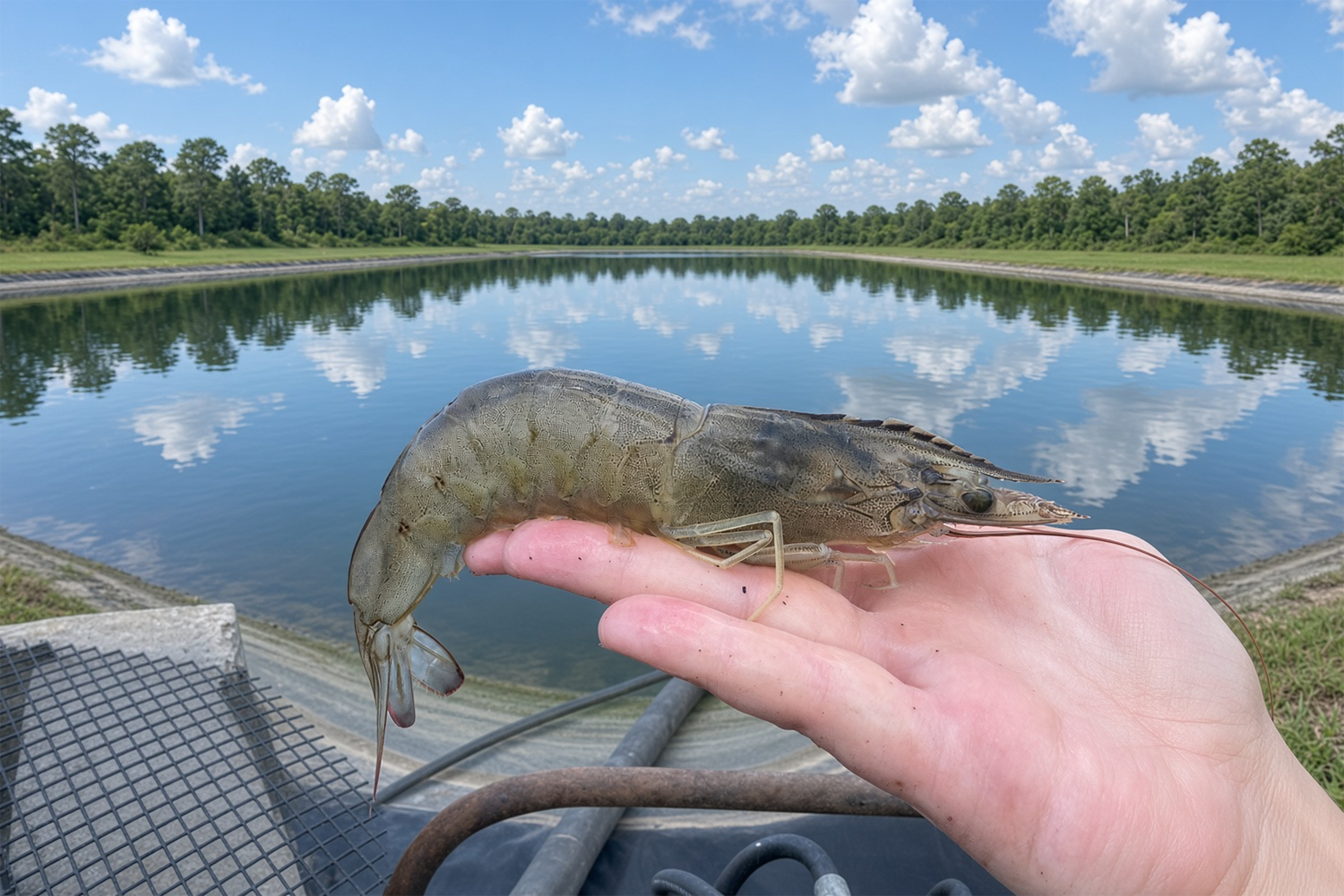
There’s ongoing debate about how far a shrimp farm should push its feeding technology – traditional hand feeding, timer-based systems and acoustic feeders that respond to the sounds shrimp make while eating.
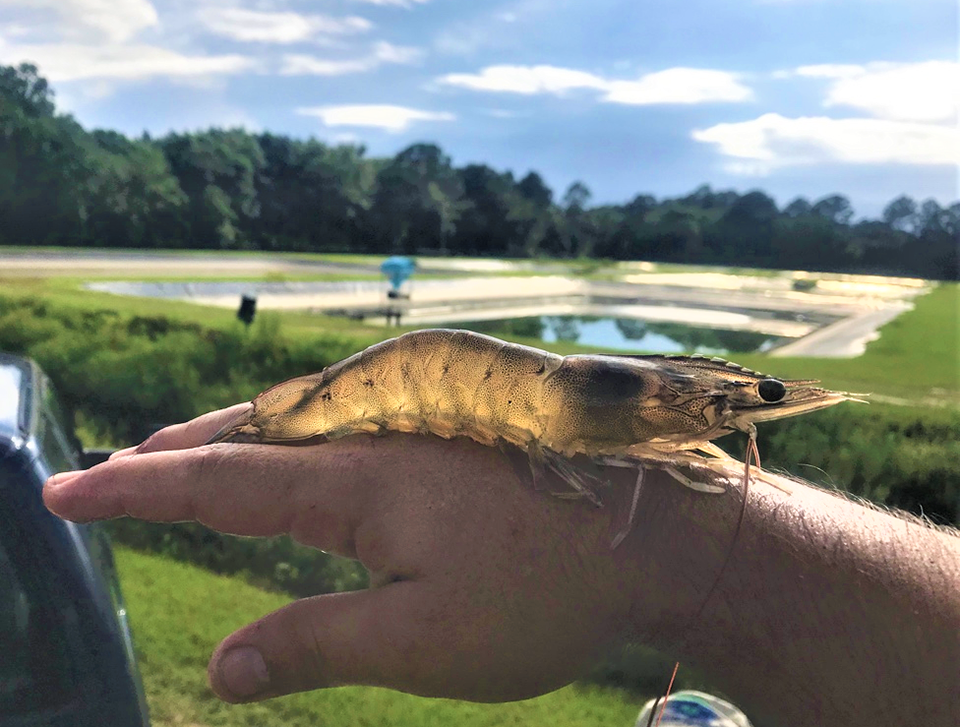
Each step adds cost and requires supporting infrastructure. We have used all three approaches to raise Pacific white shrimp (Litopenaeus vannamei) across 17 seasons from 2006 to 2024. Looking back at the pond records from the Claude Peteet Mariculture Center in Gulf Shores, Alabama, the patterns are clear.
Ponds managed with sonic (acoustic) feeders kept more of their shrimp alive (about 84 percent versus 70 percent), produced larger shrimp (29 grams versus 22 grams) and delivered higher yields (roughly 6,600 kg/ha versus 4,500 kg/ha) than hand-fed ponds. They used about 40 percent more feed but reached harvest size roughly 30 days sooner.
Feed conversion ratios were essentially the same across systems, so the extra feed went into biomass rather than waste – though the higher nutrient load does require more aeration. Timer feeders landed in between. The production gains are real, but so are the requirements: more aeration capacity, higher capital outlay and staff trained to operate and maintain the system.

This article summarizes what those 17 seasons of working records tell us about the practical differences among the three feeding methods. It is adapted from Nguyen, K.Q., M.A. Rhodes, A. Abebe, L.A. Roy, and D.A. Davis. 2026. Implementing automation and real-time feed management in shrimp farming. Proceedings of the XVI SINA 2025, November 19–22, 2025. ISBN: 978-607-27-2816-5.
Three ways to feed a pond
Feeding practices have come a long way, from farmers broadcasting feed by hand, or even from airplanes, to computer-controlled systems. At our station, hand feeding was the standard for 13 seasons; timer and sonic feeders have been in use since 2016. Each approach changes who decides how much feed goes in and when.
- Hand feeding is the cheapest system to set up and maintain. Feed is spread several times a day by hand or with a feed blower, and the next ration is adjusted based on how the previous day went – staff check feeding trays or look at gut fullness. Because every feeding needs a person, labor limits how many times the shrimp are fed and the outcome depends heavily on the skill and consistency of whoever is doing the feeding. Decisions are made after the fact, which is why we call this post-reactive management.
- Timer feeders were the first step away from that model. Programmable units spread the day’s ration over many small meals, saving labor and delivering a feeding frequency that hand methods struggle to match. Someone still has to set the total amount for the day, however, and the feeder keeps to its schedule whether or not the shrimp are eating. Management remains post-reactive. Run well, both hand and timer systems can be tuned to a farm’s budget and production goals.
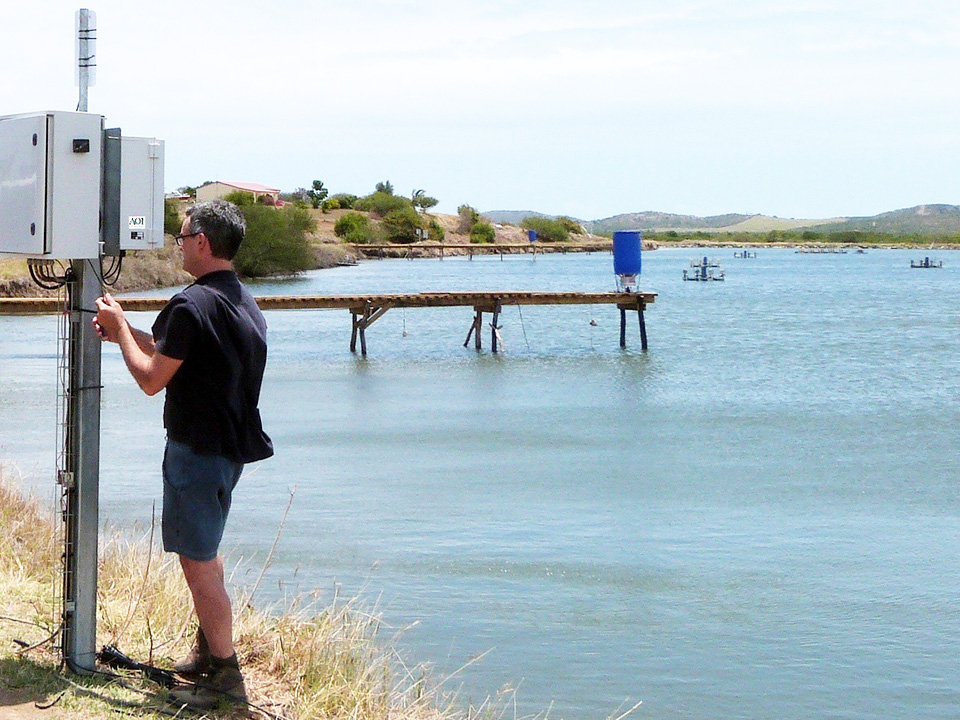
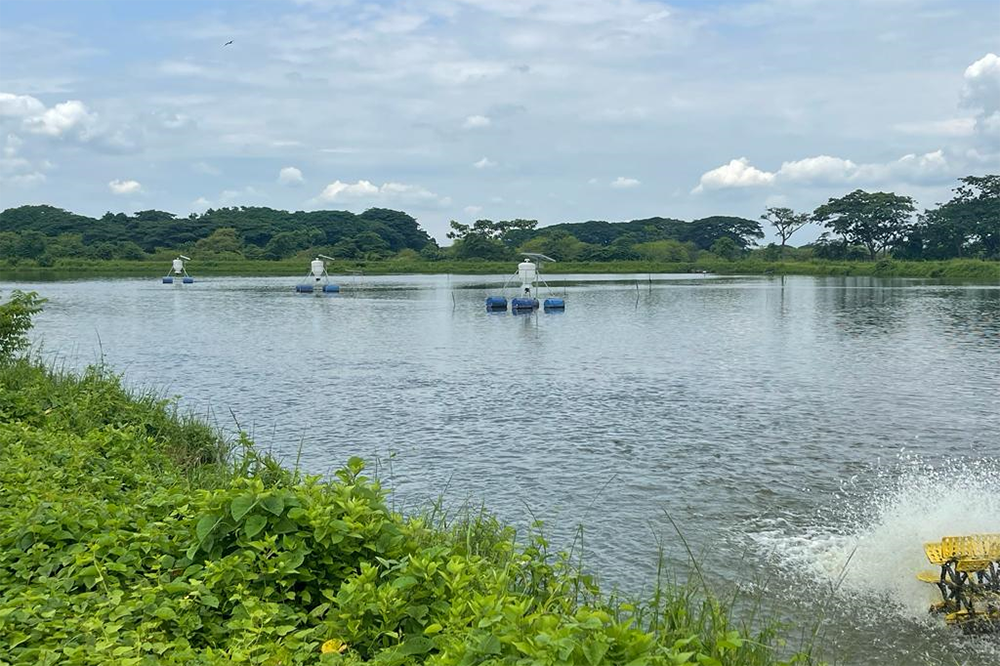
- Sonic (acoustic) feeders represent the latest step. Underwater microphones – hydrophones – pick up the clicking sound shrimp make with their mandibles as they chew. When the clicking rises, the feeder adds feed; when it falls, the feeder slows or stops. The system is typically wired to dissolved-oxygen and temperature sensors and to the aerators, so it feeds only while the pond has enough oxygen. A technician can monitor it on site or remotely and it generates a detailed data record for management. These feeders have been commercially available for less than a decade, yet they are already widely used in Latin America; adoption has been slower in Asia, where hand feeding remains preferred.
Each method is well established, yet few independent studies have compared them side by side. Our station happens to hold a long record of all three.
What we looked at
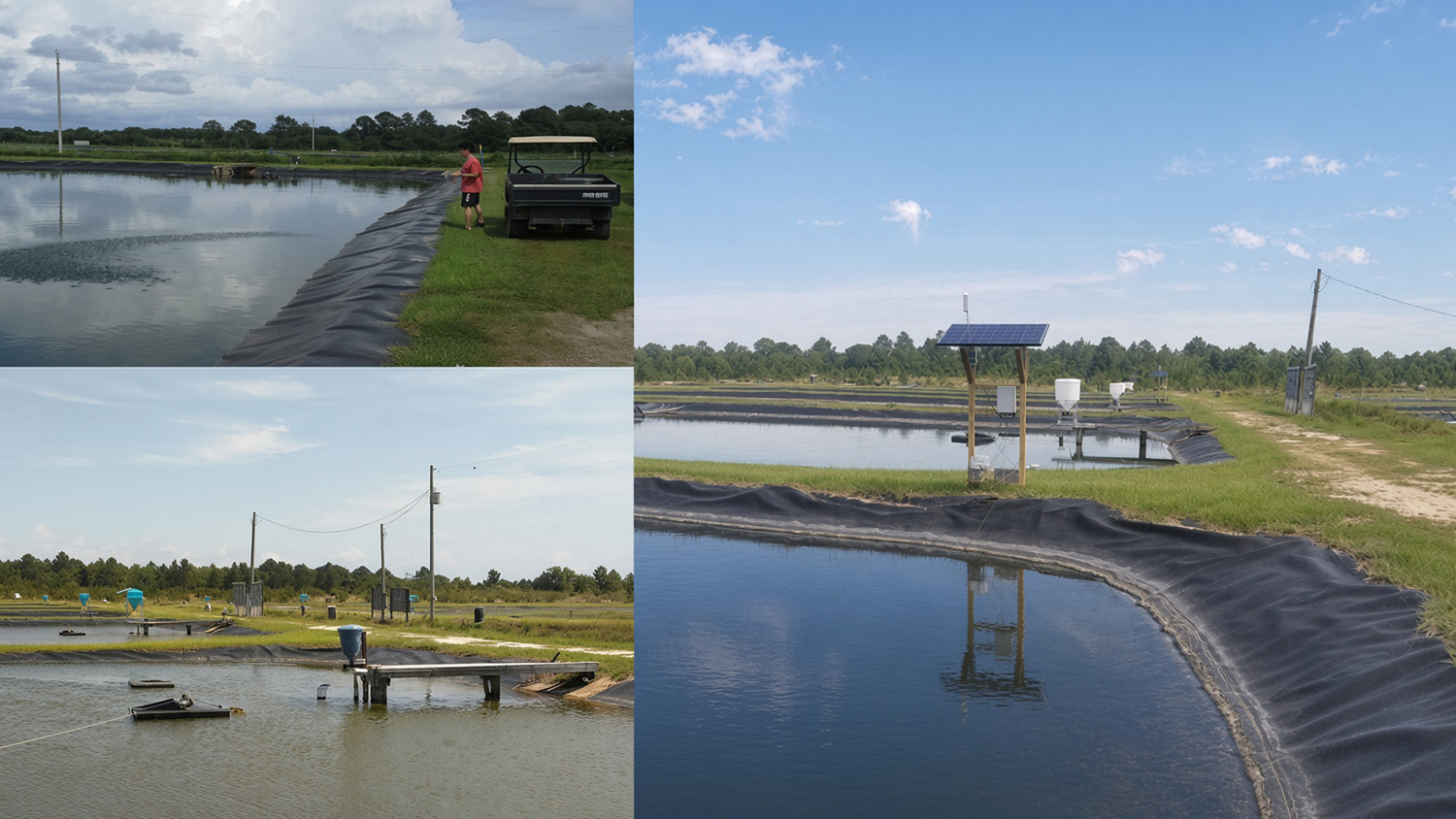
Every year from 2006 to 2024, the Claude Peteet Mariculture Center raised Pacific white shrimp in sixteen 0.1-hectare research ponds filled with filtered water from the nearby Intracoastal Waterway (salinity about 13 parts per thousand). Each week the crew cast-netted about 60 shrimp from every pond and weighed them. Ponds were hand-fed from 2006 to 2019, and timer and sonic feeders were used from 2016 to 2024. We left out 2012 and 2021, when construction and hurricanes interrupted production, and compared every pond over its first 10 weeks because sonic-fed ponds often reached harvest size sooner. That left 40 hand-fed, 9 timer-fed, and 23 sonic-fed pond crops.
These ponds were not set up as a controlled comparison of feeders. Most years they were running nutrition and feeding trials, so what follows is the record of ordinary working seasons rather than a single designed experiment.
What we found
Sonic feeding came out ahead on nearly every measure (Table 1). About 84 percent of sonic-fed shrimp survived, against about 70 percent with hand or timer feeding. They also grew bigger, reaching 29.3 grams on average against 22.3 grams with hand feeding – about 30 percent heavier. Put together, an average sonic pond produced 6,630 kg/ha of shrimp against 4,490 kg/ha for a hand-fed pond, roughly half as much again. Timer feeders sat in between, with 26.5-gram shrimp and 5,570 kg/ha and on size and harvest they could not be distinguished statistically from either of the other two. What it cost was feed: sonic ponds used about 8,050 kg/ha – roughly 40 percent more than hand- or timer-fed ponds. More feed also means a heavier nutrient load, so more aeration is required.
Nguyen, Feeders, Table 1
| Parameter | Hand | Timer | Sonic |
|---|---|---|---|
| Pond crops | 40 | 9 | 23 |
| Survival (percent) | 70.4 b | 69.9 b | 83.9 a |
| Final weight (g) | 22.3 b | 26.5 ab | 29.3 a |
| Shrimp harvested (kg/ha) | 4,490 b | 5,570 ab | 6,630 a |
| Feed used (kg/ha) | 5,676 b | 5,774 b | 8,053 a |
| Feed conversion ratio | 1.36 | 1.06 | 1.35 |
Note: Data are observational records from research ponds running primarily nutrition and feeding trials, not a purpose-designed comparison of feeder types. Yields and feed inputs are expressed per hectare for comparability.
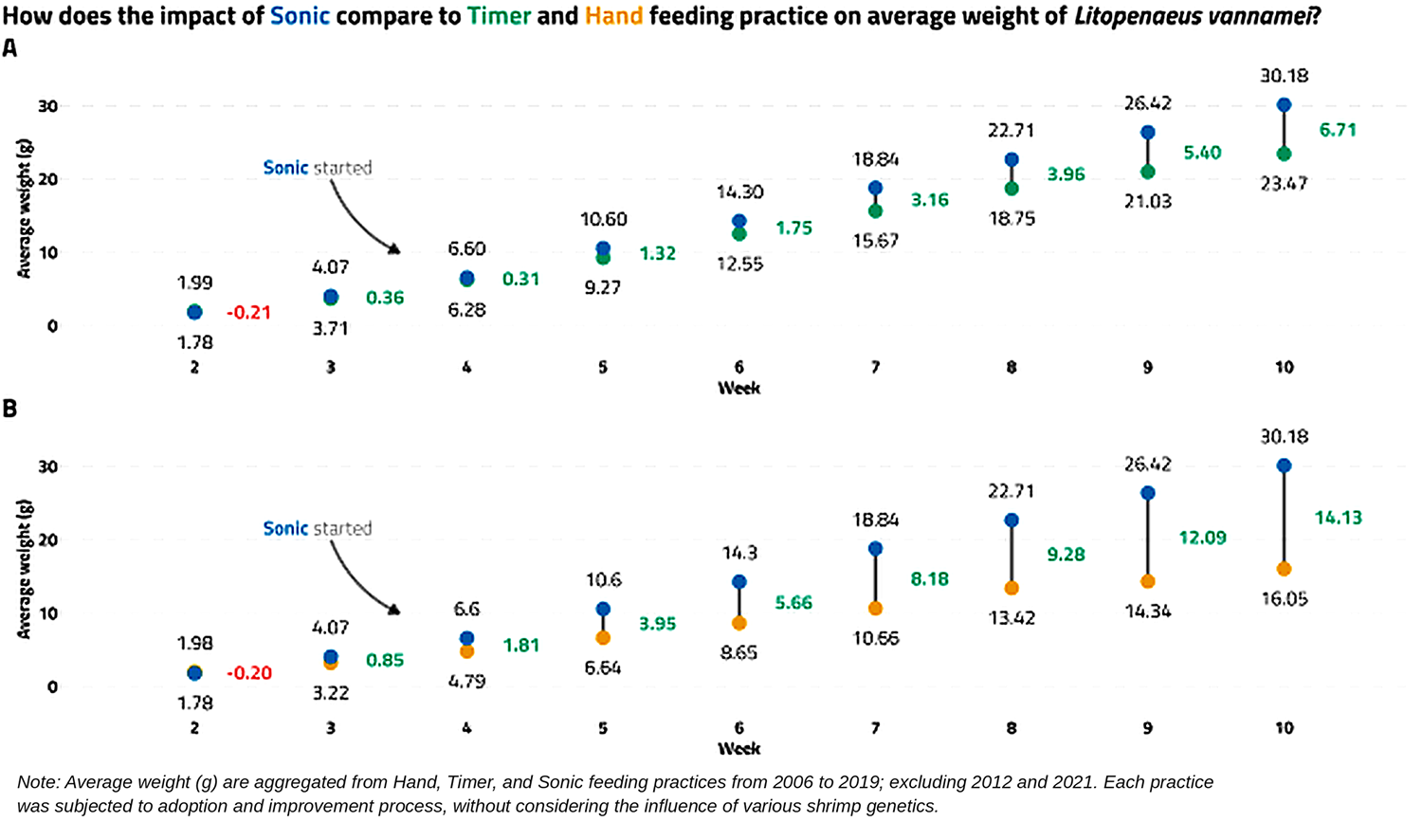
The weekly weights show where the gap opens. Shrimp grew fastest around weeks 7 and 8 in every system, whatever the feed management style. By then the difference was already large. At the midpoint of their growth curve, close to week 7, sonic-fed shrimp averaged 17.8 grams, timer-fed shrimp 14.0 grams, and hand-fed shrimp 10.1 grams, so the sonic-fed shrimp were 76 percent heavier than the hand-fed ones. At their fastest, sonic-fed shrimp put on 4.1 grams a week, timer-fed shrimp about 3 grams, and hand-fed shrimp 2.0 grams. That is more than twice the weekly gain of hand feeding. Our hand feeding was no straw man: we spent 13 seasons refining it.
The extra feed was not wasted. The feed conversion ratio (the kilograms of feed it takes to grow a kilogram of shrimp) was 1.36 with hand feeding, 1.06 with timers and 1.35 with sonic feeders, and those differences were not statistically significant (P = 0.058). The sonic-fed shrimp ate more and grew more, at about the same cost in feed per kilogram.
Little fish in a big pond: Minnowtech aims to give fresh vision to shrimp inventory
Why sonic feeding performs better
The difference comes down to when the feeding decisions are made. When we fed by hand, the next ration depended on how the last one went. Someone checked the feed trays or looked at how full the shrimp’s guts were, then adjusted the feed the following day or possibly a few days later. That always lags behind what the shrimp need right now, and a handful of trays says little about what is happening across a whole pond.
Feed trays have another catch. Shrimp pick up pellets from a tray and carry them off to nearby areas without eating them all, so the tray looks emptier than it should. Consumption is overestimated and the pond ends up overfed. Feed is more than half the cost of raising shrimp, so that waste comes straight out of the farm’s margin.
Timer feeders solve the problem of how many meals, but not of how much. They follow a set schedule that assumes the shrimp want the same amount day after day, whatever the weather, the water, or the mood of the shrimp. They can overfeed for the same reasons hand feeding does.
Sonic feeders let the shrimp set the pace. Feed goes in while they are eating and stops when they are not, and the oxygen sensors keep the system from feeding a pond that cannot take more. Because feed conversion did not suffer, the extra feed went into growth: given food when they wanted it, the shrimp came closer to their growth potential within the same 10 weeks.
What we find most telling is one result that held in every system. Weekly growth peaked around week 8 and slowed after that, across feeders, genetic lines, and years. Either the shrimp have a natural limit at that point, or something every system shares – such as the feed itself – holds them back. That is worth a closer look. In the meantime, the practical lesson is to make the most of the weeks before the peak.
The catch: oxygen, money and skills
More feed in the water means more oxygen used. The shrimp need it, and so do the algae and bacteria that process nutrients, and their demand builds toward the end of the season. As a rule of thumb, once daily feed passes roughly 30 to 40 kg per hectare, a pond needs mechanical aeration to keep oxygen from falling to stressful levels at night. A farm moving to sonic feeding has to plan its aerators along with its feeders, and its water-quality management has to change with them.
The equipment also costs more to buy. Just as important, it needs people with a different skill set – people who understand the system and can maintain it, run it, and manage the pond through it. In return, sonic-fed ponds often reached harvest size sooner in our records, and farmers who have made the switch and properly applied the technology report higher yields and better economic returns.
What this means for a shrimp farm
To be successful in shrimp farming you need good people, solid water quality, quality feed and good genetics. If you have a well-managed system, sonic feeding clearly works better, and our records agree with what farmers and other studies report.
But sonic feeding requires a major change and is a significant investment, and it pays off best on larger operations that have the capital and the technical staff to support it. For smaller farms, a well-run hand or timer program may still make more economic sense. It really depends on capital availability, labor costs, and how comfortable the farm is with the technology.
Now that you've reached the end of the article ...
… please consider supporting GSA’s mission to advance responsible seafood practices through education, advocacy and third-party assurances. The Advocate aims to document the evolution of responsible seafood practices and share the expansive knowledge of our vast network of contributors.
By becoming a Global Seafood Alliance member, you’re ensuring that all of the pre-competitive work we do through member benefits, resources and events can continue. Individual membership costs just $50 a year.
Not a GSA member? Join us.
Authors
-

Corresponding author
School of Fisheries, Aquaculture, and Aquatic Sciences, Auburn University, Auburn, AL, 36849 USA -
School of Fisheries, Aquaculture, and Aquatic Sciences, Auburn University, Auburn, AL, 36849 USA
-
Alumni Professor
School of Fisheries, Aquaculture, and Aquatic Sciences, Auburn University, Auburn, AL, 36849 USA
Related Posts

Aquafeeds
Response of Pacific white shrimp to various diets demand-fed with passive acoustic feeders
An evaluation of commercial feeds finds them adequate to achieve acceptable shrimp growth in outdoor production conditions regardless of protein source.
Innovation & Investment
Acoustic control improves feeding productivity at shrimp farms
In systems recently developed for shrimp farms, passive acoustic-based technology enables sensor-based control of multiple automatic feeders. Improved growth and feed conversion have been recorded at commercial farms using the technology.
Aquafeeds
Acoustic feedback improves automated feeding systems for shrimp
Updating Auburn University’s standard feeding protocol for shrimp into an optimized version for timer-feeders, recognizing the role of acoustic feedback.
Innovation & Investment
The artificial intelligence of things and its aquaculture applications
Artificial intelligence of things, or AIoT, is solving aquaculture challenges related to operational efficiency, sustainability and productivity.