


Why do stressed salmon make clicking sounds? Researchers still aren’t sure

Researchers detected unusual clicking sounds in stressed salmon while studying underwater noise and fish behavior in aquaculture systems
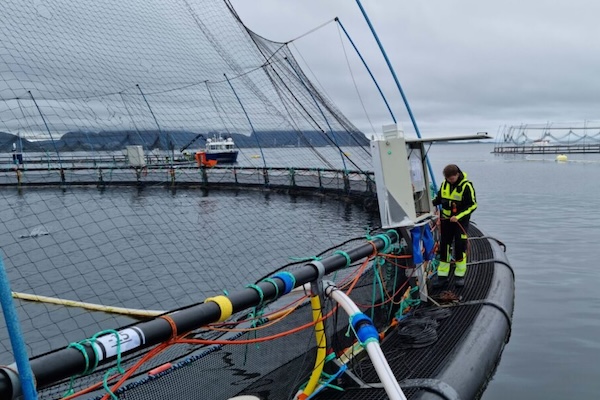
Farmed salmon produce unusual clicking sounds when exposed to stressful conditions, a SINTEF study concluded, although scientists still do not know exactly how the sounds are made.
The sounds were detected during experiments in which salmon were gradually confined to smaller spaces inside sea cages. Researchers also recorded similar clicking sounds in land-based recirculating aquaculture systems (RAS) during feeding.
“We detected a strange clicking sound when the salmon became stressed,” said Kristbjörg Edda Jónsdóttir, research scientist at SINTEF.
Researchers say salmon are generally considered a quiet species compared with fish such as cod, which use sound to communicate. The source of the clicking remains unclear.
![Ad for [BSP]](https://www.globalseafood.org/wp-content/uploads/2025/07/BSP_B2B_2025_1050x125.jpg)
“We aren’t sure what produces the sound,” said Jónsdóttir. “One theory is that the salmon opens its jaw to release air and makes a mechanical sound. Or it could be that it is trying to empty air from its intestinal system. But the more cramped things became for them, the more cases of this sound we were able to identify.”
The findings are part of a broader effort to better understand underwater sound in aquaculture, an area researchers say remains understudied.
In the sea cage trials, researchers gradually raised the bottoms of cages containing around 40 fish, reducing the amount of water available for movement. Salmon are highly active swimmers that naturally travel long distances and can become stressed in confined conditions.
The study also examined underwater noise generated during routine net cleaning operations at salmon farms. Using hydrophones positioned around sea cages, researchers monitored underwater sound levels over several months and compared periods with and without net washing activity.
“There’s so much noise. It’s incredibly loud. We were aware that it was noisy, but just how noisy hadn’t been documented,” said Jónsdóttir. “There’s been some research done that recorded the underwater acoustic soundscape for a couple of days, but this is the first time we set up long-term monitoring that lasted many months. This allowed us to look at the periods with and without net washing, and then we compared them.”
Ocean noise: How the changing sea soundscape can stress fish
The researchers recorded peak sound levels of 139 decibels during cage cleaning, although they noted that underwater and airborne sound levels are not directly comparable.
The monitoring relied on passive acoustic monitoring, which uses underwater microphones to record environmental soundscapes. Researchers tracked both human-generated sounds and biological sounds produced by marine life.
Additional experiments suggested salmon changed their movement patterns during cage cleaning, although there is not yet enough data to determine whether the noise itself caused the response.
“Research on sound in aquaculture is still in its early stages,” Jónsdóttir said. “Treatment of salmon is perhaps the most invasive activity that they are exposed to. The research has focused much more on making these activities gentle to avoid exposing the fish to things we know can cause direct damage to them. Sound has not had the highest priority.”
More research is needed to understand how farmed salmon perceive sound and whether underwater noise affects fish welfare or behavior in aquaculture systems.
“We may find that noise is no problem at all,” said Jónsdóttir. “But I think there will be more focus on this in the future.”
Now that you've reached the end of the article ...
… please consider supporting GSA’s mission to advance responsible seafood practices through education, advocacy and third-party assurances. The Advocate aims to document the evolution of responsible seafood practices and share the expansive knowledge of our vast network of contributors.
By becoming a Global Seafood Alliance member, you’re ensuring that all of the pre-competitive work we do through member benefits, resources and events can continue. Individual membership costs just $50 a year.
Not a GSA member? Join us.
Author

Related Posts
Fisheries
Study finds that acoustics are seldom considered when developing strategies to protect fish populations at risk from extinction
Can integrating fish sonifery, soundscapes and noise pollution considerations into policy improve management, conservation and recovery?
Innovation & Investment
Acoustic control improves feeding productivity at shrimp farms
In systems recently developed for shrimp farms, passive acoustic-based technology enables sensor-based control of multiple automatic feeders. Improved growth and feed conversion have been recorded at commercial farms using the technology.
Health & Welfare
Study calls for animal welfare improvements in global aquaculture
New study measures fish suffering during slaughter, offering data-driven, cost-effective solutions to improve animal welfare globally.
Fisheries
Effects of anthropogenic noise on prey quality of the forage fish Pacific sand lance
It's critical to understand how noise affects individual fish species and how it can alter ecosystems, much like climate change or pollution.