


Study identifies vessel tracking patterns linked to potential illegal fishing

Researchers found that 11 fishing vessels accounted for 73 percent of dark journeys off West Africa, offering insights for targeted illegal fishing investigations
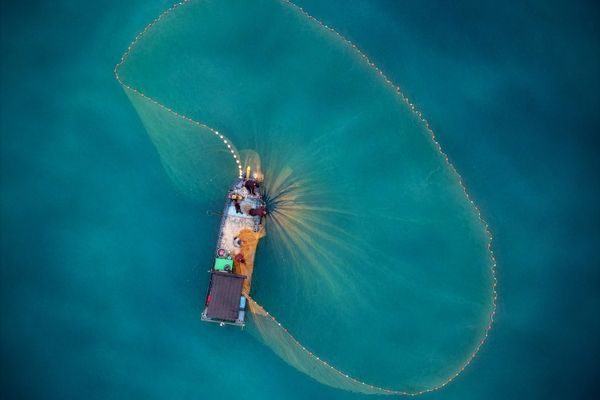
New research finds that vessel tracking gaps off West Africa are concentrated among a small number of fishing vessels, potentially helping authorities target illegal fishing investigations.
The study, published in Applied Geography, found that just 11 commercial fishing vessels accounted for 73 percent of the dark journeys identified by researchers at Florida International University (FIU) and Georgia Southern University.
Using publicly available data from Global Fishing Watch, the researchers examined more than 3,600 dark journeys recorded over three years off the coasts of 23 West African countries. Approximately 1,058 involved vessels operating under flags of convenience.
Dark journeys occur when vessels stop transmitting automatic identification system (AIS) signals and later reappear in tracking data. Although such gaps can result from technical or operational issues, the researchers examined whether recurring patterns could help identify vessels and areas warranting closer scrutiny.

“You don’t need to track down and board every fishing vessel flying a flag of convenience or going dark,” said Stephen Pires, an FIU criminologist and study co-author. “You need to identify the most chronic offenders in your waters – which in this case amounted to only 11 vessels over three years – and board those ships to ask good questions, request documentation and check whether they are also committing other crimes, such as labor abuse or trafficking illicit products.”
The researchers found that dark activity was concentrated in specific areas, particularly around the Gulf of Guinea and near the boundaries of countries’ exclusive economic zones (EEZs). Nearly half of the dark journeys involving convenience-flagged vessels began or ended beyond an EEZ boundary.
“If a fishing vessel turns off its AIS signal near the EEZ boundary, disappears for hours or even days, and then resumes its signal just outside that same boundary, that is very suspicious,” said Emilie Christiansen, an FIU doctoral candidate and study co-author. “It could potentially indicate that the vessel entered those waters to evade detection while engaging in illegal fishing activities.”
Putting IUU fishing on the map: Global Fishing Watch intends to bring the invisible into view
Flags of convenience allow vessels to register in countries other than their country of origin, sometimes providing economic or regulatory advantages. The practice is legal, and neither a flag of convenience nor an AIS tracking gap establishes that illegal fishing has occurred.
However, the study found that convenience-flagged vessels were nearly twice as likely to begin or end a dark journey beyond an EEZ boundary and averaged approximately five times as many dark journeys per vessel as those not operating under flags of convenience.
The researchers said these patterns could help countries with limited enforcement resources prioritize surveillance and inspections of vessels that repeatedly disappear from tracking systems.
Pires also suggested using geofencing technology to monitor vessel movements and generate alerts when AIS signals are disabled or vessels enter designated high-risk areas.
“These countries would benefit from the implementation of geofencing technologies that monitor vessel movements in and out of designated high-risk zones,” Pires said.
The findings suggest that recurring patterns in vessel tracking data could help authorities identify potentially suspicious activity for further investigation. However, the data alone cannot establish whether illegal fishing occurred.
Now that you've reached the end of the article ...
… please consider supporting GSA’s mission to advance responsible seafood practices through education, advocacy and third-party assurances. The Advocate aims to document the evolution of responsible seafood practices and share the expansive knowledge of our vast network of contributors.
By becoming a Global Seafood Alliance member, you’re ensuring that all of the pre-competitive work we do through member benefits, resources and events can continue. Individual membership costs just $50 a year.
Not a GSA member? Join us.
Author

Related Posts
Fisheries
A decade after anti-IUU fishing pact, Mediterranean and Black Sea overfishing drops
A decade after a the anti-IUU fishing Port State Measures Agreement, overfishing in the Mediterranean and Black Sea drops to record lows.

Fisheries
TNC-backed Edge AI seeks to streamline electronic monitoring in the ongoing effort to fight IUU fishing
With cost a barrier to wider adoption of electronic monitoring, a new tool aims to improve catch counts with lower miss rates compared to humans.
Fisheries
New database revealing salmon patterns at sea aims to curb IUU fishing
A new analysis of where salmon are concentrated at sea could aid with fisheries management and help curb IUU fishing.
Fisheries
Can an underwater artificial intelligence bot detect IUU fishing?
A new underwater artificial intelligence bot could "revolutionize" ocean monitoring and IUU fishing identification, scientists say.