


Study examines harbor porpoise behavior in a fishing gear entanglement

Findings reconstruct in detail what a small-toothed whale did immediately before, during and after a fishing net entanglement
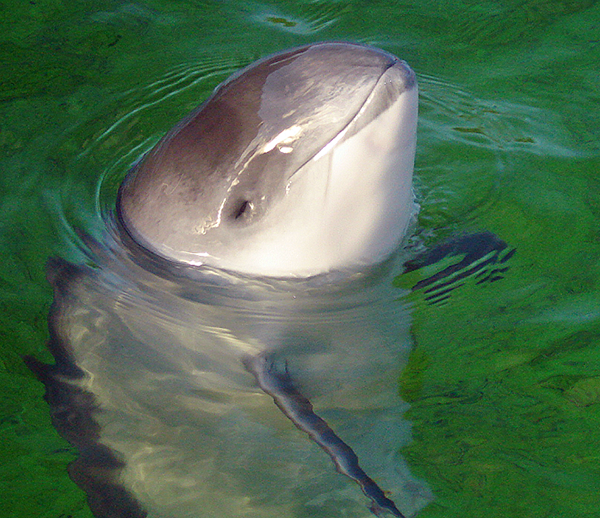
Scientists from the United Kingdom recently reported, to their knowledge, the first detailed account of how a harbor porpoise (Phocoena phocoena) – a type of small-toothed whale – behaved immediately before and during entanglement in a static fishing net. They also captured the behavior of a second animal that remained nearby but did not interact with the fishing gear.
The study – authored by Dr. Jamie MacAulay and several colleagues of the Sea Mammal Research Unit, Scottish Oceans Institute, University of Saint Andrews (Saint Andrews, UK) – suggest the porpoises were foraging around the net before the bycatch occurred and that the entangled animal raised the net by about 7 meters while caught. The two animals may have formed a social pair, as the surviving porpoise displayed atypical communication for several hours after the event.
“While we were working closely with fishers to test the practicality of a 3D acoustic cetacean tracking system to deploy on fishing nets, we unexpectedly recorded a porpoise bycatch event in unprecedented detail. The acoustic recordings and reconstructed animal movements showed two animals foraging close to the net prior to the bycatch occurring, and that their acoustic behavior changed markedly when one of the animals became entangled,” Dr. Jamie MacAulay, lead and corresponding author of the study, told the Advocate. “The systems depth sensors indicated that the bycaught animal managed to lift the net several meters up in the water while it was trying to escape, which will have required substantial force.”
Entanglement in fishing gear is the largest direct human cause of death for dolphins and porpoises. Static nets – gillnets, tangle nets and trammel nets left in place to fish – account for most of that mortality. A widely cited global estimate put annual cetacean bycatch at more than 300,000 animals, with gillnets and other entangling nets implicated across the majority of odontocete (toothed whales) species. In UK waters the usual figure is around 1,000 small cetaceans a year in static fishing nets, and most bycatch happens on unobserved gear.

The Sea Mammal Research Unit team had mounted compact passive acoustic recorders, including SoundTrap units with motion sensors, on the float line of a working gillnet. Two packages sat about 50 meters apart. When both heard the same high-frequency click, the animal’s position around the net could be reconstructed. The system belongs to the same family of kit used earlier to track porpoises around commercial nets in UK waters: practical enough to go on a fishing trip, precise enough to map foraging in three dimensions.
The record shows two porpoises feeding near the net for several minutes – about 8 minutes in the more granular accounts – repeatedly coming within roughly 5 meters of the mesh and leaving again. These animals were not swimming blindly into an invisible wall, and at close range they appeared able to detect and avoid the gear. Then one animal surfaced, dropped back toward the net, and was caught less than half a minute later. The authors’ reading, offered as speculation rather than proof, is a lapse of attention during a prey chase. This would agree with other work showing that porpoises often forage around gillnets, and that presence around the gear can rise on days when bycatch later occurs, without every approach ending in death.
“These completely unique insights are potentially extremely useful because they could help with the development of new bycatch-mitigation directions that use bioacoustic mitigation or fine-tuning fishing net strength to allow larger animals to escape while maintaining fish catches,” Dr. MacAulay added. “We will continue working closely with fishers and our aspiration is to find mitigation approaches that are effective at reducing bycatch but also minimize, or maybe even eliminate, operational impacts on fishes.”
How gillnet mesh sizes impact catch efficiency of Greenlandic lumpfish
What matters next is practical. How often do animals hit the net in the last seconds of a chase, rather than while they are simply travelling? How often is another porpoise nearby, and does that raise the risk of a second death? Can reflective panels or a change in hanging cut those close-range mistakes without losing fish? And if the calls after a bycatch are distinctive enough, could a cheap single-channel logger mark a problem haul without needing a full tracking array?
The finding that is hardest to accept is also the one that should shape the next designs. These animals were feeding around gear they could, for a time, avoid. The death happened in a brief interval when hunting overrode caution, and the net then did what nets are made to do. Static nets will stay part of coastal fishing, and that gap is what gear, fishing practice and acoustic tools now have to close.
“Understanding behaviors prior to and during a bycatch event could significantly improve bycatch mitigation strategies in static net fisheries, and this paper demonstrates a new method for how this can be achieved,” concluded the authors.
Now that you've reached the end of the article ...
… please consider supporting GSA’s mission to advance responsible seafood practices through education, advocacy and third-party assurances. The Advocate aims to document the evolution of responsible seafood practices and share the expansive knowledge of our vast network of contributors.
By becoming a Global Seafood Alliance member, you’re ensuring that all of the pre-competitive work we do through member benefits, resources and events can continue. Individual membership costs just $50 a year.
Not a GSA member? Join us.
Author
-

Editor Emeritus
Related Posts
Fisheries
Could these high- and low-tech approaches help curb fisheries bycatch?
From marine mammal ‘pingers’ to seabird-sparing fishing hooks, commercial fishermen have a growing number of options to prevent fisheries bycatch.
Fisheries
Study finds that acoustics are seldom considered when developing strategies to protect fish populations at risk from extinction
Can integrating fish sonifery, soundscapes and noise pollution considerations into policy improve management, conservation and recovery?
Fisheries
Balancing protection and production: Diving into the North Atlantic right whale conflict with lobster and crab fishing
A closer look at the conflict between North American fixed-gear fisheries and North Atlantic right whale protection measures.
Innovation & Investment
Responsible Fisheries Innovation Award Finalist: GenusWave and its Targeted Acoustic Startle Technology
To reduce predation and increase catch, GenusWave uses brief sounds to startle marine mammals, using technology to target specific species.