


Seaweed-inspired ‘fluffy net’ captures ocean microplastics in freshwater and seawater

Biopolymer mesh removes large and small microplastics in lab tests, offering possible tool for removing freshwater and marine plastic pollution
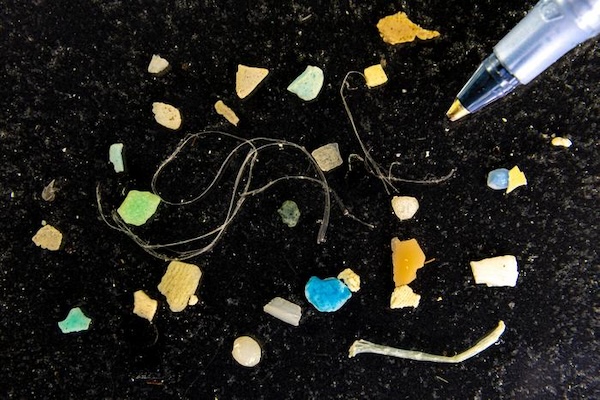
Researchers have developed a seaweed-inspired mesh that captures microplastics across a wide range of sizes in laboratory testing, offering a potential new approach to removing plastic pollution from freshwater and marine environments.
The study, published in Science Advances, describes a highly porous, adhesive mesh made from alginate and chitosan, biopolymers derived from seaweed and crustacean shells. The design was inspired by naturally occurring mats of tangled seaweed and “Neptune balls,” which have been shown to collect microplastics in the ocean.
“We wanted to create structures that mimicked what the tangled seaweed is already doing,” said Orlin Velev, the study’s corresponding author and a professor of chemical and biomolecular engineering at North Carolina State University. “Our goal here was to develop a multiscale structure that allows us to capture the full range of plastic microparticles.”
Existing methods can capture either larger microplastic particles or much smaller ones, but efficiently removing both in a single process has remained a challenge. According to the researchers, the new mesh is designed to address that challenge by combining a porous structure that traps larger particles with a coating of branching chitosan nanofibers that adhere to much smaller plastics.

The researchers described the design as a “fluffy net.” The porous mesh captures larger plastic particles, while the fine chitosan fibers coating each strand adhere to even the smallest microplastics and nanoparticles.
“The ‘net’ part of the structure is a mesh capable of capturing the larger plastic microparticles – a millimeter or larger in size,” said Velev. “Further, the individual strands of the net are ‘fluffy’ because they are coated with soft dendritic colloids, which are able to capture by adhesion even very small plastic microparticles – down to tens of nanometers in size.”
In proof-of-concept tests, the researchers found the mesh was effective at capturing both laboratory-produced nanoparticles and real-world microplastics across a wide range of sizes in both freshwater and saltwater.
“We’ve demonstrated that this design works,” Velev says. “And the materials we used are of natural origin and relatively inexpensive. So, it may present a viable path forward. Can it be used on a large scale? That depends on the extent to which we want to invest in scaling up such cleanup approaches.”
The researchers said the mesh could be collected and reprocessed after use. One possible approach would use microbial digestion to break down both the captured microplastics and the mesh, producing more biopolymer material for future cleanup applications.
Now that you've reached the end of the article ...
… please consider supporting GSA’s mission to advance responsible seafood practices through education, advocacy and third-party assurances. The Advocate aims to document the evolution of responsible seafood practices and share the expansive knowledge of our vast network of contributors.
By becoming a Global Seafood Alliance member, you’re ensuring that all of the pre-competitive work we do through member benefits, resources and events can continue. Individual membership costs just $50 a year.
Not a GSA member? Join us.
Author

Related Posts
Fisheries
Catch & Culture Review: How microplastics impact the early life stages of fish and the ecosystem
This review of fisheries research explores the impacts of microplastics on marine species and ecosystems as well as strategies to mitigate pollution.
Responsibility
Microplastics in fish found in one-third of samples from remote Pacific islands
Microplastics in fish are widespread across Pacific island waters, raising risks for ecosystems and food security in remote regions.
Aquafeeds
‘We will very likely find it’: Microplastics warning sounded for aquafeeds
The warning about microplastics pollution is finding its way to aquaculture, as a new study finds contaminated samples of fishmeal, a prominent aquafeeds ingredient.
Responsibility
Researchers detect microplastics in the muscle tissues of Oregon seafood
A Portland State University study finds microplastics in the muscle tissue of samples of commonly consumed seafood products from Oregon.