


Japan tests world’s first closed-cycle recirculating aquaculture system for chum salmon

Closed-cycle RAS could help sustain chum salmon production as climate change and declining returns threaten Japan’s salmon fisheries
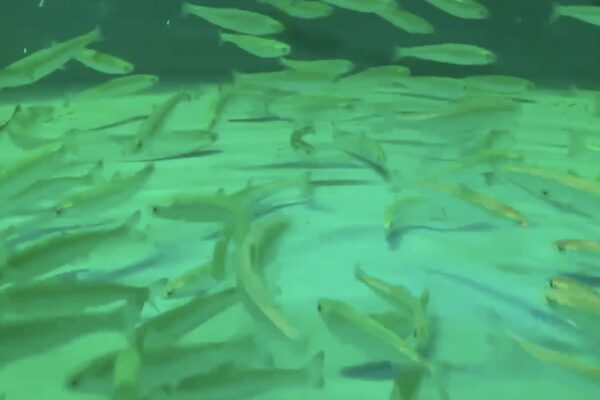
Researchers in Japan are testing whether chum salmon can be farmed entirely on land, using a closed-cycle recirculating aquaculture system designed to support the species through its full life cycle.
Okayama University of Science and Murakami City in Niigata Prefecture have launched the joint research project at the university’s Next-Generation Aquaculture Center. The university says the project is aimed at establishing the world’s first fully closed-cycle aquaculture system for chum salmon.
Juvenile chum salmon delivered from Murakami earlier this year are being raised in a 35-ton tank using the university’s Third Water technology. According to the university, the fish have grown to an average weight of 23 grams and an average length of 13 centimeters.
Murakami has long been one of Japan’s leading salmon-producing regions along the Sea of Japan coast, with a salmon culture dating back to the Heian period. But climate change has altered the distribution of marine species in the region, increasing predation on released juvenile salmon by northward-expanding species such as yellowtail and Spanish mackerel.
![Ad for [BSP]](https://www.globalseafood.org/wp-content/uploads/2025/07/BSP_B2B_2025_1050x125.jpg)
‘The ultimate setting’: Why Japan wants to grow fish in space
The impact has been severe. According to the Japan Fisheries Research and Education Agency, the nationwide average salmon return rate fell to 0.66 percent in 2025, the lowest level recorded since 1989. In Niigata Prefecture, the return rate dropped to just 0.06 percent, meaning almost none of the released fish returned to their natal rivers.
In response, Murakami has turned to land-based aquaculture as a potential way to help revitalize its salmon industry, partnering with the Department of Bioscience at Okayama University of Science.
The juvenile salmon were first raised in small tanks before being moved to a 7-ton tank once they reached about 8 to 9 centimeters in length and 5 grams in weight. After reaching an average length of 13 centimeters, 2,080 surviving fish were transferred to a 35-ton tank. Researchers expect the salmon to reach about 1 kilogram within one year and between 1.5 and 3 kilograms within two years.
The center aims to establish a fully closed-cycle aquaculture system for chum salmon using its Third Water closed-recirculating technology. If successful, the university said, it would be the world’s first fully closed-cycle land-based aquaculture system for the species.
“If we succeed in establishing a fully closed-cycle aquaculture system for chum salmon, it could fundamentally change the future of salmon production,” said Toshimasa Yamamoto, associate professor of the Department of Bioscience at Okayama University of Science. “The ability to raise salmon sustainably on land would have an enormous impact on fisheries around the world.”
Yamamoto said the research team will continue evaluating the project while working with Murakami City to determine whether land-based production can reduce dependence on ocean-based salmon resources and support the industry’s long-term sustainability.
Now that you've reached the end of the article ...
… please consider supporting GSA’s mission to advance responsible seafood practices through education, advocacy and third-party assurances. The Advocate aims to document the evolution of responsible seafood practices and share the expansive knowledge of our vast network of contributors.
By becoming a Global Seafood Alliance member, you’re ensuring that all of the pre-competitive work we do through member benefits, resources and events can continue. Individual membership costs just $50 a year.
Not a GSA member? Join us.
Author

Related Posts
Health & Welfare
Study reveals how salmon adapt to low hydrogen sulfide in RAS
Study shows salmon can adapt to low hydrogen sulfide in recirculating aquaculture systems, improving fish health and aquaculture practices.

Innovation & Investment
Novel technology addresses off-flavors, water mold for RAS production
New fiber technology reduces off-flavors and water mold in recirculating aquaculture systems (RAS), boosting efficiency and improving fish quality.
Innovation & Investment
Connecticut ‘urban fish farm’ leans on RAS to produce branzino
The Ideal Fish “urban fish farm” in Connecticut is producing branzino, or European sea bass, using RAS technology. Learn about this project from the company that designed and supported it: Pentair Aquatic Eco-Systems.
Innovation & Investment
Oceanloop nets millions in loans to build first land-based shrimp farm in Spain
Oceanloop's $38 million loan will be used to build a land-based shrimp farm in Spain and expand operations in Germany.