


‘Europe must act now’: Coalition urges EU to adopt blue foods action plan to address food security risks

Fisheries and aquaculture groups press EU to take ‘decisive action’ on blue foods to address growing production and food security risks
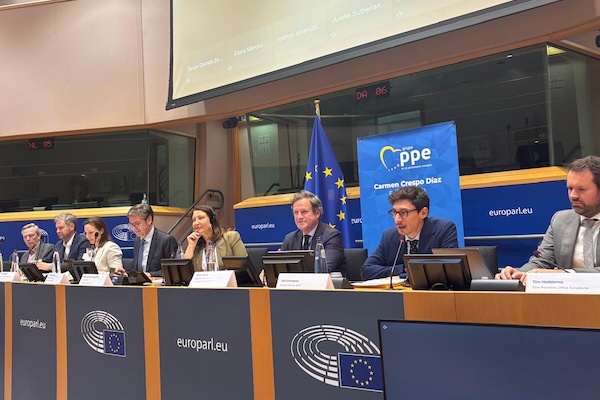
A coalition of Europe’s fisheries and aquaculture organizations is urging the European Commission to adopt a dedicated Action Plan on Blue Foods to strengthen food security, sustainability and coastal communities. The appeal, made at an event in Brussels on Sept. 3, comes as Europe faces declining production, rising imports and growing food security risks.
The coalition – which includes the European Bureau for Conservation and Development (EBCD), Europêche, the European Association of Fish Producers Organisations (EAPO), the Federation of European Aquaculture Producers (FEAP) and the EU Fish Processors and Traders Association/European Federation of National Organisations of Importers and Exporters of Fish (AIPCE.CEP) – pressed policymakers to take “decisive action” to integrate aquatic foods into Europe’s broader food and sustainability strategies.
“Blue foods must be at the core of the EU’s Ocean Pact and its sustainable food strategy,” said Carmen Crespo Diaz, chair of the Committee of Fisheries of the European Parliament. “We now call on the European Commission to move from vision to action by supporting responsible aquaculture, fair market conditions and a competitive, future-oriented fisheries sector. There is no truly ambitious Ocean Pact without a strong commitment to blue food systems.”
The launch, hosted at the European Parliament, put aquatic products in the spotlight and highlighted what the groups described as an often-overlooked issue in European food policy debates. Representatives of the EU also took part in the event.
![Ad for [membership]](https://www.globalseafood.org/wp-content/uploads/2025/07/membership_web2025_1050x125.gif)
Javier Garat, rapporteur on the opinion of the European Economic and Social Committee (EESC) on the Ocean Pact, said the committee has endorsed the call for a Blue Food Action Plan. He described it as a vital step to modernize fisheries and aquaculture, strengthen Europe’s food security and support the resilience of coastal communities. Industry leaders echoed the message.
“We need to support responsible fisheries and aquaculture within Europe, while also securing open, rules-based trade with reliable international partners,” said Guus Pastoor from AIPCE. Trade agreements, partnerships in the field of science, product quality, institutional structures and management schemes are some examples of actions we can take to secure our supplies.”
Blue foods – including wild-caught and farmed fish and seafood – provide key nutrients, such as omega-3s, vitamins and minerals, while generally carrying a lower carbon and resource footprint than many land-based proteins. They also support millions of jobs in coastal and rural communities, linking the ocean to Europe’s social and economic fabric.
Despite this, Europe’s aquatic food sector faces significant challenges. The Food and Agriculture Organization (FAO) reports that Europe is the only continent experiencing a decline in local aquatic production. According to the European Market Observatory for Fisheries and Aquaculture Products (EUMOFA), per capita consumption of wild-caught seafood in the EU has fallen to its lowest level in a decade, even though most European fish stocks are considered sustainably managed. The decline coincides with rising rates of obesity and diet-related disease across the region.
“Europe cannot afford to ignore its own capacity to produce aquatic food,” said Szilvia Mihalffy from FEAP. “At a time when imports dominate and production at home stagnates, we need a dedicated EU Action Plan that recognizes fish farming as strategic for food security, jobs and sustainability. Blue foods are not the future – they are here and Europe must act now.”
Now that you've reached the end of the article ...
… please consider supporting GSA’s mission to advance responsible seafood practices through education, advocacy and third-party assurances. The Advocate aims to document the evolution of responsible seafood practices and share the expansive knowledge of our vast network of contributors.
By becoming a Global Seafood Alliance member, you’re ensuring that all of the pre-competitive work we do through member benefits, resources and events can continue. Individual membership costs just $50 a year.
Not a GSA member? Join us.
Author

Related Posts
Responsibility
EU Commission eyes fisheries and aquaculture improvements to stop biodiversity loss
New measures aim to improve the fisheries and aquaculture sector, but some question their value in achieving COP15 biodiversity goals.
Innovation & Investment
France receives big financial boost to develop aquaculture and seafood sectors
France has received €567 million in funding from the European Commission to help develop the aquaculture and fisheries sectors.
Responsibility
European Commission activates crisis measures to support seafood sectors impacted by Ukraine-Russia war
The European Commission has activated new crisis measures to support the seafood sectors impacted by the Ukraine-Russian war.
Responsibility
Is the seafood industry prepared for the next level of transparency under CSRD?
The EU's Corporate Sustainability Reporting Directive (CSRD) raises concerns about supply chain traceability and reporting accuracy.