


Plankton declines raise concerns about ocean health in the Northeast Atlantic

More than 60 years of plankton data found no assessed pelagic habitats achieved Good Environmental Status, raising concerns about ocean health
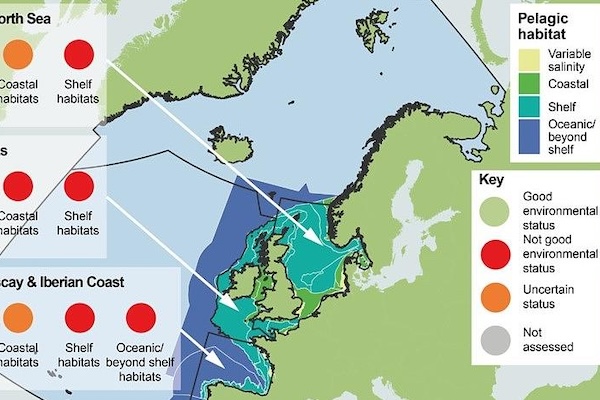
Plankton populations have declined across large areas of the Northeast Atlantic over the past six decades, according to a recent study that found no marine habitats assessed met the standard for Good Environmental Status.
The study, led by researchers at the University of Plymouth, analyzed more than 60 years of data from 23 plankton datasets collected by 13 research institutions, along with satellite observations. Together, the data provided the first quantitative assessment of the health of pelagic, or open-ocean, habitats across western Europe under the European Union and the United Kingdom’s Marine Strategy Framework Directive.
The findings highlight concerns about the health of marine ecosystems in a region stretching from Portugal to Norway, including the entire North Sea. Plankton play a critical role in ocean ecosystems, supporting marine food webs, regulating carbon and producing about half of the world’s oxygen through phytoplankton.
“Our study is the first to provide a quantitative assessment of the state of plankton across key regions such as the Celtic Sea, the Bay of Biscay and the North Sea,” said Abigail McQuatters-Gollop, professor at the University of Plymouth. “It has shown there is an urgent need to improve the health of these waters and to reduce the harm we are causing to the ocean, at both a local and a global level.”
![Ad for [Aquademia]](https://www.globalseafood.org/wp-content/uploads/2025/07/aquademia_web2025_1050x125.gif)
The researchers focused on pelagic habitats, the open-water parts of the ocean where plankton form the foundation of marine ecosystems. While previous assessments documented changes in plankton populations, they had not combined those observations into a single regional measure of ecosystem health. By integrating long-term monitoring data from multiple assessment areas and fixed sampling stations, the team produced the first regional assessment of pelagic habitat status.
The assessment found that none of the pelagic habitats studied met the standard for Good Environmental Status. Six habitat-region combinations were classified as “Not Good,” three were rated “Uncertain,” and one could not be assessed because of insufficient data.
At the regional level, the Celtic Seas and the Bay of Biscay and Iberian Coast were classified as “Not Good,” while the Greater North Sea received an “Uncertain” rating. The most pronounced declines were found in shelf habitats, where researchers observed changes in plankton communities alongside declines in phytoplankton biomass and zooplankton abundance.
Study: Ocean warming boosts deep sea phytoplankton, threatening marine ecosystems
The study also identified several environmental changes associated with those trends, including rising sea surface temperatures, shifting nutrient conditions, declining ocean pH and changes in ocean mixing.
Based on the findings, the researchers said reducing greenhouse gas emissions is the most important step to protect pelagic habitats. They also called for stronger efforts to reduce nutrient pollution, particularly nitrogen, and for continued investment in long-term plankton monitoring.
According to the study, several long-running plankton monitoring programs in the OSPAR region have been paused or are at risk because of funding constraints, despite providing data considered essential for tracking ecological change and informing marine management.
The study involved contributions from about 40 plankton experts working through OSPAR, the Regional Seas Convention for the Northeast Atlantic, and builds on the organization’s 2023 assessment of the region’s marine ecosystem.
The researchers said future assessments could be improved by incorporating additional long-term plankton datasets, expanding monitoring in coastal and estuarine waters, and using technologies such as imaging systems and environmental DNA to better capture underrepresented plankton species.
“The warning is clear: plankton are changing across some of Europe’s most important seas, and those changes matter far beyond the plankton themselves,” said McQuatters-Gollop. “They affect food webs, fisheries, carbon cycling and the wider benefits people receive from the ocean. The challenge now is to use this evidence to drive practical action, from climate mitigation to better nutrient management and long-term monitoring.”
Now that you've reached the end of the article ...
… please consider supporting GSA’s mission to advance responsible seafood practices through education, advocacy and third-party assurances. The Advocate aims to document the evolution of responsible seafood practices and share the expansive knowledge of our vast network of contributors.
By becoming a Global Seafood Alliance member, you’re ensuring that all of the pre-competitive work we do through member benefits, resources and events can continue. Individual membership costs just $50 a year.
Not a GSA member? Join us.
Author

Related Posts
Innovation & Investment
Minderoo Foundation pledges to support ocean health and the blue economy
Minderoo Foundation commits $5.9 million to the ReOcean Fund, backing ocean restoration, sustainable seafood and science-based data solutions.

Responsibility
Ocean ‘dead zones’ are growing, with human activity exacerbating the problem
Oxygen-deficient “dead zones” in the Pacific Ocean are expanding partly because of climate change and coastal nutrient discharge.
Responsibility
European Commission launches platform to promote algae production
The European Commission is launching EU4Algae – a European algae stakeholder platform – to expedite the algae industry's development.

Fisheries
Study: Climate change is likely ‘suffocating’ the world’s fisheries
A new study indicates the ocean is losing oxygen due to climate change, greatly affecting fisheries and other marine resources.