


Tagged bigeye tuna recaptured after nearly a decade could help improve fisheries management

Scientists say the nearly decade-long recapture may improve growth estimates used for bigeye tuna fisheries management
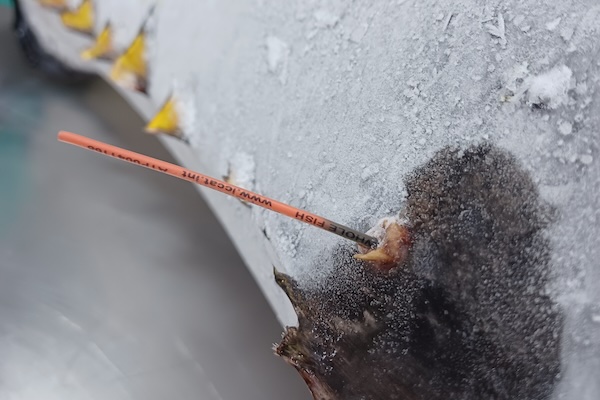
Researchers have recovered a bigeye tuna nearly a decade after it was tagged in the Atlantic Ocean, giving scientists a rare opportunity to measure how the species grows in the wild and improve future fisheries management.
The fish, originally tagged off Cape Verde in 2016 as part of the International Commission for the Conservation of Atlantic Tunas’ Atlantic Ocean Tropical Tuna Tagging Programme (AOTTP), was recently caught by the Galician longliner Escualo Cuatro in the equatorial Atlantic.
Because the tuna was injected with a chemical marker when it was tagged, researchers can now determine precisely how much it grew over nearly 10 years. The data will be used to refine bigeye tuna stock assessment models and improve scientific advice for managing the fishery.
“Every tagged and recovered fish is of immense scientific value,” said Patricia Lastra, researcher at AZTI. “This particular specimen, however, spans almost an entire lifetime.”
![Ad for [BSP]](https://www.globalseafood.org/wp-content/uploads/2025/07/BSP_B2B_2025_1050x125.jpg)
According to AZTI, the vessel’s crew recognized the tag and notified researchers, allowing scientists to recover the specimen and collect biological data that would otherwise have been lost. After the tuna was landed, it was preserved by the Galician cold-storage company WOFCO before being transferred to researchers working on the European Union-funded ITUNNES project, coordinated by AZTI in collaboration with scientists from several ICCAT member countries.
When the fish was tagged in 2016, researchers injected it with a chemical marker that left a permanent timestamp in its otoliths – small, calcified structures in a fish’s inner ear that record growth throughout its life, much like the rings of a tree. By examining the otolith under a microscope, scientists can distinguish the growth that occurred before and after the fish was tagged.
The tuna measured 55 centimeters when it was tagged off Cape Verde in 2016. When it was recaptured nearly a decade later, it had grown to 158 centimeters in length and weighed 79 kilograms.
“This tagged fish is a unique reference specimen: it allows us to read with certainty what, in other individuals, we can only estimate,” said Lastra. “Its otolith helps us validate the reading criteria and methods that we apply to the entire population.”
ISSF: Nearly 50 percent of tuna stocks are subject to overfishing
Researchers say more accurate growth data can improve the scientific assessments used to manage bigeye tuna fisheries, including decisions on catch limits and conservation measures. Because bigeye tuna grows slowly and takes several years to reach maturity, accurately estimating its age is critical to understanding population abundance. Incorrect growth estimates can affect recommendations for sustainable catch levels.
“That level of detail – knowing exactly how much a fish has grown between tagging and recapture and verifying that the growth rings accurately reflect that interval – is what allows us to build reliable growth curves, information that is essential for the models we use to assess the status of fish stocks,” said Lastra.
The specimen is being analyzed as part of the ITUNNES project, which aims to improve scientific knowledge of tropical tunas. Researchers said the findings will feed directly into stock assessment models that support international fisheries management decisions, strengthening the scientific evidence for sustainably managing bigeye tuna fisheries.
Now that you've reached the end of the article ...
… please consider supporting GSA’s mission to advance responsible seafood practices through education, advocacy and third-party assurances. The Advocate aims to document the evolution of responsible seafood practices and share the expansive knowledge of our vast network of contributors.
By becoming a Global Seafood Alliance member, you’re ensuring that all of the pre-competitive work we do through member benefits, resources and events can continue. Individual membership costs just $50 a year.
Not a GSA member? Join us.
Author

Related Posts
Fisheries
Tuna fisheries most at risk from climate change, new research suggests
A global study warns tuna and other migratory fisheries face the greatest climate risks as warming seas shift stocks and strain management.

Fisheries
Metastudy finds large-scale marine protected areas boost tuna populations
A new study finds that large-scale marine protected areas boost tuna populations and catch rates, benefiting both ecosystems and fisheries.
Fisheries
ISSF: Tuna fisheries improving, overfishing remains a challenge
New ISSF report shows 88 percent of the global tuna catch is from healthy stocks, signaling progress despite challenges with overfishing.
Fisheries
ICCAT adopts stronger measures for tuna and swordfish fisheries management
New measures enhance responsible fisheries management of tuna and swordfish, emphasizing science, conservation and small-scale fisheries.