


Responsible Seafood Innovation Award finalist: A field detection tool for both aquaculture pathogens and species identification

WildTechDNA is a 2026 Responsible Seafood Innovation Award finalist for rapid DNA testing that can detect aquaculture pathogens in the field in minutes
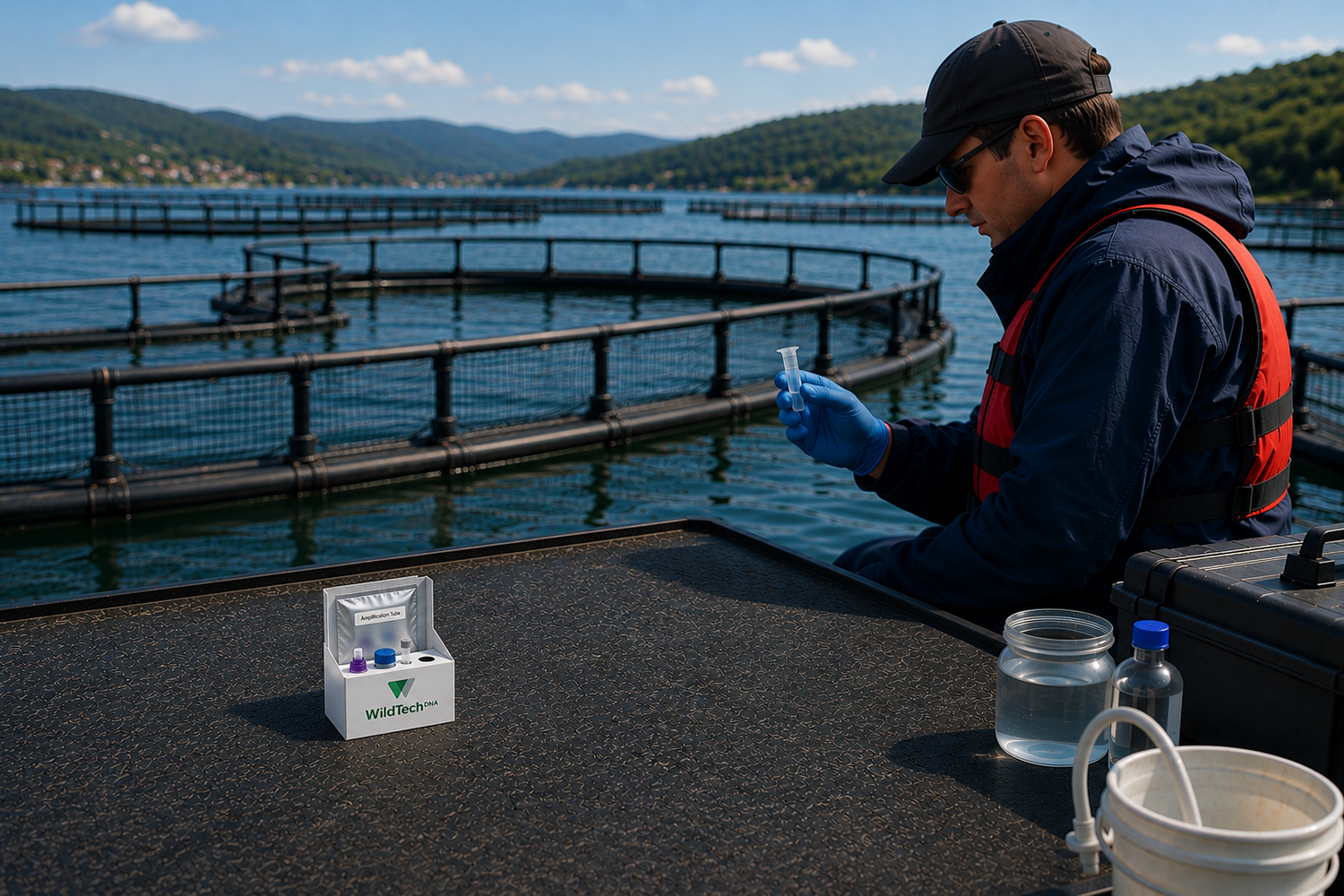
What do unlawfully trafficked eels and bacterial pathogens that cause billions in aquaculture losses annually have in common? Every one of those eels and bacteria contains species-identifying genetic material. But detecting and classifying that DNA has traditionally meant using a remote lab, refrigerated samples and skilled technicians, a process that traditionally takes days or weeks and at considerable expense.
To address this, WildTechDNA developed ORYA, a field-ready solution that can be done by non-experts on site and that yields an answer in less than 20 minutes. For pathogen control, this technology makes early detection and targeted treatment easier. It also aids in spotting fraudulent species substitution. Because of this innovation, WildTechDNA, a startup based in Hamilton, Ontario, Canada, is a finalist for the 2026 Responsible Seafood Innovation Award in the aquaculture category.
A diagnostic technology intended for field use must meet certain requirements, Natalie Schmitt, CEO and founder of WildTechDNA told the Advocate. “For a technology like this to be really useful, it needs to be highly portable. It needs to be ultra-rapid, affordable, easy to use and specific for your target species of interest.”
The development of the DNA identifying test from concept to product took about 10 years, Schmitt said. An earlier version of the technology was used for eel species identification, demonstrating it could be an important tool for custom agents trying to stop the illegal movement of endangered species across borders.
![Ad for [membership]](https://www.globalseafood.org/wp-content/uploads/2025/07/membership_web2025_1050x125.gif)
ORYA, the current incarnation of the diagnostic methodology, follows steps akin to what’s done in an at-home Covid or flu test. First, users collect a sample, such as by swabbing a fish with a cotton tip. Then they put that sample into a tube and massage it to release DNA. After that, users put drops of the freed DNA containing liquid into another tube holding dried reagents, chemicals that amplify any DNA from the target species that’s present. Users then place this second tube inside a small reusable heat book with a disposable heat pack, which provides the constant temperature needed for DNA amplification without requiring electronic equipment. This amplification turns what can a miniscule amount of identifying genetic material into something that can be readily detected.
After amplification, there’s readout of the results using a lateral-flow strip, with the appearance of a bar indicating the presence of the target species. If a bar is present, then the target species – such the bacterial pathogens Aeromonas, Vibrio, Flavobacterium and Streptococcus if the test is designed to detect them – is in the swabbed sample.
The technology allows tests to be multiplexed, making it possible for one test to detect multiple pathogens. This capability has been done with eel species identification, showing a line in one location for European eels and multiple lines in a different location for Japanese eels, and so on.
In a controlled setting, ORYA can detect as low as five to 10 DNA copies per sample, according to Schmitt. She added that under controlled conditions the test has a about a 98 percent specificity, meaning that it is very capable in distinguishing the target from non-targets.
Schmitt noted that the technology is specifically designed for use by non-experts outside the laboratory. Thus, she said, “An important part of our validation process is understanding how factors such as user handling and environmental conditions affect performance, and then continually refining the design to minimize those potential sources of error.”
In the fight against seafood fraud, the technology behind trace element fingerprinting is maturing
That approach to improving the technology’s performance has already paid dividends. Field trials of an earlier prototype of the species detector, for instance, helped identify potential sources of user error. To address these issues, WildTechDNA simplified the workflow and went to dry reagents. The last change extended the shelf life of ORYA products to more than 14 months.
Today OYRA is in beta testing different applications, with pilot studies underway evaluating detection capabilities of various species. Rapidly spotting pathogens in the field would allow a fish farmer to begin treatment sooner. What’s more, by knowing the bacterial species the aquaculture producer could target treatment. WildTechDNA’s technology could also be modified to tell if the bacteria are antibiotic resistant, providing additional information that can be used to optimize infestation mitigation.
One possibility is for pathogen detection to be done by using a water sample. Making that work requires filtering the water and then testing it, with one research project underway to see if this approach works in the field. If successful, the technique would eliminate the need to capture fish and swab them.
Schmitt expects beta testing to wrap up this year or early next, and production to begin next year. The company can tailor the technology to fit specific situations along with further improvements. WildTechDNA is also open to working with companies interested in beta testing, Schmitt noted.
Finally, in discussing what it means to be up for an Innovation Award as a recognition of years of work, she said, “We’re so thrilled that we’ve been nominated as a finalist for this award. We’re so excited. We’re absolutely thrilled.”
GSA’s 2026 Responsible Seafood Innovation Awards in the aquaculture and fisheries categories will be presented at the Responsible Seafood Summit in Bangkok, Thailand.
Now that you've reached the end of the article ...
… please consider supporting GSA’s mission to advance responsible seafood practices through education, advocacy and third-party assurances. The Advocate aims to document the evolution of responsible seafood practices and share the expansive knowledge of our vast network of contributors.
By becoming a Global Seafood Alliance member, you’re ensuring that all of the pre-competitive work we do through member benefits, resources and events can continue. Individual membership costs just $50 a year.
Not a GSA member? Join us.
Author
-

Hank Hogan is a freelance writer based in California who covers science and technology. His work has appeared in publications ranging from Boy’s Life to New Scientist.
Related Posts
Health & Welfare
A rapid, sensitive RPA assay for detection of Vibrio parahaemolyticus in seafood
A real-time RPA method has been developed for the detection of Vibrio parahaemolyticus with high sensitivity and specificity.
Fisheries
Applying fish DNA sensors for authenticity assessment to sardine species identification
DNA sensors are cost-effective and can be used by authorities for fish authentication control or any laboratory including fish processing industries.
Intelligence
AI is becoming an ‘integral part’ of fisheries management and seafood processing
Artificial intelligence (AI) is playing a larger role in seafood, as data is at the heart of the so-called fourth industrial revolution.
Intelligence
Can handheld DNA testing technology stand up to seafood fraud?
The MasSpec Pen, developed to diagnose tumors, can identify fish species by touching the tip to a sample. But the species database is lacking.