


Study: Oysters play unexpected role in protecting blue crabs from disease

Oysters reduce parasite infections in juvenile blue crabs by filtering pathogens from the water, revealing a new disease management role
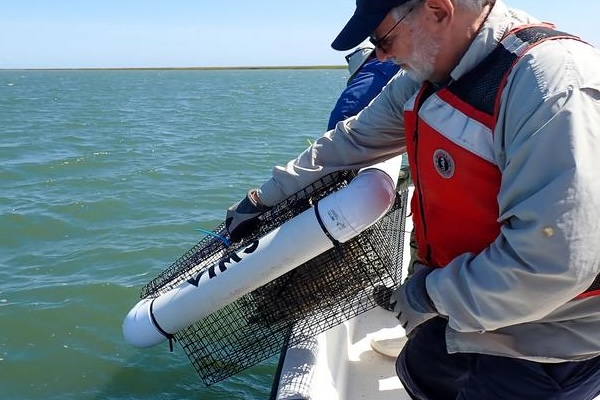
Oysters may play a broader role in coastal ecosystems than previously understood, helping limit the spread of disease in nearby marine species, according to new research focused on the Chesapeake Bay’s blue crab.
The study, conducted by researchers at William & Mary’s Batten School of Coastal & Marine Sciences and the Virginia Institute of Marine Science, found that oyster filter feeding can reduce transmission of Hematodinium perezi – a parasite that commonly infects juvenile blue crabs in high-salinity waters.
Published in Ecology, the research showed that juvenile crabs placed near live oysters during field experiments on Virginia’s Eastern Shore were about one-third less likely to become infected than crabs placed in areas without oysters.
“We know that oysters and oyster reefs provide a variety of ecological benefits, and that crabs are drawn to them for food and protection, but their ability to remove pathogens from the environment has not been well studied,” said Jeffrey Shields, a professor at the Batten School & VIMS who worked with his graduate student and several undergraduates on the study, including lead author Xuqing Chen, Ph.D.
![Ad for [BSP]](https://www.globalseafood.org/wp-content/uploads/2025/07/BSP_B2B_2025_1050x125.jpg)
The researchers tested the effect in both laboratory and field experiments. During peak summer conditions – when the parasite is most prevalent – they placed uninfected juvenile blue crabs in high-salinity coastal bays where infections are common.
Some crabs were positioned among live oysters, others among empty oyster shells and a third group was left without protection. Only crabs placed near live oysters showed a reduced risk of infection, indicating that active filter feeding, rather than the physical structure of oyster reefs, was responsible for limiting disease transmission.
The team also replicated the experiments under controlled conditions at the Batten School and VIMS’ Seawater Research Lab. When oysters were exposed to dinospores – the free-swimming, infectious stage of the parasite – they removed them from the water at rates similar to other plankton. On average, oysters eliminated more than 60 percent of the parasites within an hour.
The researchers also observed lower mortality among crabs in the treatment group. However, they cautioned that multiple factors were involved and that the result could not be attributed to the presence of oysters alone.
“This study is part of a larger collaboration with the eventual goal of modeling these parasite-host interactions at the fisheries scale,” said Chen. “I would love to see more attention paid to disease dynamics in marine ecosystems, since they are complex and can have a huge impact on our fisheries.”
Hematodinium infections can be especially deadly for juvenile blue crabs during warm summer months, with infection rates in some high-salinity bays approaching 100 percent. While the researchers expected the smallest crabs to be the most vulnerable, they instead found higher rates of new infections over time among larger juvenile crabs, a result that surprised the team.
“This is something that had not been documented previously, and it has some interesting implications because the fishery removes approximately 40 percent of adult crabs from the system annually,” said Shields. “The juvenile crabs must fill that void, yet they are highly susceptible, so we need to think about how all of this comes together to increase or decrease the spread of disease.”
As North Carolina restores oyster reefs, a case for regenerative aquaculture grows
The study is part of a broader, National Science Foundation-funded effort at William & Mary that combines fieldwork, lab experiments and modeling to examine how oysters affect disease spread. The modeling could help guide fisheries management and oyster restoration by identifying where and when oyster filtration is most effective, particularly as coastal waters warm.
“While we’ve made important strides in oyster restoration in the Bay, we know that populations are still far below historic levels. This represents a significant reduction in filtering capacity,” said Shields. “One of the beautiful features of mathematical modeling is that it allows us to scale this effect by orders of magnitude. That’s where we’re going next – trying to determine whether we can meaningfully influence this effect for overall ecosystem and fishery benefits.”
Now that you've reached the end of the article ...
… please consider supporting GSA’s mission to advance responsible seafood practices through education, advocacy and third-party assurances. The Advocate aims to document the evolution of responsible seafood practices and share the expansive knowledge of our vast network of contributors.
By becoming a Global Seafood Alliance member, you’re ensuring that all of the pre-competitive work we do through member benefits, resources and events can continue. Individual membership costs just $50 a year.
Not a GSA member? Join us.
Author

Related Posts

Intelligence
Offshore mussel farm restores shellfish reefs to England’s south coast after 150 years
New research links offshore mussel farm in Lyme Bay to the revival of shellfish reefs, improving habitats for commercial fishing.
Responsibility
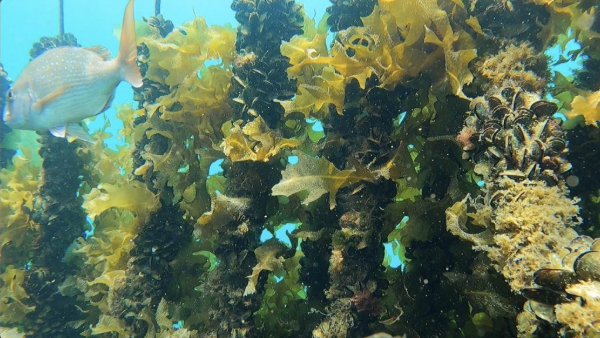
Study: Mussel and seaweed farming can boost wild fish populations
Study shows mussel and seaweed farming can increase fish populations and biodiversity, showing potential environmental and economic benefits.

Intelligence
Scientists use lobster tags to study how offshore aquaculture restores marine habitats
The Ropes to Reefs project uses lobster tagging to assess the wider benefits of the UK’s first large-scale offshore mussel farm.
Responsibility
Shellfish reefs improve marine biodiversity in South Australia
Benefits of more shellfish include improved water quality from filter-feeding and providing habitat and nursery grounds for marine species.