


Spatiotemporal dynamics of Peruvian anchovy spawning in northern Chile

Intertwined biological and environmental factors – size reductions, biomass declines, upwelling variations and El Niño – have restructured E. ringens spawning
Pelagic species have developed diverse strategies to ensure the survival of new generations, and consequently, the persistence of species. One of the most common strategies employed by small pelagic fish is synchronizing their spawning season with optimal environmental conditions at the time of metamorphosis, which enhances larval survival. Larvae need high food concentrations when they have absorbed their yolk sac and acquired the biological characteristics necessary to feed themselves, or they could die of starvation.
Most pelagic fish species exhibit annual variability in their reproductive cycles, but this variability can vary spatiotemporally due to environmental and demographic conditions. Temperature has been considered one of the most important environmental factors governing the phenology (the study of periodic events in biological life cycles and how these are influenced by seasonal and interannual variations in climate) of pelagic species, with consequences for population dynamics.
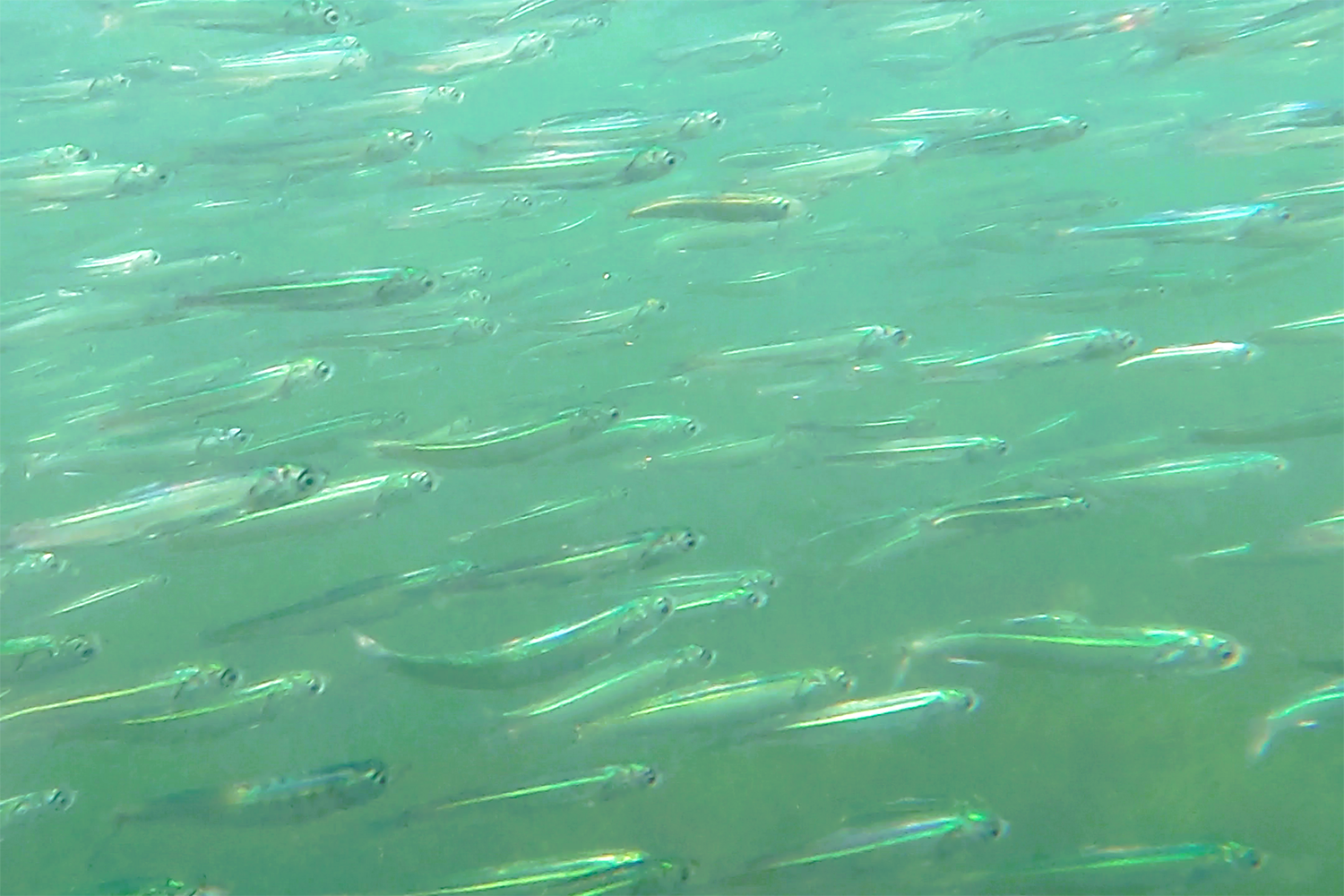
The Peruvian anchovy (Engraulis ringens) is a small pelagic fish that forms large, dense surface schools, has a short life cycle, a fast growth rate, and a naturally high mortality rate. It has a wide distribution, playing an important ecological role in the Humboldt Current and supporting one of the most significant fisheries in the South Pacific. Although spawning events occur throughout the year, the main spawning season is observed during the austral winter, with a peak between August and September. However, Hernández-Santoro et al. reported a delay in the spawning period after 2009 for E. ringens in the northern region of Chile, which could have important consequences for their offspring’s survival, as a decoupling of spawning timing and larval food abundances can severely impact larval survival during their first weeks of life. Despite this, there is no information regarding the effect of this delay on egg abundance on a more local scale.
This article – summarized from the original publication (Bonicelli, J. et al. 2025. Spatiotemporal variation in the spawning strategy of the Peruvian anchovy Engraulis ringens in northern Chile: Is the Peruvian anchovy developing a new strategy for survival? Fisheries Research Volume 288, August 2025, 107458) – discusses a comprehensive analysis of the spatial and temporal variability of anchovy spawning based on three monthly time series of anchovy egg abundance collected over 26 years at three coastal stations in northern Chile.
![Ad for [Aquademia]](https://www.globalseafood.org/wp-content/uploads/2025/07/aquademia_web2025_1050x125.gif)
Researchers uncover possible explanation for California anchovy boom-and-bust cycles
Study setup
This study analyzed the spatiotemporal differences in the spawning of E. ringens in northern Chile. We used three monthly time series of anchovy egg abundance collected over 26 years at three coastal stations in northern Chile (Arica, Iquique, Mejillones) and assessed the relative effects of hydrographic factors (i.e., temperature, salinity) and female reproductive conditions (i.e., Gonadosomatic Index, GI; the calculation of the gonad mass as a proportion of the total body mass) on egg abundance before and after the delay in the reproductive peak observed after 2009. The analysis of egg abundance time series can provide information about the impact of environmental conditions on successful spawning, explaining potential inconsistencies between fecundity and recruitment.
For detailed information on the experimental design, sample collection and analysis, refer to the original publication.
Results and discussion
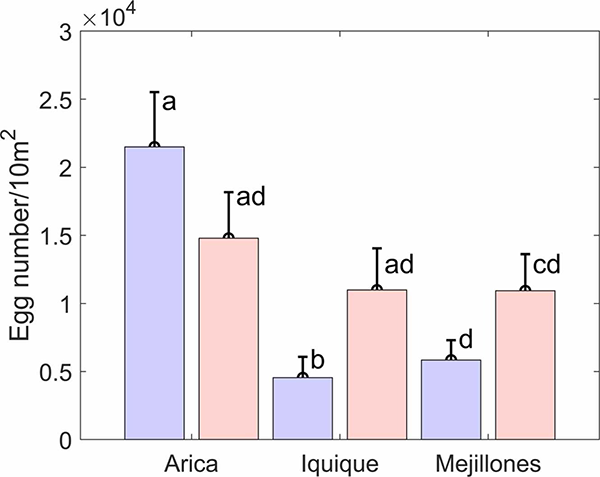
This study examined long-term historical data on egg abundance of the Peruvian anchovy E. ringens in northern Chile, aiming to uncover spatiotemporal variations in its spawning cycle. The analysis spans two distinct periods: P1 (1998–2009) and P2 (2011–2024), focusing on three coastal stations: Arica, Iquique and Mejillones. Overall findings show significant shifts in the spatial distribution and annual variability of egg abundance over time, transitioning toward a more homogenized spawning pattern across sites in P2. During P1, Arica stood out with markedly higher egg abundance, positioning it as the dominant spawning hub in the region. This disparity diminished in P2, where egg levels equilibrated among the stations and were predominantly confined to a core spawning window.
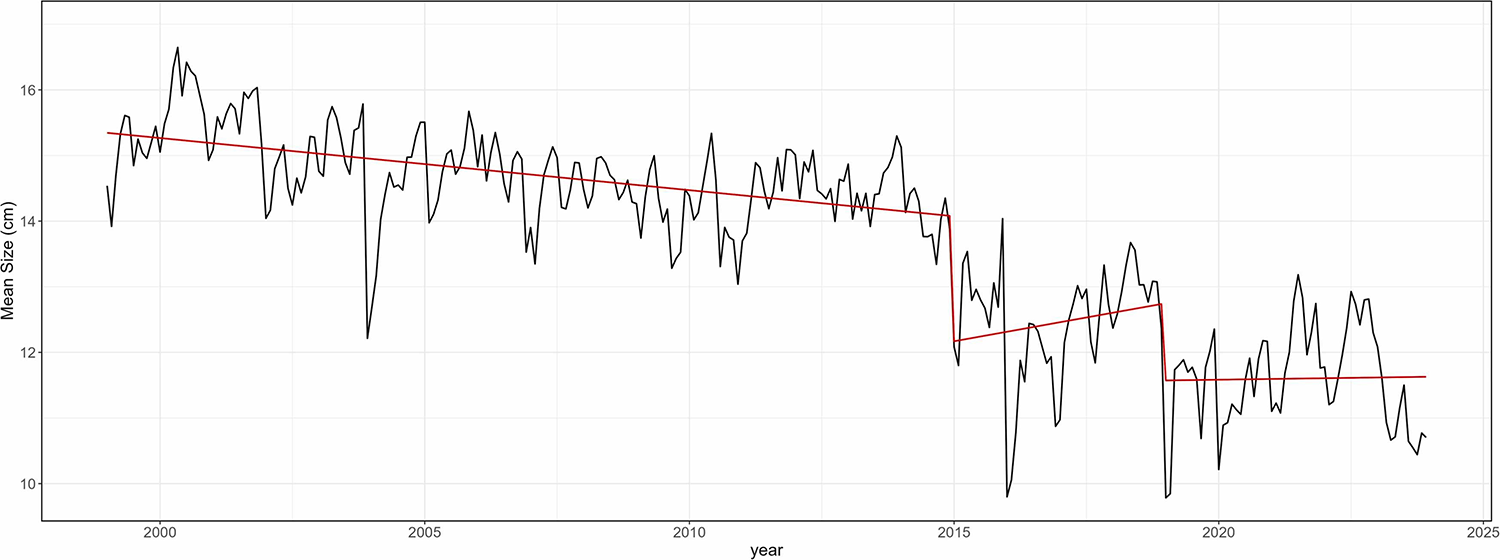
In Arica, while total egg abundance remained consistent between periods, the spawning dynamics evolved notably. The reproductive season contracted in P2, correlating with reduced gonadosomatic index values and a truncated peak breeding phase. Landing data indicate a progressive decline in the body size of E. ringens in northern Chile over the past decade), influencing spatial distribution and reproductive output. Smaller females typically yield fewer and diminutive eggs, alongside abbreviated spawning durations. Thus, the observed temporal and spatial alterations may stem from size-dependent effects, underscoring how demographic changes in adult fish populations can reshape reproductive strategies.
Contrastingly, Iquique recorded the lowest egg abundance in P1, but experienced a substantial uptick in P2, despite unchanged GI levels. This shift points to extrinsic environmental influences rather than intrinsic biological ones. Iquique’s coastal regime features more robust and persistent upwelling compared to Arica, which historically propelled eggs offshore, diminishing detectable abundances at nearshore sampling points during P1. The P2 surge in egg counts, coupled with an elongated primary spawning event, implies enhanced survival prospects, possibly due to moderated upwelling intensity that curbs turbulence and advective losses. Furthermore, this could reflect migratory influxes of females from adjacent zones seeking superior reproductive habitats. Such adaptive relocation patterns have been reported for other pelagic species.
The Mejillones station demonstrated remarkable inter-period stability in egg abundance and spawning cyclicity, suggesting a resilient ecosystem. As a bay sheltered from dominant upwelling currents, it facilitates superior surface water retention, likely sustaining consistent egg densities. Stable GI across periods further indicates unchanging female reproductive health, reinforcing the absence of variability in egg metrics. Moreover, Silva et al. predicted a decrease in the favorable habitats for E. ringens due to warmed waters and low food availability along the northern coast, except at Antofagasta (close to the study site Mejillones), where positive spots can be observed. This supports our results, which showed no change in spawning activity between periods.
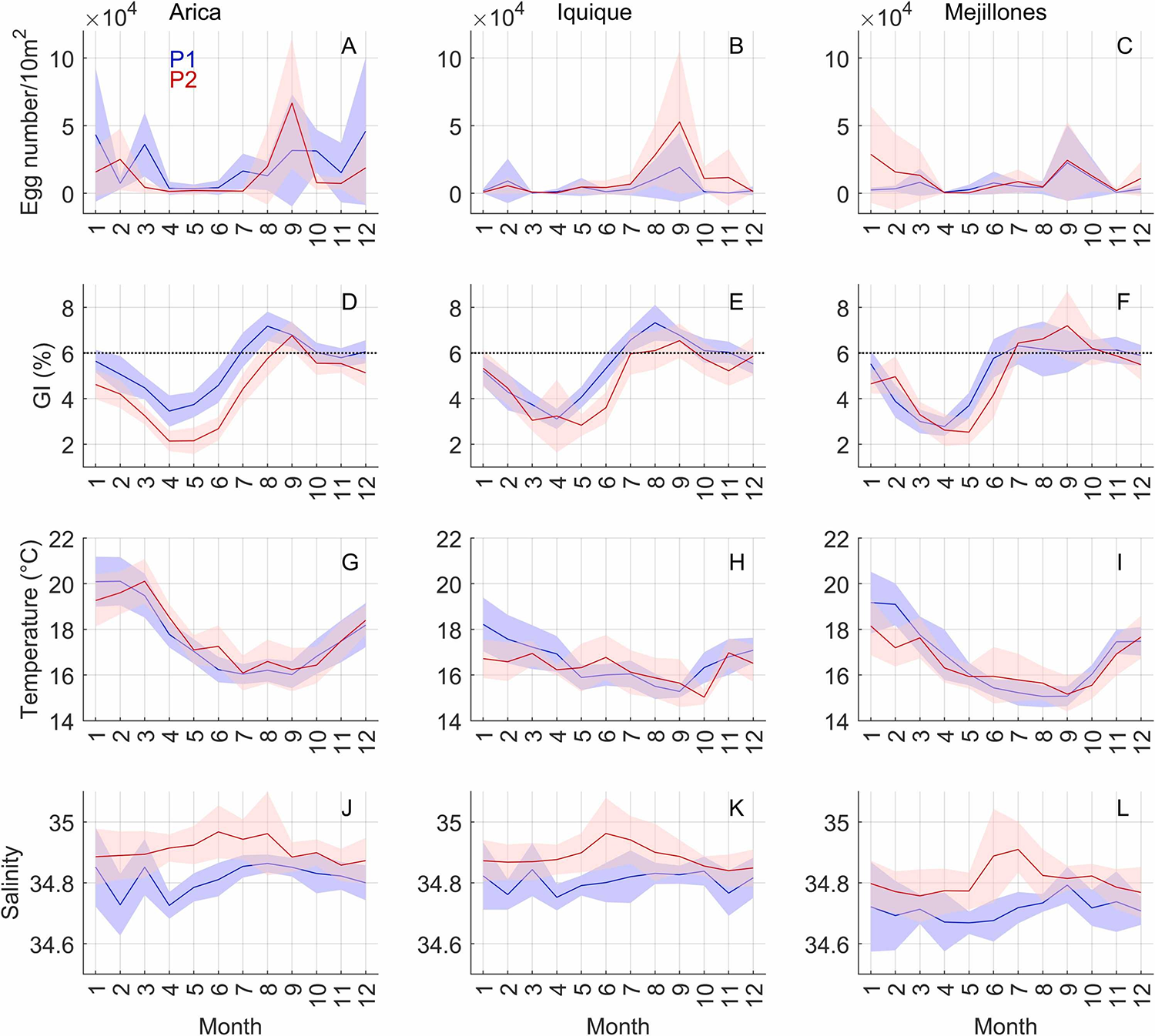
Generalized Additive Model (GAM) analyses highlight site-specific drivers of egg abundance. In Arica, temperature and GI significantly modulated spawning, whereas Iquique and Mejillones showed no such dependencies. The subdued egg levels in these latter sites during P1, juxtaposed with Arica’s dominance, imply they served as suboptimal zones, prompting sporadic spawning pulses uncorrelated with GI or temperature. P2 introduced greater organizational coherence across all sites, with spawning condensing to August–October, indicative of narrowed optimal environmental windows.
Additional evidence includes post-2015 reductions in average anchovy length, where P2 maxima fell below P1 minima spawning stock biomass – assessed through the daily egg production method from annual spring cruises by Chile’s Fisheries Development Institute – declined markedly in P2. Biomass exceeded the median in 9 of 11 P1 years but only in 3 of 8 in P2, with ANOVA confirming a significant drop from 2011–2024, incorporating post-2009 data for robust sampling. These trends –compressed seasons, diminutive adults, and biomass erosion – signal waning spawning vigor. Anchovies may be consolidating efforts temporally to bolster survival, fostering P2’s observed GI-egg abundance linkage and GI-centric modulation absent environmental overrides.
Hydrographic shifts in P2, evidenced by elevated salinity across sites, suggest altered water masses. This period encompassed intense ENSO (El Niño-Southern Oscillation is a major global climate phenomenon that emerges from variation in winds and sea surface temperatures over the tropical Pacific Ocean) fluctuations, including El Niño events in 2015–2016, 2017 (coastal) and 2023–2024, plus a prolonged La Niña from 2020–2023. Such events likely reconfigured habitats, prompting anchovies to favor coastal refugia and temporally restricted spawning for progeny viability. Modifications in reproductive timing and locale can profoundly impact early-life survival by dictating developmental milieus. The match-mismatch hypothesis posits that climatic desynchronization between spawning and plankton blooms erodes stocks via diminished prey interactions.
Annual E. ringens landings in northern Chile have oscillated from 139,301 tons to 1,415,723 tons since 1998, but plummeted recently to 139,301 tons in 2023 per SERNAPESCA (Chile’s National Fisheries and Aquaculture Service), potentially attributable to the documented spawning reconfigurations. Comparable phenomena have been reported by various authors for other similar species in other regions.
Overall, this research explains how intertwined biological and environmental factors – size reductions, biomass declines, upwelling variations, and ENSO perturbations – have restructured E. ringens spawning in northern Chile. The homogenization and temporal contraction in P2 may represent adaptive responses to stressors, but also indicate vulnerabilities for fishery sustainability amid ongoing climate shifts. Future monitoring should integrate these insights to inform management, emphasizing habitat preservation and adaptive strategies to mitigate match-mismatch risks and support population resilience.
Perspectives
To our knowledge, this study is the first to analyze the spawning strategy of E. ringens on a local scale within northern Chile, highlighting the importance of implementing more regional management plans. Future studies should aim to determine the environmental conditions driving these changes. Additionally, characterizing the maternal effects of females involved in both reproductive events, as well as the availability of food for the subsequent life stages, is needed to better understand the reproductive success of the species. Furthermore, determining the population structure and boundaries of the northern population of E. ringens could also explain the differences found here.
The extent to which climate variability impacts the phenology (the study of periodic events in biological life cycles and how these are influenced by seasonal and interannual variations in climate, as well as habitat factors) of marine organisms of economic importance remains a topic yet to be investigated.
Now that you've reached the end of the article ...
… please consider supporting GSA’s mission to advance responsible seafood practices through education, advocacy and third-party assurances. The Advocate aims to document the evolution of responsible seafood practices and share the expansive knowledge of our vast network of contributors.
By becoming a Global Seafood Alliance member, you’re ensuring that all of the pre-competitive work we do through member benefits, resources and events can continue. Individual membership costs just $50 a year.
Not a GSA member? Join us.
Authors
-

Corresponding author
Instituto de Fomento Pesquero, Blanco 839, Valparaíso, Chile -
Instituto de Fomento Pesquero, Blanco 839, Valparaíso, Chile
-
Instituto de Fomento Pesquero, Blanco 839, Valparaíso, Chile
-
Instituto de Fomento Pesquero, Blanco 839, Valparaíso, Chile
-
Instituto de Fomento Pesquero, Blanco 839, Valparaíso, Chile
-
Instituto de Fomento Pesquero, Blanco 839, Valparaíso, Chile
Related Posts
Fisheries
A global IUCN Red List assessment of abalones at risk in a changing climate
Abalone are vulnerable to climate stressors and require restoration aquaculture, reductions in fishing pressure, MPAs and other measures.
Responsibility
Can ranching ‘zombie urchins’ boost uni, save kelp forests?
With Norwegian knowledge and a partnership with Mitsubishi, Urchinomics aims to turn worthless empty urchins into valuable seafood while restoring kelp forests and creating jobs.
Fisheries
Fishing effort dynamics around the Galápagos Marine Reserve as described by Automatic Identification System data
Spatial and seasonal data are essential to understanding fishing effort dynamics and improving fisheries management in less-studied areas.

Aquafeeds
Fishmeal and fish oil alternatives are here but a greater scale is needed for true impact
While salmon farmers are reducing fishmeal and fish oil usage, alternative ingredients are promising but supplies need scaling up, feed experts say.