


Indigenous partnership builds Australia’s first commercial freshwater prawn farming industry

An Indigenous-led project in Queensland aims to launch Australia’s first commercial giant freshwater prawn farming industry
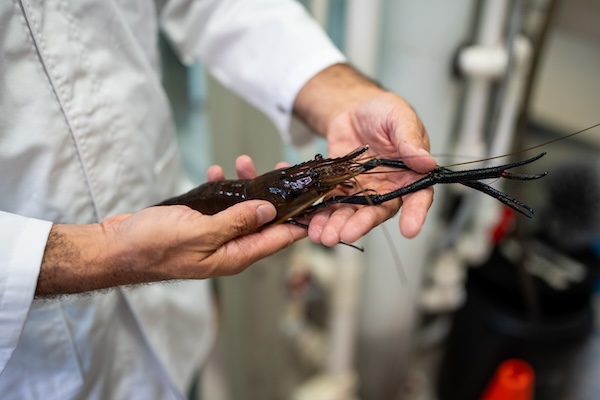
An Indigenous-led partnership in Far North Queensland is working to establish Australia’s first commercial giant freshwater prawn farming industry, combining traditional knowledge with hatchery research to support regional employment and food security.
The initiative is being led by the Hope Vale Foundation with support from the Queensland Government-funded Regional University Industry Collaboration program delivered by CSIRO. Researchers from the University of the Sunshine Coast are developing breeding methods for giant freshwater prawns, addressing a technical barrier that has prevented commercial production in Australia despite established global markets.
“We are leading a first-of-a-kind, Indigenous-led aquaculture revolution focused on scaling up giant freshwater prawn production, right here in Far North Queensland,” said Tony Matchett from Hope Vale Foundation, the community development organisation driving the initiative.
“Our focus is commercializing Australia’s native giant freshwater prawn – a climate-adapted protein with global demand exceeding U.S. $5 billion –yet we have no commercial production in Australia.”
![Ad for [membership]](https://www.globalseafood.org/wp-content/uploads/2025/07/membership_web2025_1050x125.gif)
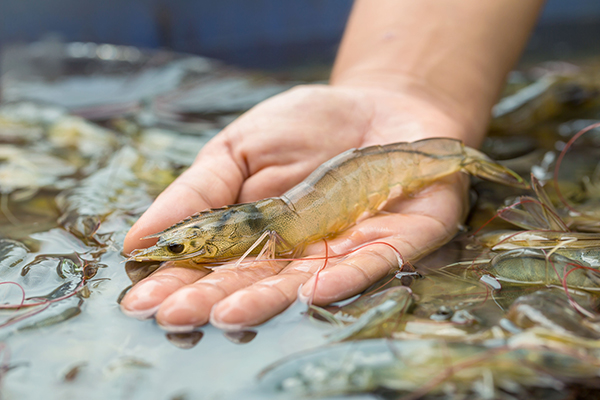
The giant freshwater prawn, a species of the genus Macrobrachium, is native to northern Australian waterways and supports aquaculture industries in parts of Asia and other regions. However, it has not been farmed commercially in Australia because hatchery protocols have not been successfully adapted to local conditions.
Hatcheries produce juvenile prawns that are later grown to market size. Without reliable methods to breed and raise larvae through their early life stages, commercial production cannot proceed.
In controlled tank systems, the research team is monitoring how broodstock from Cape York respond to varying water conditions. They are testing feeding regimes, measuring growth rates and tracking survival as larvae develop into post-larvae and juvenile prawns. The data collected will inform hatchery protocols required for commercial production.
Can this breeding technique breathe new life into giant freshwater prawn farming?
“This is detailed, patient work,” Ventura explained. “We’re establishing optimal temperatures, salinity levels during larval stages, and the right nutrition at each phase. These aren’t just academic questions – they’re the operational manual for commercial producers.”
The project aims to establish reliable hatchery methods to enable commercial scaling, create aquaculture training and employment pathways, and contribute to economic and food security outcomes in Indigenous and remote communities.
Because the species is adapted to tropical freshwater environments, proponents say the model could expand across northern Queensland, the Northern Territory and Western Australia, with hatcheries supplying juvenile prawns to pond and recirculating aquaculture systems.
“We are solving two major problems: the looming global protein supply gap, and food insecurity in remote communities,” said Matchett. “By blending ancient wisdom with cutting-edge agtech, we’re building a scalable hatchery-to-grow-out model that’s low-emission, water-efficient and culturally grounded.”
Now that you've reached the end of the article ...
… please consider supporting GSA’s mission to advance responsible seafood practices through education, advocacy and third-party assurances. The Advocate aims to document the evolution of responsible seafood practices and share the expansive knowledge of our vast network of contributors.
By becoming a Global Seafood Alliance member, you’re ensuring that all of the pre-competitive work we do through member benefits, resources and events can continue. Individual membership costs just $50 a year.
Not a GSA member? Join us.
Author

Related Posts
Health & Welfare
Tasmanians pursue selective breeding to produce salmon with improved heat and disease tolerance
Tasmanian salmon farmers say selective breeding has produced fish with improved tolerance to heat and disease after a major mortality event.
Intelligence
CSIRO introduces pompano to Australian aquaculture to boost economy
A new white-flesh fish for Australian aquaculture, pompano, could boost the economy, reduce imports and offer sustainable seafood options.
Responsibility
Experts discuss seafood nutrition, accessibility and sustainability amid climate change in the Southern Hemisphere
An expert panel of scientists convened by CRC discussed driving the blue economy while improving seafood nutrition, accessibility and sustainability.
Intelligence
Australian biotech company launches early detection technology for shrimp diseases
Genics has launched Shrimp MultiPath2.0, a technology that can detect 18 shrimp diseases and identify genetic variations in a single test.