


FAU’s Queen Conch Lab and ISSF’s Jelly-FAD win the 2025 Responsible Seafood Innovation Awards

FAU’s Queen Conch Lab and ISSF’s Jelly-FAD win top honors at the Responsible Seafood Summit, advancing sustainable aquaculture and fisheries
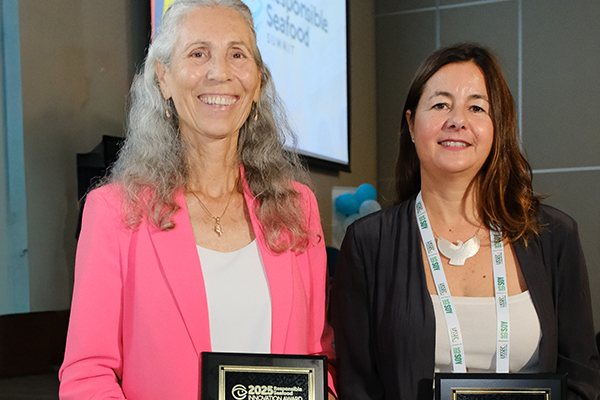
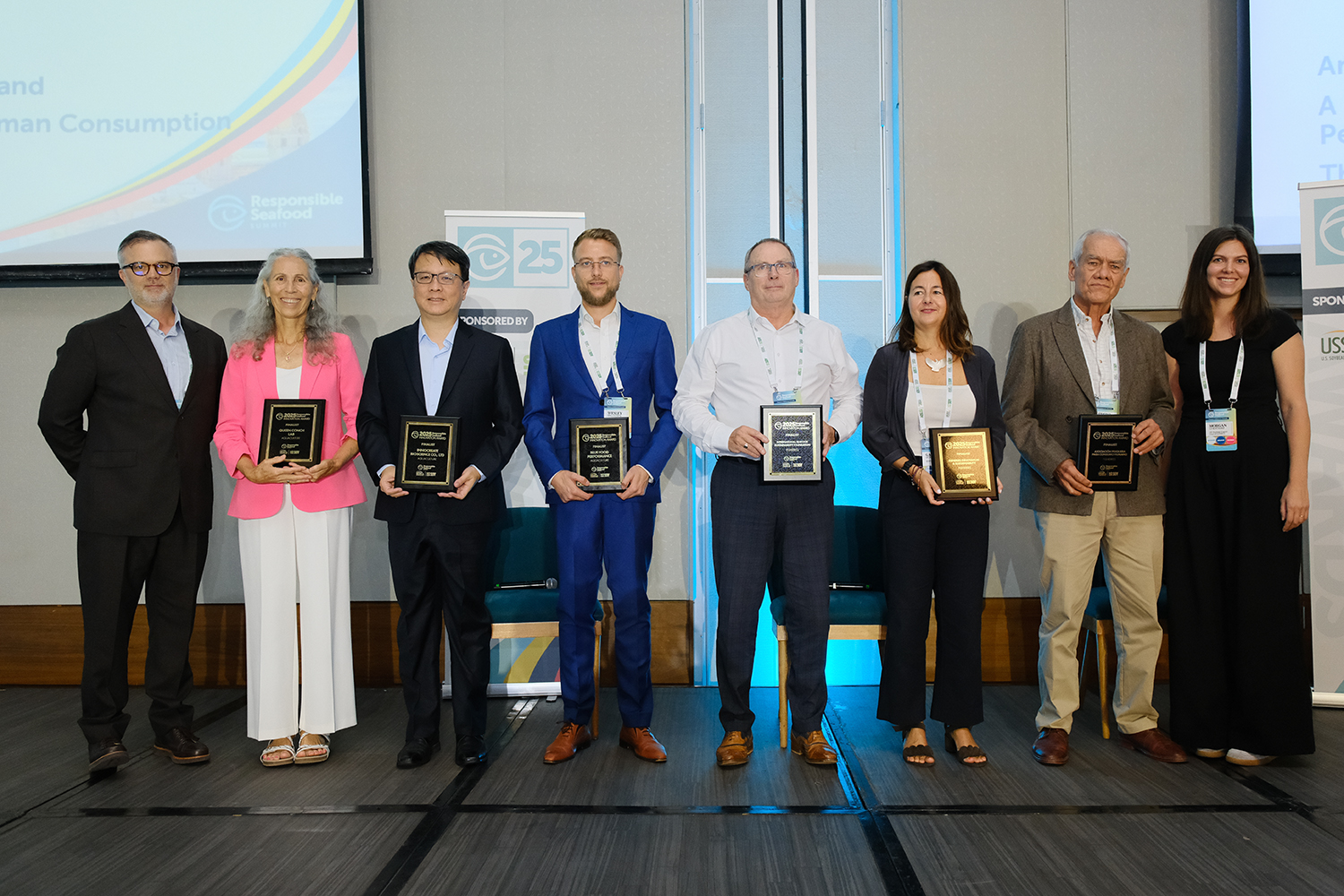
Each year, the Responsible Seafood Innovation Awards spotlight fresh solutions to some of the industry’s toughest challenges. Sponsored by the U.S. Soybean Export Council (USSEC), this year’s program opened with presentations from USSEC and last year’s fisheries category winner, Genus Wave – a startle technology that uses short bursts of sound to keep marine mammals away from fishing operations, cutting bycatch and noise pollution.
After finalist pitches, an audience vote awarded Florida Atlantic University’s (FAU) Harbor Branch Oceanographic Institute the winner of the Responsible Seafood Innovation Award in aquaculture for its Queen Conch Lab — a mobile hatchery program restoring the species across the Caribbean.
“It’s a plug-and-play lab that brings aquaculture to previously unconsidered areas of the Caribbean,” said Dr. Megan Davis, research professor at FAU. “Over the past seven years, we’ve built nine mobile labs. We’ve delivered them to Puerto Rico, Jamaica and the Bahamas, and we’re in discussion with Turks and Caicos, Saint Vincent and the Grenadines and St. Lucia.”
The queen conch has suffered steep declines from overfishing and habitat loss, and NOAA listed the species as “threatened” under the Endangered Species Act in 2024. Surveys warn that Bahamian fisheries could collapse within 10 to 15 years. Davis, however, is charting another path with these mobile labs.

“We can take aquaculture to previously unconsidered areas,” she said. “We can employ the local people. We’ve fostered global partnerships. We’ve secured multi-million dollar brands, and attracted a world-renowned chef and philanthropist [as a partner].”
Each trailer-sized lab runs on solar power and connects to coastal seawater to create a self-contained hatchery. But FAU isn’t just delivering equipment. The program partners with local groups to drive restoration, careers in science and sustainable seafood.
“It’s a small investment with a big impact, bridging aquaculture, fisheries, conservation and community,” said Davis.
ISSF won the Global Seafood Alliance’s Responsible Seafood Innovation Award in the fisheries category for its Jelly-FAD — a fish aggregating device (FAD) that reduces bycatch, ghost fishing and ocean pollution. Built from sustainable, locally sourced materials and free of netting, it cuts entanglement risks while maintaining fishing efficiency.
ISSF researchers had tried swapping plastics and metals for biodegradable materials, but early designs lasted only months. The breakthrough came from the jellyfish.
“We call it the jelly-FAD because it mimics the jellyfish,” said Gala Moreno, ISSF senior scientist and developer of the jelly-FAD. “It drifts with neutral buoyancy and uses biodegradable materials instead of plastic.”
With neutral buoyancy, the jelly-FAD is lighter and collapsible, with a submerged raft for shade and an artificial reef effect tethered by a drogue for stability. Clay solves deployment challenges by providing weight that dissolves quickly after submersion. Made from clay, bamboo, canvas, cord and cotton rope, it balances durability, cost and accessibility.
“We had to do something that could be used on a remote island in the Pacific,” said Moreno. “So, you have to use bamboo, you have to use clay, something that anyone can find and is cheap.”
The Responsible Seafood Innovation Awards celebrate individuals and organizations tackling the seafood industry’s toughest challenges with fresh ideas. The competition includes two categories — aquaculture and fisheries — and has been held annually since 2012, when the Global Seafood Alliance launched it to spotlight solutions driving a more sustainable future for seafood.
Read more Responsible Seafood Summit coverage here.
Now that you've reached the end of the article ...
… please consider supporting GSA’s mission to advance responsible seafood practices through education, advocacy and third-party assurances. The Advocate aims to document the evolution of responsible seafood practices and share the expansive knowledge of our vast network of contributors.
By becoming a Global Seafood Alliance member, you’re ensuring that all of the pre-competitive work we do through member benefits, resources and events can continue. Individual membership costs just $50 a year.
Not a GSA member? Join us.
Author
-

Lisa Jackson is a writer based in Hamilton, Canada, who covers a range of food and environmental issues. Her work has been featured in Al Jazeera News, The Globe & Mail and The Toronto Star.
Related Posts
Intelligence
The Advocate reports from the Responsible Seafood Summit in St Andrews
More than 80 speakers took the stage to discuss a wide range of topics in fisheries and aquaculture and responsible seafood sourcing.
Fisheries
Responsible Seafood Innovation Awards finalist: The on-board innovation set to improve animal welfare – and life on deck – for the U.K. scampi industry
A new on-board machine that stuns and tails nephrops could transform UK scampi fishing with better animal welfare, safer crews and higher value.
Innovation & Investment
Responsible Seafood Innovation Awards: Anchoveta for all – Peru’s Fisheries Association for Human Consumption drives food security and better livelihoods for fishers
Peru’s Fisheries Association for Human Consumption promotes anchoveta consumption to aid food security, health and artisanal fishers’ livelihoods.
Aquafeeds
Responsible Seafood Innovation Awards: Blue Food Performance wants the industry to speak the same language on fish-in:fish-out metrics
Blue Food Performance’s FIFO Performance Tool standardizes fish-in:fish-out metrics to strengthen aquaculture, improve transparency and counter misinformation.