


Beyond bait: Fisheries innovators use light, behavior and biology to reduce impact

‘Baitless’ fishing systems move from fringe experiments to commercially meaningful applications
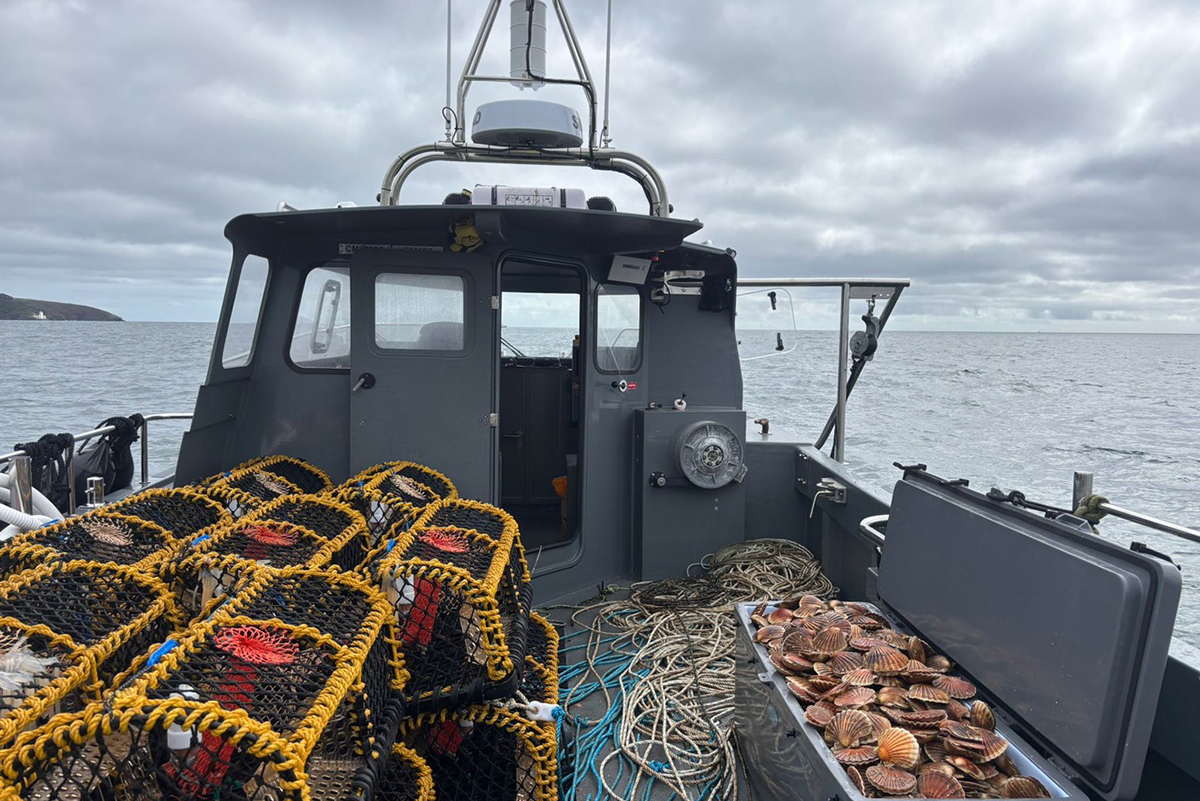
For centuries, commercial fishing has relied on one simple principle: Bait attracts fish.
From crab pots baited with oily fish to longlines with thousands of hooks, consumable attractants have long sat at the center of capture fisheries economics.
Today, a new generation of fisheries innovators across Europe, North America and beyond is balking on bait and exploring “baitless” systems that use visual stimuli, species-specific responses and gear design to draw in target species, rather than directly offering up food.
While such concepts remain niche – and, in many fisheries, experimental – growing industry pressure around fuel costs, bait prices, bycatch reduction and environmental performance is driving keen interest in technologies that could fundamentally alter how some fisheries operate in the future.
![Ad for [BSP]](https://www.globalseafood.org/wp-content/uploads/2025/07/BSP_B2B_2025_1050x125.jpg)
Among those challenging the status quo are organizations like U.K.-based Fishtek Marine, the Netherlands’ Pot Fishing Agency and the International Pole & Line Foundation (IPNLF), which alongside a growing number of operators, are trialing alternative capture systems.
Achieving varying levels of success and progress, they’ve helped shift the central question on from “are baitless fisheries technically possible” to “can they deliver without compromising on catch efficiency or profitability.”
Where baitless is already proven
Few companies have been more closely associated with baitless fishing innovation than Fishtek Marine. Originally known for bycatch reduction technologies and fisheries consultancy work, the U.K.-based company has increasingly focused on practical ways to improve static-gear performance without relying on conventional bait inputs.
“Fishtek Marine as a company is pretty unique in that we do everything from fisheries consultancy and conceptualization through to prototyping, field testing, manufacture and ultimately resale,” technical sales manager Thomas Day explained to the Advocate. “The best bit of my work – and probably the most interesting – is getting out on boats, collecting data, proofing our products and chatting to fishermen. That’s really where you start seeing the little nuances in fisheries.”
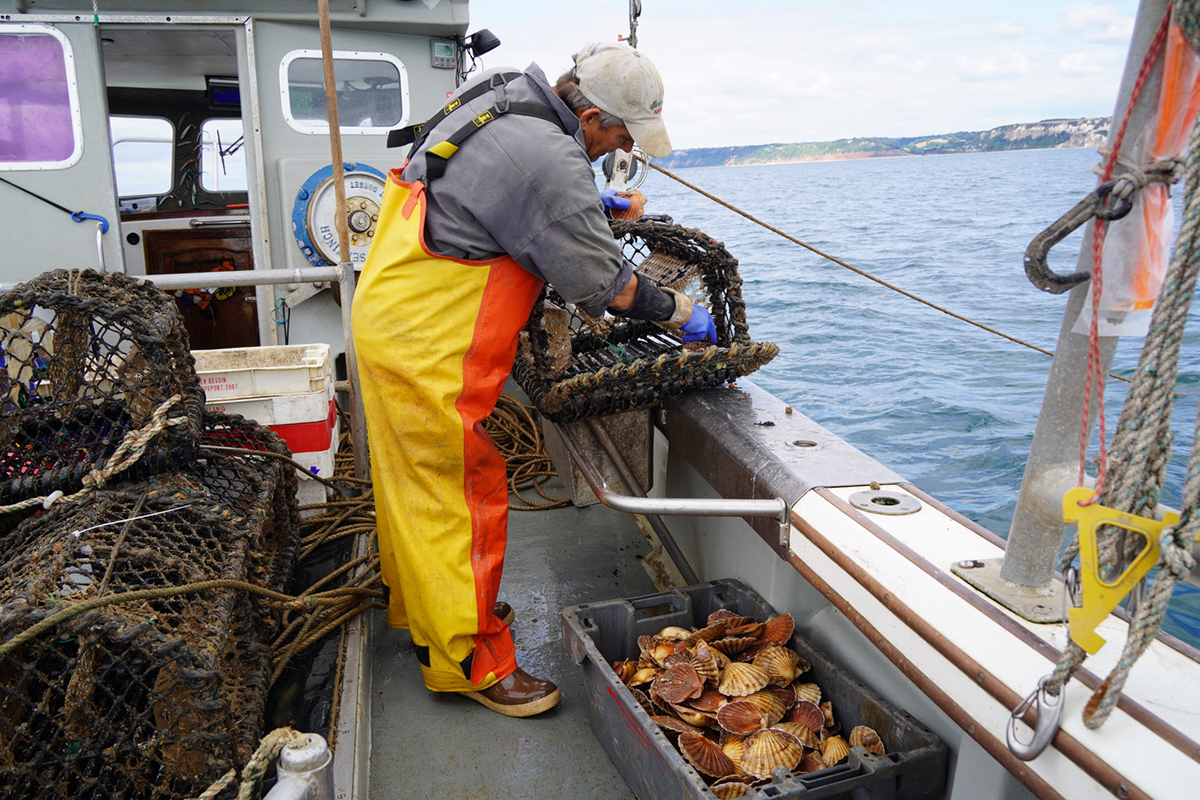
One of the company’s best-known projects is its scallop potting initiative, commercially branded as “Disco Scallops,” where illuminated pots are used to attract scallops without bait. This fishery has evolved into a commercially active operation, including supplying U.K. seafood restaurant group Rockfish and its online retail marketplace.
Illuminating the way: How light technology is reshaping fisheries
“Many didn’t believe you could create a viable scallop fishery using lights. Now, five years later, we’re landing between 4,000 and 12,000 scallops a week – from just a handful of boats,” Day said.
Outperformed by light
The science behind many baitless fisheries is rooted in behavioral ecology. In Norway’s emerging cod pot fishery, for example, lights are not attracting cod directly. Instead, they trigger what Day describes as a “trophic or predatory cascade.”
“The lights attract zooplankton – krill, mysids and similar species – and then the cod move in to feed on them. That’s the attraction method.”
It’s an approach that’s gained significant traction in northern Norway since regulators lifted restrictions on the use of lights in fisheries several years ago. According to Fishtek, cod catches using illuminated pots can substantially outperform conventional baited systems.
“There was research by the Norwegian Fisheries Institute showing that using lights could drastically increase cod catches – in some cases by as much as 17 times compared with bait alone,” Day said. “Fishermen in Norway relay that 50 kilos of cod per shot is pretty standard now, with some being over 200 kilos on a single, short soak.
“Alaska’s Pacific cod pot fishery is another market we’re expanding into now, with the quality of pot-caught fish demanding a great market price. This benefit, we’re finding, is filtering down to those fishermen who are willing to spend on a kit like our lights to gain an edge.”
The cost logic is just as compelling: Unlike bait, which degrades after a matter of days, light systems continue functioning throughout the effort period, allowing fishers to avoid recurring and often volatile bait expenses.
“Bait prices fluctuate massively – anywhere between GBP 25 and GBP 50 (U.S. $33–66) a box,” Day explained. “Compare that with fishing using lights. You only change the battery every six weeks, which works out at a fraction of a penny per day. As long as a light is operating, you know the pot is actively fishing.”
Reducing the bait burden
One of the strongest sustainability arguments for baitless fishing lies in reducing the dependence on bait fisheries themselves, with many commercial fisheries continuing to rely heavily on small pelagic species and fish-processing waste as bait inputs.
While some of bait sources are byproducts, others compete directly with food systems, aquaculture feed supply chains or marine ecosystems that are already under pressure. Developers therefore argue that alongside reducing the operational costs, replacing or reducing bait demand could help improve overall seafood system efficiency.
Supporters of baitless systems also argue the technologies align closely with broader fisheries sustainability goals. Static gears generally generate lower seabed impacts than mobile bottom-contact gears, while selective pot fisheries can also reduce bycatch and discard mortality through being very size selective when the gears are well designed.
There’s also growing policy relevance as governments and seafood markets increasingly prioritize lower-impact fisheries. In the U.K.’s Isle of Man, for example, Fishtek’s scallop-potting trials were granted access to areas closed to mobile gears because the fishery aligned with conservation objectives. Similarly, in the Lyme Bay Marine Reserve (Dorset, U.K.), dredging scallops was banned in 2008. Since then, both the environment and scallop populations have experienced dramatic turnarounds, with the latter recovering to the extent that there’s now a new, high-value domestic market for low-impact, pot-caught scallops.
This, Fishtek asserts, is a “stunning example” of what effective management can achieve for the environment and local fishing economies.
It’s also for reasons such as these that the Pot Fishing Agency has spent years exploring alternative attractants for species such as crab, lobster, Dover sole and langoustines, explained the Dutch-based company’s founder, Stefan Tijsen.
Among a broad portfolio of projects that include the “Clawbinder Pro” machine that seals PVC sleeves over crab claws and an “Oyster Innovator Robot” that turns, cleans and shakes oyster bags, the company is also developing biodegradable gel-based attractants, timed-release bait systems and behavioral triggers designed to maximize attraction while minimizing bait waste.
“What we’re seeing with normal bait is that you put it into the pot and after a few days the smell is already gone on the seabed,” Tijsen explained. “What we want to do is create systems that attract animals for much longer.”
Another concept it has under development involves timed bait-release tubes designed specifically for Dover sole fisheries. The idea being that bait cues are released only during periods of peak activity – particularly at night, when sole leave the seabed and begin swimming.
“You want to create a bait bloom that travels for miles,” Tijsen said. “Instead of losing bait continuously, the system would release attractants only at the right moment.”
Cost remains a limiting factor
Of course, not all fisheries respond equally to behavioral attractants. Fishtek’s own trials in Scotland’s northern pink shrimp fishery failed to demonstrate commercial viability at that stage, although the company believes further gear optimization would help.
Technology costs also remain relatively high, particularly for deepwater fisheries requiring robust pressure-resistant lighting systems.
However, the company’s latest PotLight Pro technology, designed for fisheries operating at depths of up to 1,000 meters, represents a major technological leap – albeit one that’s still likely to be adopted in wealthier fisheries first.
“We’ve already got trials underway with the Australian government exploring deepwater shrimp fisheries using our lights, because competitor systems leaked regularly and not even at half the depth of our Pro lights,” Day said.
Initially, Fishtek expects the technology’s uptake to remain “concentrated and at pace” in high-value, derby fisheries looking for the edge over their counterparts. However, it has also recognized there’s enormous scope in fisheries such as those in Asia that revolve around species like cuttlefish, gurnards and even potentially blue swimming crab, with recent tank trials showing they all respond to light.
Underlying such projects is a broader industry conversation around fishing efficiency – not simply maximizing catches, but improving how catches are achieved, such as reducing reliance on monofilament gillnets that bring a higher risk of marine mammal and turtle bycatch. Other projects aim for techniques that reduce seabed habitat disturbance.
For both Fishtek Marine and the Pot Fishing Agency, baitless systems exist to address operational efficiency as well as environmental performance.
“I always look first from the perspective of the fisherman,” Tijsen said. “Bait is becoming a really big problem because of the costs. If your pots stay in the water for a week but your bait only works for two days, that’s not efficient.”
Breaking tuna’s live-bait dependence
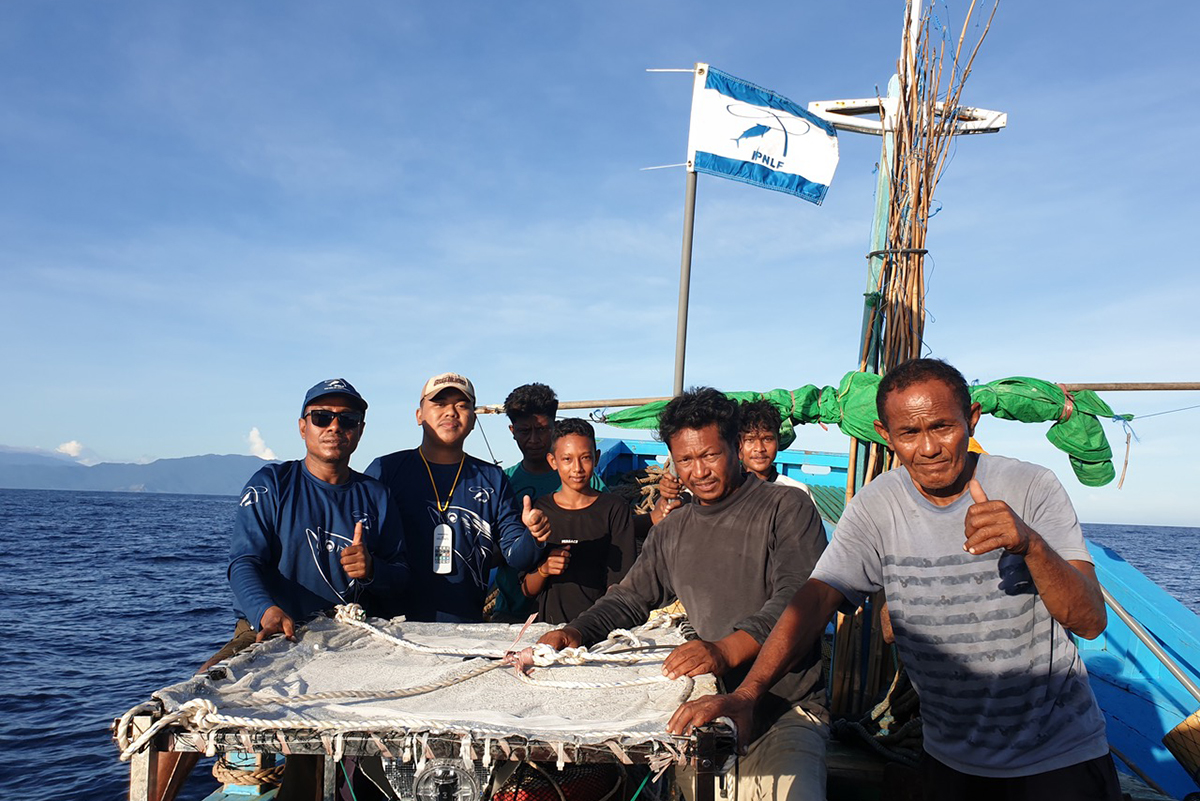
While much of the current momentum regarding baitless fishing centers on pots and creels, another strand of innovation has emerged in one of the world’s most visible low-impact fisheries: pole-and-line tuna fishing.
For decades, live baitfish have been central to pole-and-line tuna operations, particularly in regions such as Indonesia and the Maldives. There, small pelagic species are captured alive, stored onboard in circulating tanks and then released during fishing operations to trigger feeding frenzies that keep tuna schools close to vessels.
But according to the IPNLF, dependence on live bait is increasingly becoming one of the sector’s biggest operational constraints – economically, logistically and environmentally.
“Should pole-and-line tuna fisheries be decoupled from this dependence on live bait, it will become more cost-effective and efficient, making it a more commercially competitive fishing method,” explained Craig Turley, fisheries director at IPNLF. “It would also reduce the carbon footprint of these fisheries, because less time and fuel would be spent searching for baitfish.”
In 2022, IPNLF launched an experimental alternative live bait project funded through the U.K. Government’s Darwin Innovation Fund, partnering with technology company CatchCam Technologies. Instead of using live bait to provoke feeding, the project explored whether tuna could be drawn in through a combination of programmable LED lighting, underwater sound playback and olfactory stimulation.
“The project was highly experimental and innovative in its approach,” Turley said. “We hypothesized that tuna would be triggered to feed by some combination of visual, auditory and olfactory cues.”
To test that theory, researchers developed an experimental rig incorporating programable underwater LED systems alongside underwater speakers supplied by Lubell Labs. Initial trials attempted to deploy the systems aboard operational fishing vessels, but researchers quickly encountered practical difficulties.
“It became very disruptive to fishing operations and difficult to isolate what may or may not have been working under dynamic ocean conditions,” Turley explained.
The project later pivoted to sea-cage experiments in northern Bali using juvenile tuna held in controlled environments. Even there, though, maintaining healthy tuna proved difficult, with stress and mortality affecting feeding behavior and complicating data collection.
While by the end of the two-year project, the concept remained unproven commercially, Turley insists the underlying logic still holds strong promise.
“The challenge is finding the right combination of stimuli, at the right intensity, that can reliably trigger a feeding frenzy under real ocean conditions in a way that is repeatable and scientifically robust,” he said. “Even with live bait, it can sometimes be difficult to trigger feeding behavior in an uninterested school of tuna.”
Is the seafood industry prepared for the next level of transparency under CSRD?
A potential step-change for one-by-one
With the understanding that in some one-by-one tuna fisheries, as much as 40 percent of operational fishing time can be spent searching for and capturing live baitfish – a situation that in turn creates significant fuel costs, labor demands and vulnerability to baitfish availability, Turley believes reducing that dependence could fundamentally reshape the sector’s economics and scalability.
“A fully baitless system, or even a significant reduction in live bait use, would almost certainly be a step-change in one-by-one tuna fisheries,” he said. “It could open opportunities for low-impact tuna fisheries in regions where live bait availability currently limits development.”
For now, IPNLF sees more immediate gains through improving live bait handling systems, onboard bait wells and survival rates – interventions that can already significantly improve bait-to-tuna efficiency ratios. But the organization still maintains the wider concept deserves further exploration.
“To solve this challenge requires creativity and expertise from many different disciplines,” Turley suggested. “Personally, I think this type of problem lends itself really well to a hackathon-style competition.”
For now, the work by IPNLF, Fishtek Marine, and the Pot Fishing Agency sits within a swelling number of projects that point toward a possible future in which fisheries increasingly rely on species’ behavioral science and environmental understanding rather than consumable inputs alone.
Now that you've reached the end of the article ...
… please consider supporting GSA’s mission to advance responsible seafood practices through education, advocacy and third-party assurances. The Advocate aims to document the evolution of responsible seafood practices and share the expansive knowledge of our vast network of contributors.
By becoming a Global Seafood Alliance member, you’re ensuring that all of the pre-competitive work we do through member benefits, resources and events can continue. Individual membership costs just $50 a year.
Not a GSA member? Join us.
Author
-

Jason Holland is a London-based writer for the international seafood, aquaculture and fisheries sectors. Jason has accrued more than 25 years’ experience as a B2B journalist, editor and communications consultant – a career that has taken him all over the world. He believes he found his true professional calling in 2004 when he started documenting the many facets of the international seafood industry, and particularly those enterprises and individuals bringing change to it.
Related Posts

Intelligence
Bangladesh seeks more buck for its ‘bagda’
As more than 80 percent of Bangladeshi shrimp exports already go to EU markets, a consultation meeting involving buyers from the bloc and Bangladesh industry stakeholders and authorities was held at the end of last month in Utrecht, the Netherlands.
Innovation & Investment
Mind the gap: Smart cameras are pushing aquaculture performance into a new phase
Norway’s salmon sector is rapidly adopting smart cameras and the performance gap between farms with and without these systems is becoming harder to ignore.
Intelligence
Can Britain learn to love sardines? Shifting seafood market trends hint at change
New research explores shifting U.K. seafood market trends and whether consumers are ready to embrace local fish like sardines, sprats, anchovies and herring.
Innovation & Investment
Responsible Fisheries Innovation Award Finalist: Global Fishing Watch’s digital tool to combat IUU fishing
Global Fishing Watch’s new open-access platform strengthens the fight against illegal, unregulated and unreported (IUU) fishing and helps reduce supply chain risks.