


Global shrimp industry navigating sustainability, innovation and shifting trade dynamics

Conference explores wild shrimp fisheries, shrimp byproduct valorization, small-scale producer challenges, growing consumption, automation and more
Focused on all things shrimp supply chain related, the 2025 Global Shrimp Forum, held on September 2 to 4 in Utrecht, Netherlands, convened more than 580 industry stakeholders to discuss the pressing challenges and opportunities facing the global sector.
With a focus on sustainability, innovation and resilience, the fourth annual edition of the forum featured many expert speakers, with key discussions centering on topics such as climate-smart farming practices, supply chain transparency and the industry’s response to a fast-changing global trade landscape.
The event also underscored the sector’s commitment to transformation, with initiatives like the launch of the “Carbon Footprint of Farmed Shrimp: An Industry Guide,” which is aimed at providing actionable insights for reducing greenhouse gas emissions in shrimp farming.
Wild-caught shrimp must plug the sector’s data gaps
Ahead of the conference proper, a couple of side events helped get delegates into a shrimp-focused mindset. The first of these, a “wild-caught shrimp summit,” hosted by the Marine Stewardship Council (MSC), highlighted the sustainability journey of wild-caught shrimp fisheries, with its 3.3 million metric tons (MT) accounting for around 27 percent of the overall 12 million MT global shrimp production volume.
![Ad for [BSP]](https://www.globalseafood.org/wp-content/uploads/2025/07/BSP_B2B_2025_1050x125.jpg)
MSC Program Development Director Camiel Derichs further noted that when looking at the international trade data, wild-captured shrimp “punches above its weight,” making up between a third and 35 percent of global trade.
“It is an important part of the global shrimp industry. And even if aquaculture is getting more important, wild-captured shrimp provides an incredible amount of jobs for communities,” he said.
However, Derichs also acknowledged that just a third of global shrimp stocks are certified or are part of a fishery improvement project, while two-thirds have not been assessed or don’t have any form of sustainability classification thus far. This, he said, indicates there are a lot of data gaps in the industry, adding that this is confirmed by the FAO’s State of World Fisheries and Aquaculture (SOFIA) reporting.
“This is a real sustainability challenge, with real risks associated for reputation. Consumers care about sustainability…We [also] see that there are market challenges in the case of those fisheries that are not sustainable, they don’t have easy access to the market. They also have challenges to find capital.”
He continued: “Regulatory compliance becomes an increasing challenge as well. If you want to make a sustainability claim or a responsibility claim on packaging in Europe, you need to meet the green claim requirement.”
It’s more than a business, it’s our life. We work very hard, and we try to be resilient in all the stages that we have to face.
But there are solutions to these and other challenges, Derichs insisted: “The fisheries managers of this world, when they have data, they can make well-informed decisions, they can allow stocks to recover.”
He also pointed out that fish stock recovery and adopting proper fisheries management systems are included in the United Nations’ SDG 14’s ocean targets: “The UN recognizes this is not just something that the public sector can do alone, it’s something they need to work together on with the private sector and have credible tools and systems necessary to help private sector and public authorities demonstrate compliance with targets under the SDGs, and it recognized, for instance, credible certification systems like MSC to help in this respect.”
Shrimp fisheries engagement with MSC is increasing, Derichs said. Today, 17 species of wild-caught shrimp or 500,000 MT of MSC-certified products are available in the global market.
“We see fisheries around the world, especially now in the Global South, starting to engage and embark on improvement projects, including a number of fisheries in India, Indonesia and some fisheries that are suspended, trying to work their way back to get the recognition of the MSC program. And later this year, we hope to celebrate the certification of Argentinian red shrimp.
“These fisheries are there for a reason. Of course, they are well-managed, sustainable operations that want to communicate effectively in the market. They also want to have the market benefits.
“Sustainability challenges are definitely present in this industry, but we know that with good fisheries management and tools such as MSC, we can address reputational risks and produce essentially sustainable long-term opportunities for wild-caught shrimp,” he said.
Small-scale shrimp producers: the inclusivity challenge
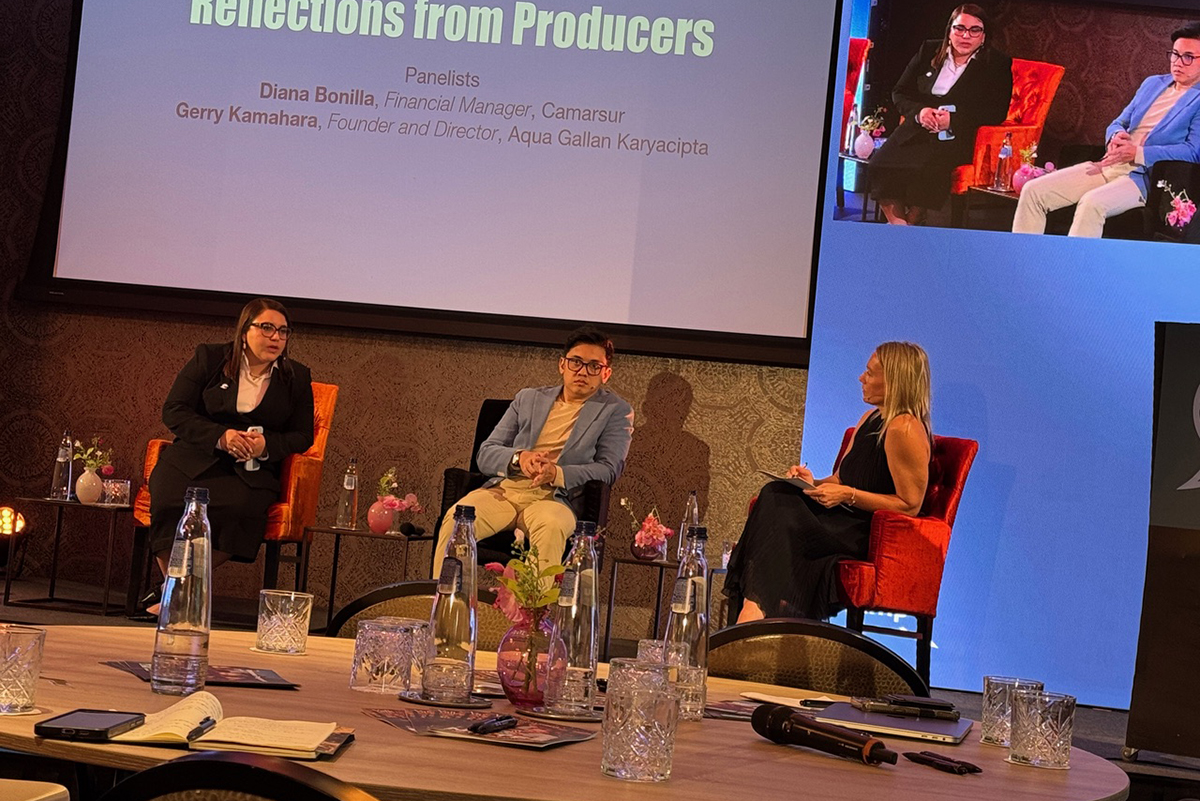
The second side event, delivered by the Aquaculture Stewardship Council (ASC), focused on the challenges faced by small-scale shrimp farmers, particularly in Honduras and Indonesia, in surviving in a worldwide industry. Setting the scene, BioMar’s Global Marketing Director Katherine Bryar explained that throughout the global seafood space, endeavors geared toward such goals as consolidation, certification and traceability have exerted a lot of additional pressure on small-scale producers, and what’s needed now are efforts to help progress these independent ventures so they are included and supported in their continuous improvement and so they can meet current and future demands.
From the certification side, ASC’s Improver Program Global Lead Roy van Daatselaar acknowledged there are “a lot of challenges” that are hindering smaller, independent farmers from being part of international supply chains, particularly the demand from the marketplace to supply a certified product – not least issues with access to finance, access to inputs, the role of technology.
“There’s a lot happening in the space at the moment. There’s a lot of institutional hurdles that the sector needs to address before certification becomes sort of part of that part of that picture. ASC is not here to certify the whole world – that’s actually not what we want. Our mission is to sort of drive the uptake of responsible output, and we use our certification program as an instrument to do that. But I think we need to realize that [certification] is not the only instrument in the toolbox.”
Instead, what ASC is looking to do is drive some “shared thought leadership” in the shrimp industry, with the hope to create a coalition of “front-runners” that can take, test, and bring to scale some of the existing best-practice models and novel ideas around finance and onboarding new technologies, van Daatselaar said.
Underlying the challenges faced at a small-scale producer level, Diana Bonilla, Financial Manager at Honduras shrimp farmer Camarsur, said that, as well as accounting for 2.2 percent of the country’s GDP and generating USD 280 million annually, the country’s shrimp industry provides direct employment for 20,000 people, and indirectly for a further 100,000.
“It’s more than a business, it’s our life. We work very hard, and we try to be resilient in all the stages that we have to face.”
However, environmental vulnerability and market access following the loss of the Taiwan market have become increasingly difficult, while financial access is the biggest barrier to further industry expansion, she said.
“If we could have financial access and low interest rates, farmers can invest in technology…we can have automatic feeders as well as aerators, and that way we can lower our production faster. We can also work on finding ways to get certified so that we can get into other markets, and that way we can improve and grow.”
It’s a similar situation for Indonesia’s small-scale sector, confirmed Gerry Gilang Kamahara, Founder and Director of Aqua Gallan Karyacipta (AGK), a company committed to transforming Indonesia’s shrimp farming sector through strategic farm rent acquisitions and sustainable aquaculture practices.
Banks don’t see these producers as creditable, Kamahara said, explaining that AGK looks to overcome this financial problem by offering a profit-sharing model with “zero financial risk.”
In taking on the risk, it’s helping to mitigate the situation that these producers find themselves in, he said.
Recognizing the financing challenge, the meeting discussed the implementation of a new “baseline code” in the shrimp industry to standardize practices at a national level, enable market access and improve supply chain efficiency, while giving local ownership.
Part of the problem is communications, Bryar said. “There are a lot of green loans and green opportunities that aquaculture would fit naturally into if bankers actually understood the value that [aquaculture] brings to the world.”
She continued: “I do believe that when we come together, great things can happen. And I very much like the idea of bridging the gap and going to small-scale farmers and finding out what they need and who they are and what makes them special. From there, we can enter into new dialogs, figure out technologies and things that will actually solve their problems, rather than what we believe or perceive to be their problems. But I think communication, as per normal, always ends up at the top of the conversation, whether it is communicating between ourselves or understanding truly what the small-scale farmer needs.”
Growing the pie – why shrimp needs to focus on consumer consumption
The competition between producers in Latin America and Asia for markets isn’t the most important battle going on in the shrimp industry today. Instead, it’s the fight to grow the product’s overall share of the consumer wallet, according to Nutreco CEO Bastiaan van Tilburg.
Presenting the Global Shrimp Forom keynote titled “State of the Industry – a Skretting Perspective,” Van Tilburg acknowledged the impact of technology, geopolitical disruptions, and sustainability on the industry. Sharing insights from Ecuador’s and India’s shrimp farming industries, he also emphasized the need for innovation and collaboration.
While the markets, environments, farming practices and systems, and also challenges for these two producer countries are very different, there is an opportunity to apply experiences and knowledge to unlock further potential, particularly those that led to Ecuador’s big production boost, he said.
“Everybody knows the potential of the [Indian] market is a lot higher than we are seeing today. Now, how do you want to unlock that potential? That is probably the question on many people’s minds, and there are many answers to it. We have invested a lot of time and energy in understanding this, and of course, it’s not a ‘copy and paste’ of what we’ve seen in other markets, because the system is different. But that doesn’t mean you cannot use similar solutions and then customize them and come to success.”
As a result of farm technifications, there have been some “very interesting performance improvements” on FCRs, survival rates, cycle dates, growth and size variation, van Tilburg said, adding that alongside the farmers, banks have been very interested in these results, which is key to financing new approaches and investing in new systems, with the availability of lower interest rates.
“It’s a fantastic way to grow the industry,” he said, adding that another way to achieve this would be to grow India’s per capita consumption from its current level of less than half a kilogram each annually, compared with 2.3–2.7 kilos in the United States.
“If India was consuming the same amount of shrimp per capita every year, there would be 3 million metric tons of shrimp additionally in the market. This is what I meant by saying it’s not a battle of who gets the bigger piece of the pie. It’s a battle of growing the pie…In the end, this is something we need to do together. Everybody wins. So, let’s invest a bit in building this awareness.”
Substantiating green claims (and avoiding greenwashing)
While value chain partnerships are key to driving change, it’s also important that shrimp supply chains ensure they avoid greenwashing by providing specific, substantiated claims, TaylorWessing Senior Associate Lucas de Groot said.
Green advertising is a broad category, entailing all kinds of marketing related to the environmental benefits of products and services, as well as the environmental commitments of companies to benefit the environment. Meanwhile, green claims comprise all environmental statements made by companies to indicate the environmental friendliness or positive environmental impact of their products or services, as well as company commitments.
Though there’s no set international definition for green advertising, and while it can appeal to consumer demand, among other things, attracting ESG-friendly investors and partners, there is a risk that green advertising can drift into becoming greenwashing, de Groot told the forum. He also added that this space is becoming increasingly regulated and that non-compliance could result in enforcement and negative exposure.
His tips to avoid greenwashing in advertising campaigns include mapping the regulatory landscapes, adapting to each culture and market and aligning the marketing with product reality, and then preparing for scrutiny.
He also offered a framework for every claim:
- Make sure a claim is clear, accurate, truthful and specific
- Make sure claims are substantiated and backed by evidence
- Clearly distinguish between current impact and future ambitions
Shrimp exports and imports – What’s shaping trade in 2025
Featuring at the forum for the third consecutive year, the Export and Import Panel discussed global shrimp trade dynamics, focusing on Ecuador’s rapid growth, particularly in headless and peeled shrimp exports, which disrupted traditional markets dominated by India, Vietnam and Indonesia.
Global Shrimp Forum Foundation Managing Director Willem van der Pijl highlighted that Ecuador’s exports surged 70 percent in the first half of 2025, with a projected 1.4 to 1.5 million MT for the year. Elsewhere, India’s exports grew 3 percent in 2024 and are expected to stabilize this year, while Vietnam and Indonesia showed slight recovery, with Vietnam focusing on value-added products.
Just as these shifts were unfolding, US President Donald Trump’s proposed reciprocal tariffs “entered the sea,” said van der Pijl, adding that the expectation is that they will accelerate Ecuador’s competitive advantage.
“While the exact impact of the tariffs remains to be seen, the broader trend of trade flow reconfiguration due to the growth of Ecuador’s exports is clear and likely to continue,” he said. “Companies that adapt will survive and even thrive. But the supply landscape is consolidating, favoring Ecuador and, in the long term, also India. Producers in Vietnam, Indonesia and other smaller nations face a tough road ahead.”
Commenting, Gunturu Pawan Kumar, President of the Seafood Exporters Association of India, said that while the country faces some geopolitical challenges with regard to the US market, its shrimp exporters are eyeing both the European and Japanese markets as good alternative outlets.
“The tariff situation may not last long. What we anticipate, what we expect and we feel is that everything should be normal, maybe in the next couple of months or so,” he said. “The good news here is there are serious negotiations happening between the EU and India. The trade deal is on the way, hopefully, to be signed in October.”
In terms of markets, van der Pijl’s analysis determined that among key shrimp markets, US imports increased significantly in the first half of 2025, with a projected year-end volume of 780,000 MT. China’s imports declined by 4 percent in the first half, and are expected to reach 880,000 MT by year-end. Europe’s imports grew by 25 percent in the first half, with France and Spain leading the market, while Japan’s imports are stable, with a potential increase due to tourism.
100 percent shrimp utilization – valorizing side streams
With the shrimp industry in a period of lower prices and lower margins, there’s a great need for some reinvention in the sector, according to Tom Prins, who was part of the leadership team at investment fund Aqua-Spark until mid-2024. Setting the tone for a forum session on maximizing the value of shrimp products as a resource, Prins said this is certainly applicable and relevant at the farm level, and also at the processing plant.
Delivering Preliminary Findings from a Global Shrimp Forum Foundation-funded study on the potential for valorizing shrimp processing byproducts, Global Seafood Alliance (GSA) Director of Strategic Engagements Melanie Siggs highlighted that currently, shrimp processing typically removes between 30 and 50 percent of the animal.
On a basic level, that is a huge amount that is being fed and produced and then being largely treated as waste, she said.
“It’s a burden on the bottom line, and something [to get] rid of – something that’s got to be dealt with,” said Siggs. “Getting this residual material to contribute to the bottom line and not to cost money or even break even, feels like a very important part of spreading the production footprint.”
There is, Siggs added, “an incredible number of products” that already exist and ready markets that these shrimp-derived side streams can contribute to. As well as resolving issues and adding value to other sectors, these undertakings will also build the influence of the shrimp industry.
“We have a product that can improve other food systems,” said Siggs. “It can replace materials that we’re using, which are damaging the planet. It can be used in pharmaceuticals. It can improve the soil in agriculture.”
According to the study’s initial findings, there’s an estimated 827,382 MT of residual material generated by just 10 countries (Bangladesh, Brazil, Ecuador, Honduras, India, Indonesia, Madagascar, Mexico, Thailand and Vietnam) on an annual basis.
“We used to talk about whole fish thinking. I think this is about whole shrimp thinking,” said Siggs. “We’re no longer thinking about taking that animal, removing the piece of protein and just selling that and having it create enough profit and wealth for everything else that the business does. With 100% whole shrimp thinking [they can] take and use that whole animal. Everything has a purpose.”
She also offered a valorization action checklist, with the message that “there are no overnight solutions, but there are ways forward,” she contended:
- Establish how much material you have
- Are there any others you could co-create solutions with?
- Is there a local/regional issue that a shrimp-based product could address (e.g. improving soil, creating a feed ingredient or wastewater treatment, or resolving agricultural or horticultural issues)
- Distance to the nearest animal/aquaculture feed manufacturer
- Engage an expert to help think through cost and the best models for bespoke solutions
The full report will be released before the end of this year.
AI and automation – where shrimp processing can benefit first
Artificial intelligence and automation are a pathway to boost efficiency and profitability in the shrimp sector. These solutions are also rapidly becoming more affordable and accessible for processes worldwide, the forum heard.
“Following the agricultural revolution, we had the scientific revolution, the Industrial Revolution, the information revolution, the digital revolution, and now we are in the AI revolution. AI is changing every industry,” offered Miles Moncada, Business Development Manager at Laitram Machinery.
With regards to shrimp processing, it’s the combination of AI and other technologies that have been around for some time, like Near-Infrared (NIR) and Short-Wave Infrared (SWIR) cameras that can see things the human eye cannot, as well as faster, cheaper and more accessible robotics that are changing things up, Moncada said.
“When we combine the mechanical tools that we knew how to use in the past with these additional models in robotics, we can get into a new frontier in the shrimp processing industry,” he said. “In a microsecond, through AI, they can be used to detect many defects.”
Already, there are more than 100 units worldwide deployed to grade shrimp, with around 20 in Ecuador, between 40 and 50 in India, as well as some in Thailand, Vietnam and the United States. A first one is also about to be installed in Mexico, Moncada said.
“These grading systems scan every piece, every shrimp, one by one, and AI helps to develop a three-dimensional model of the shape of that shrimp. And with that, we get a very precise estimation of waste.”
He also revealed that the first AI-powered shrimp de-heading solution was installed just weeks ago. This model scans every shrimp and understands if it’s lying on the right side in the belt or if it’s lying on the left side. It recognizes the eye, the tail shape of the body and then it communicates with the robot and informs it where the best point is to de-head that animal.
AI can also take on the quality control process, including helping identify and separate unwanted, foreign materials accompanying the shrimp in the production line, Moncada said.
“The future is going to be automatic,” he said. “I think it’s exciting how AI is going to shape the industry in the future, and changes that are going to happen in the near term and in the long term.”
While there are some early adopters of AI-powered computer vision in shrimp, there is already a lot more in the salmon industry, with applications including counting biomass and measuring growth rates, noted Eric Enno Tamm, CEO and co-founder of seafood traceability software provider ThisFish Inc.
“But we’re now starting to see it come into other industries,” he said. “We’re broadly across different species, so one thing that I’m really excited about is I can talk about this with any kind of processor; a squid processor, they can immediately find a use case of how we can inspect squid. I didn’t think you could use AI to inspect lobsters, but one of our lobster customers now has us working on a lobster project. It’s really exciting to have the industry coming to me and telling me how they think the AI can be used.”
For shrimp, Tamm believes that computer vision is going to take off quicker than, for instance, machine learning. The reason for this, he said, is that the process of taking all the operational data and using it to predict yields or other forms of optimization is hard for the industry to achieve in a lot of cases because a lot of that data exists on spreadsheets or unconnected equipment.
Computer vision, though, to some degree, can be achieved almost overnight, with a camera set up and collecting sufficient data to build a model, he said.
“That’s why I think the adoption of computer vision is going to be a lot quicker in the shrimp industry than the full digitization of plants.”
Lessons from poultry: what the future holds for feed formulation
Feed formulation has a critical role to play in the sustainability and profitability of the animal protein industry, stressed David Nickel, VP of Sustainability & Business Solutions, DSM-Firmenich Animal Nutrition and Health. Delivering the forum keynote, “The Future of Feed Formulation,” Nickel highlighted that by 2050, animal protein demand will increase by 30 percent, consuming up to 80 percent of the world’s carbon budget if current practices continue.
This, he said, is not going to be acceptable, meaning that change has to happen, adding that what’s going to be key moving forward is precision nutrition.
“People are really focused on how to make reductions possible, and the key [area] is feed. This stands to reason, about 70 percent of the world’s soybeans are going into animal feeds. In fact, 37–38 percent go into poultry feed and poultry is really growing very, very fast.”
Overall, some 50 to 80 percent of the footprint of animal production, depending on the species being farmed, is coming from nutrition, Nickel said, adding that it’s also a very big driver of costs – pointing to recent Boston Consulting Group (BCG) analysis which found that in the Norwegian salmon industry, 55 percent of the cost of growing the fish is feed – up from 45 percent in 2020.
To move toward precision feed formulation and essentially matching ingredient nutrient specifications to the species’ nutrient requirements at the lowest cost, the shrimp industry could take some pointers from “the world of poultry, which is extremely focused on nutrition,” he said. “It’s very much about very advanced nutritional science and precision. It’s about reducing the protein content; understandably so, with the amount of commodities they’re using, they know they have to make changes, but it’s for good reason – reducing cost. You reduce water consumption with a lower protein diet; you reduce welfare problems. It’s all very well linked into what supply chains want.”
Nickel also noted that poultry producers are looking at functional fibers, which allow them to get into alternative and local raw materials, as well as the next generation of feed enzymes.
“When you start to combine precision nutrition with footprint, even the top broiler producers can get a nine to 10 percent reduction in carbon footprint – a lot of it driven through nutrition.”
The general trend in shrimp feed formulation, which is still heavily reliant on fishmeal and other marine ingredients, is the transition toward more diverse and sustainable innovation, particularly in terms of establishing alternative raw materials, Nickel said.
“That’s a very promising area, tailoring very much to the life of the animal. That’s been very important in poultry, where 90 percent of the improvement in nutrition is very much linked to the genetics of the bird.”
Nickel further noted that, as in the salmon farming sector, functional feeds for shrimp have become an increasingly important field, with a strong focus on marine ingredients, but also understanding the EPA and DHA requirements of the species and the impact that these omega-3s can have in terms of productivity and survival.
“We know that some of the latest research coming out in the area of lipid nutrition is focusing on these two really important ingredients, and I think the key thing is securing that supply going forward. We know that it’s going into decline, so it’s a critical topic,” he said. “The alternatives that are now coming on to the market are doing so for a reason … I think the shrimp industry has to get a detailed understanding of those fatty acid requirements, particularly those that are already showing some very promising data.”
The “key takeaway” for the shrimp industry is that a lot of change is taking place and that there are a lot of opportunities to capitalize on, Nickel said. “Some very good wins will be made.”
Now that you've reached the end of the article ...
… please consider supporting GSA’s mission to advance responsible seafood practices through education, advocacy and third-party assurances. The Advocate aims to document the evolution of responsible seafood practices and share the expansive knowledge of our vast network of contributors.
By becoming a Global Seafood Alliance member, you’re ensuring that all of the pre-competitive work we do through member benefits, resources and events can continue. Individual membership costs just $50 a year.
Not a GSA member? Join us.
Author
-

Jason Holland is a London-based writer for the international seafood, aquaculture and fisheries sectors. Jason has accrued more than 25 years’ experience as a B2B journalist, editor and communications consultant – a career that has taken him all over the world. He believes he found his true professional calling in 2004 when he started documenting the many facets of the international seafood industry, and particularly those enterprises and individuals bringing change to it.
Related Posts
Responsibility
Crouching Tigers: Bangladesh shrimp farming at a critical juncture
With improver programs and branding opportunities for its black tiger producers, Bangladesh shrimp farming eyes a more profitable future.

Intelligence
Bangladesh seeks more buck for its ‘bagda’
As more than 80 percent of Bangladeshi shrimp exports already go to EU markets, a consultation meeting involving buyers from the bloc and Bangladesh industry stakeholders and authorities was held at the end of last month in Utrecht, the Netherlands.
Intelligence
Carbon clarity and a call to action: Shrimp industry urged to start work on low-emissions future
New Shrimp Carbon Footprint Guide launches at Global Shrimp Forum, urging swift industry action and practical steps for a low-carbon future.

Intelligence
10 takeaways from GOAL 2019 in Chennai, India
The Global Aquaculture Alliance held its GOAL conference in Chennai, India, and recruited a host of experts in various fields to share their expertise.