


Effect of nucleotides on immunoregulation and AHPND resistance in Pacific white shrimp

Dietary supplementation with commercial nucleotide at 0.1% inclusion supported reduced fishmeal levels in feeds and improved immune functions
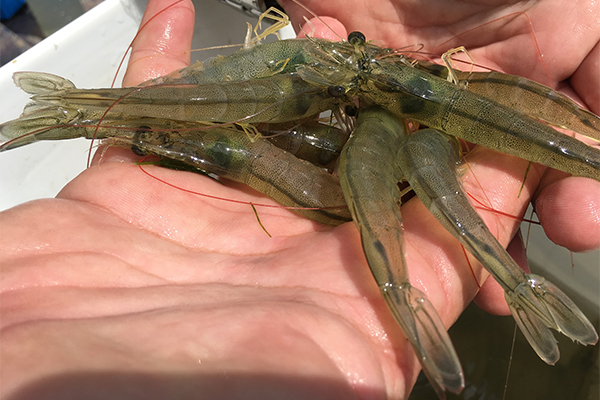
Nucleotides are low-molecular-weight bioactive compounds that perform key roles in many physiological processes in living organisms. Dietary nucleotide supplementation becomes essential when there is increased nucleotide demand and the organism is not able to produce enough. This occurs in situations of physiological stress, immunosuppression, infection and disease.
Nucleoforce® is a proprietary brand of a nucleotide-rich yeast extract from Saccharomyces cerevisiae developed by Bioiberica S.A.U. (Palafolls, Spain). Prior published research has reported on its benefits in several animal species, including aquatic species; also, yeast derivatives have been described as promising immunostimulants to control diseases in aquaculture.
The efficacy of this commercial nucleotide in diets for Pacific white shrimp (Litopenaeus vannamei) has recently been further supported by two studies performed in Indonesia, showing a positive impact of nucleotide supplementation on performance, immune response, profitability and disease resistance against Vibrio harveyi. Our research group hypothesized that they could also be beneficial for L. vannamei in a production system based in Vietnam and support the immune health of shrimp against shrimp diseases like acute hepatopancreatic necrosis disease (AHPND), a significant bacterial disease mainly caused by Vibrio parahaemolyticus and a major problem in many shrimp farming countries.
This article – summarized from the original publication (Segarra, S. et al. 2023. Immunoregulation and Resistance to Aquatic Pathogens with Dietary Nucleotides in Pacific White Shrimp, Litopenaeus vannamei. Fishes 2023, 8(6), 308) – reports on a study that evaluated the effects of dietary supplementation with the commercial nucleotide Nucleoforce® on performance, immune response, and survival of L. vannamei when challenged with V. parahaemolyticus in shrimp diets where fishmeal had been partially replaced by vegetable protein sources.
![Ad for [membership]](https://www.globalseafood.org/wp-content/uploads/2025/07/membership_web2025_1050x125.gif)
Study setup
A feeding trial with 1,000 shrimp and lasting 56 days and a challenge trial with 600 shrimp for 10 days were performed using diets with different fishmeal inclusion levels (26, 23.4, 22.1 and 20.8 percent), with or without 0.1 percent nucleotides. A non-challenged, non-supplemented group was also used in the challenge trial. The feeding trial was carried out at the ShrimpVet R&D Demonstration Farm, while the challenge trial was conducted at the ShrimpVet Laboratory (both facilities located in Ho Chi Minh City, Vietnam) to evaluate a potential immunoregulatory effect of dietary supplementation with the commercial nucleotide product in L. vannamei and a possible positive impact on performance and resistance to aquatic pathogens.
Diets were prepared with different fishmeal inclusion levels, partially replaced by vegetable sources. The control diet (260FM, containing 26 percent fishmeal) was designed to serve as a representative for commonly used diets for L. vannamei production in Vietnam. Nucleotides were supplemented at 0.1 percent in the other diets used in this study, in which a reduction in fishmeal content of 0 percent (260FMN) 10 percent (234FMN), 15 percent (221FMN) and 20 percent (208FMN) was applied. At the end of the trial, hemolymph samples were obtained from five shrimp per tank and used for quantification of total hemocyte count (THC) and phenoloxidase (PO) activity – both biomarkers for health status. For detailed information on the trials, refer to the original publication.
Dietary nucleotide supplementation of Pacific white shrimp farmed in intensive outdoor ponds
Results and discussion
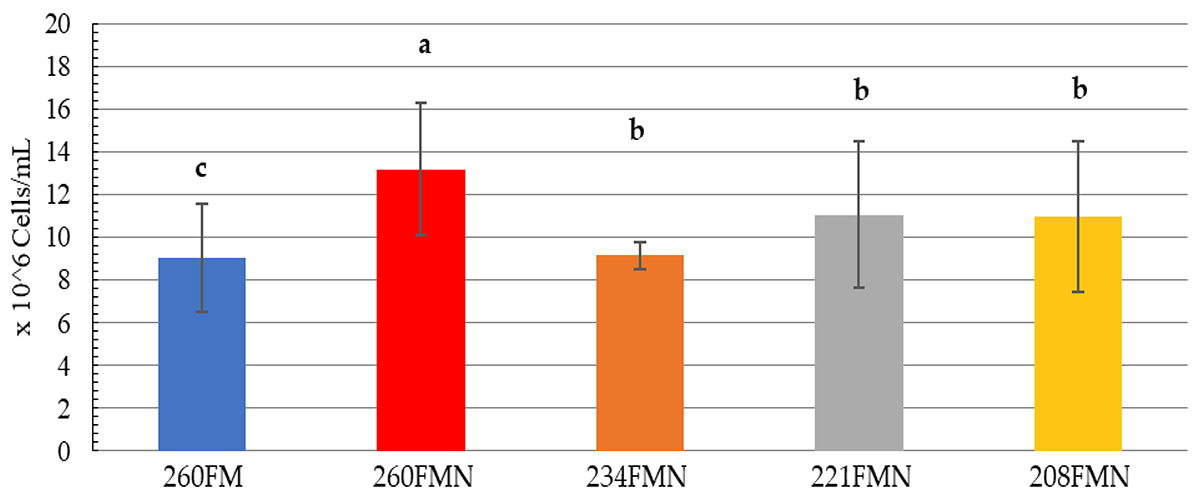
After 56 days, THC levels were significantly higher in all N-supplemented groups, compared to the control. Group 260FMN showed THC levels significantly higher than any other group. THC in the 234FMN, 221FMN and 208FMN groups (with a 10, 15 and 20 percent fishmeal reduction, respectively) were also significantly improved compared to the control group (regular 26 percent fishmeal inclusion level) (Fig. 1). No significant differences were found between groups in PO activity.
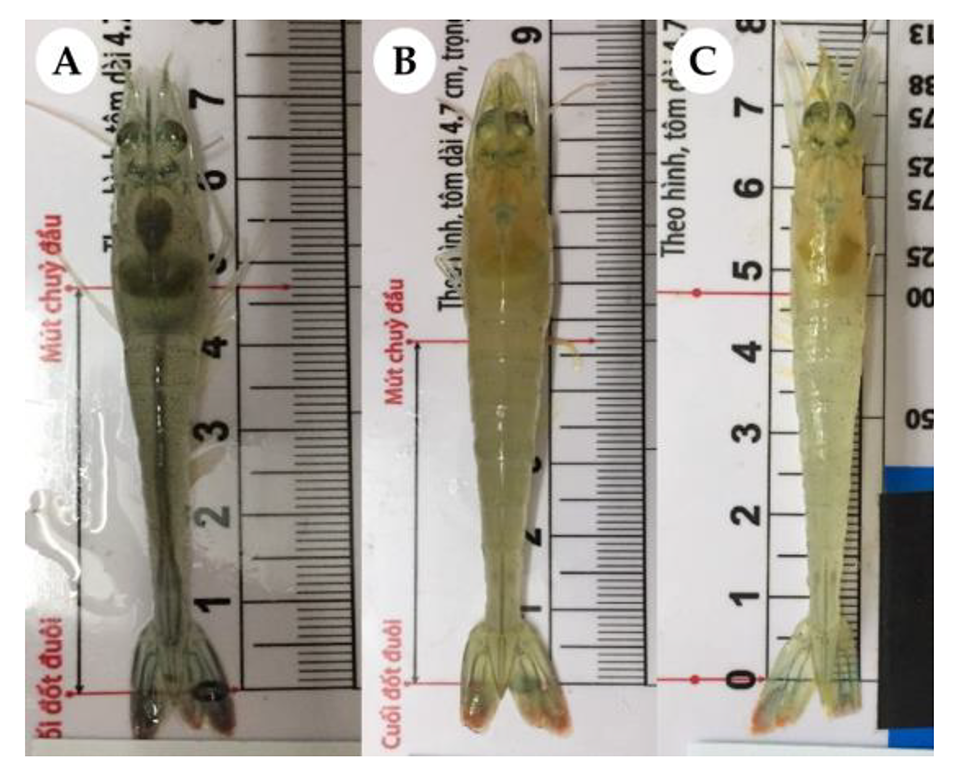
Nucleotide supplementation using regular fishmeal levels (260FMN) led to improved performance, achieving better final mean body weight, final biomass, mean weight gain, average daily gain and feed consumption, compared to control (260FM), although this effect did not reach the level of statistical significance. On the other hand, several performance parameters including final mean weight, final biomass, mean weight gain, average daily gain, specific growth ratio, and feed consumption were significantly better in the 260FMN group compared to 234FMN, 221FMN, or 208FMN.
Shrimp survival rate after 56 days was very high in all study groups (91 to 93 percent) in groups 260FM, 260FMN, 234FMN, 221FMN and 208FMN, respectively), with no statistically significant differences between them. It was also noticed during the trial that shrimp fed diets with nucleotides had higher locomotion activity and a shorter time to consume the feed, compared to the non-supplemented groups. And the economic analyses showed improved profitability after adding nucleotides to the diet with regular fishmeal inclusion levels (260FMN vs. 260FM).
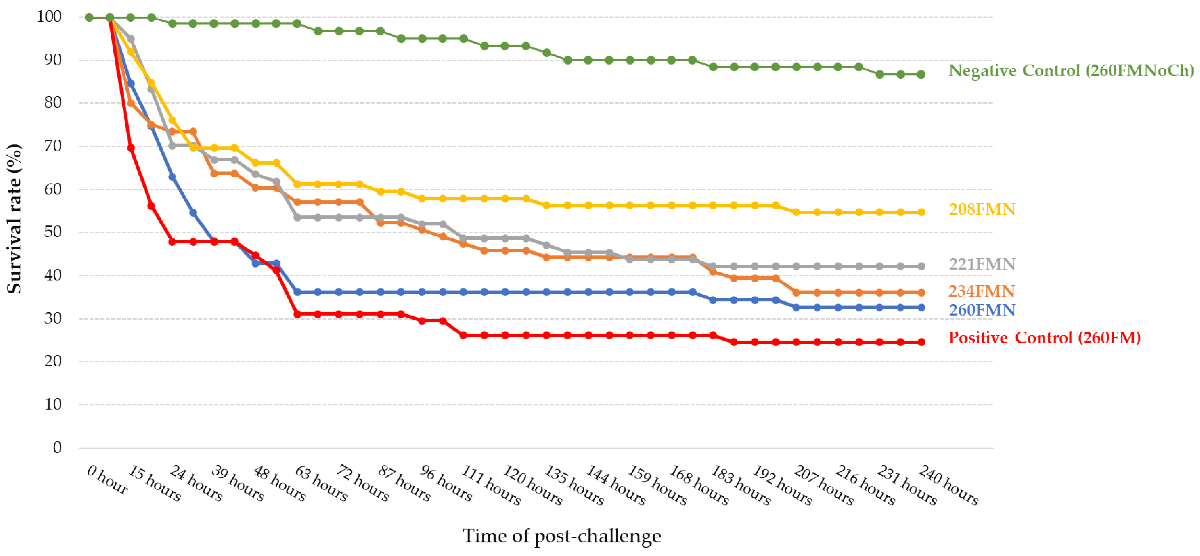
At 10 days post-challenge, survival rate was significantly lower in the positive control group (260FM), compared to the negative control (260FMNoCh). All groups in which the diets incorporated nucleotides showed higher survival rates than the positive control group during the post-challenge period (Fig. 3). Fifteen hours post-challenge, a significantly higher survival rate compared to the positive control group was achieved with 221FMN and 208FMN, while survival rate in these groups at that time was not statistically inferior to the negative control group.
The incorporation of dietary nucleotides led to several beneficial effects in the feeding trial. Adding nucleotides to a diet with regular fishmeal levels led to significantly better immune response, (higher THC levels). Using nucleotides in a diet with regular fishmeal levels also led to significantly better growth parameters, compared to groups with lower fishmeal levels, while the performance results in the control diet (without nucleotides) did not reach such significant effect, compared to the rest of the diets. On the other hand, when regular fishmeal levels were used, adding nucleotides led to a numerical improvement, although this effect did not reach the level of statistical significance.
Profitability is key for shrimp producers. To gain more profits and competitive advantages, shrimp producers must minimize production costs and adopt sustainable practices. Nowadays, many novel ingredients, feed additives and functional products have been explored, tested and partially applied in shrimp farming to farm more efficiently, to increase productivity, and to boost shrimp health and disease tolerance. In Vietnam, the production cost is still much higher than in Ecuador and India. The investment in infrastructure becomes high and costly and does not last for long due to depreciation. The profit margin for shrimp producers is unprecedentedly slim and Vietnam shrimp products would lose their competitive advantage on the market if they cannot find appropriate solutions.
The Vietnamese government is targeting U.S. $10 billion in shrimp exports by 2025. To achieve this goal, the shrimp industry in Vietnam is currently focusing on hi-tech farming with more intensification and sustainability. Alternative ingredients have been used to replace fishmeal and animal protein ingredients; functional feeds have also been produced by many reputable feed millers in the last few years; more and more potential feed additives have been demonstrated to enhance growth performance, feed utilization and disease tolerance.
In this study, we demonstrated that adding nucleotides to shrimp diets improved profitability. This might be explained by the improvements in performance which, despite some not being statistically significant, taken together with the minimal impact of nucleotides on diet costs and their contribution to sustainability, eventually result in economic advantages for the producers.
Perspectives
Supplementation with 0.1 percent of the commercial nucleotide Nucleoforce® for 56 days in Pacific white shrimp grown under recirculating aquaculture system conditions in Vietnam improved immune function, profitability and survival upon challenge with an AHPND-causing V. parahaemolyticus strain and allowing for fishmeal replacement by vegetable protein sources without having a negative impact on performance. This nucleotide could be used as sustainable and effective functional ingredient in L. vannamei production.
Follow the Advocate on Twitter @GAA_Advocate
Now that you've reached the end of the article ...
… please consider supporting GSA’s mission to advance responsible seafood practices through education, advocacy and third-party assurances. The Advocate aims to document the evolution of responsible seafood practices and share the expansive knowledge of our vast network of contributors.
By becoming a Global Seafood Alliance member, you’re ensuring that all of the pre-competitive work we do through member benefits, resources and events can continue. Individual membership costs just $50 a year.
Not a GSA member? Join us.
Authors
-

Corresponding author
R&D Bioiberica S.A.U., 08950 Esplugues de Llobregat, Spain -
ShrimpVet Laboratory, Nong Lam University, Ho Chi Minh City 700000, Vietnam
-
ShrimpVet Laboratory, Nong Lam University, Ho Chi Minh City 700000, Vietnam
-
ShrimpVet Laboratory, Nong Lam University, Ho Chi Minh City 700000, Vietnam
Related Posts
Aquafeeds
Animal co-product hydrolysates sources of key molecules in aquafeeds
Key molecules found in animal byproduct hydrolysates show potential for use as functional ingredients in aquaculture feeds. Animal co-product hydrolysates from slaughterhouse waste and rendered animal byproducts present a protein alternative.
Health & Welfare
Fish protein hydrolysates enhance stress resistance of aquaculture species
Fish protein hydrolysates are naturally rich in nutrients that can help support aquatic species’ immune defenses in resisting stressors.
Health & Welfare
Measuring susceptibility differences to IHHNV infection
This study evaluated the susceptibility to IHHNV in three different shrimp batches by measuring infectivity titers. Each batch showed a different infectivity titer, therefore, each batch had a specific susceptibility to IHHNV.
Health & Welfare
New techniques, peptide treatments aid intensive shrimp farm in Ecuador
The PescaMaris shrimp farm in Ecuador uses fish peptide isolates to accelerate probiotic bacteria growth and improve water quality.