


Scientists in Scotland develop land-based method to cultivate red seaweed year-round

Tank-based trials reduced early mortality and produced rapid growth, potentially enabling commercial red seaweed production in the U.K.
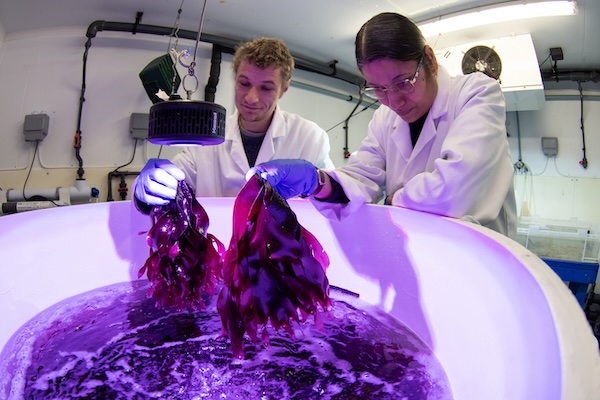
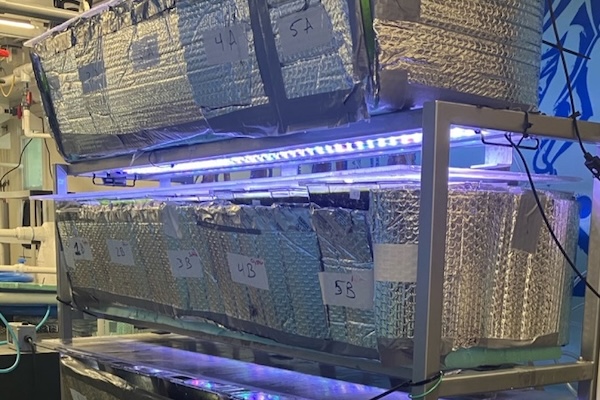
Scientists at the Scottish Association for Marine Science (SAMS) have developed a land-based cultivation method for the red seaweed Palmaria palmata, commonly known as dulse, a species traditionally harvested from the wild.
In controlled tank trials, researchers reported rapid growth, with biomass doubling in roughly one week. The findings suggest the species could be suited to more consistent, year-round land-based production.
“The growth is phenomenal,” said Dr. Frederik De Boever, a researcher on the team. “We’re growing the seaweed from the spore stage to germlings, which increases resilience, compared with vegetatively cut thalli from established adult seaweeds. The spore-to-germling mortality rate is usually high, but in the lab, we have more control over that crucial life stage.”
Palmaria palmata is sold as a premium food product and commands a higher value per ton than kelp. It is also used in animal feed, dyes, cosmetics and pharmaceuticals. Global demand for red seaweed continues to grow, but production is concentrated in a limited number of species cultivated primarily in Asia – systems increasingly affected by climate pressures and disease outbreaks.
![Ad for [membership]](https://www.globalseafood.org/wp-content/uploads/2025/07/membership_web2025_1050x125.gif)
“There is an urgent need to diversify seaweed cultivation practices to include important UK and European red seaweeds to help address the uncertainty in the red seaweed global market supply, as well as address sustainability and net zero targets,” said Kumari.
Despite its value, dulse has proven difficult to farm. Although it occurs naturally along the Atlantic coast, wild stocks are limited and previous cultivation attempts have reported hatchery mortality rates of 60 to 70 percent, often linked to disease.
“When discussing seaweed cultivation, a lot of focus is often on large kelps that generate lots of biomass, but more research effort is required to help expand and diversify the cultivation of red seaweeds in the region,” said Dr. Puja Kumari, who heads up the FABRICS cultivation project at SAMS. “Red seaweed cultivation is important for the seaweed aquaculture industry because it contributes to half the net worth of world seaweed production.”
The team focused on improving survival during the early hatchery stage, identified as a key bottleneck. Palmaria palmata has a short reproductive window and differing maturity cycles between males and females, complicating life-cycle management.
By adjusting the microbiome — introducing natural grazers and applying probiotic techniques to limit disease — researchers reduced spore mortality to around 10 percent, according to the team.
Land-based cultivation offers greater control over environmental conditions than open-sea farming, the researchers said. They reported producing healthier biomass with lower iodine and metal accumulation, while also enabling year-round production.
The FABRICS project is funded by UK Research and Innovation’s Biotechnology and Biological Sciences Research Council and includes commercial partners W.L. Gore & Associates in the United States and SeaDyes, a company based at The James Hutton Institute that develops natural dyes from seaweed.
“Through our involvement in the FABRICS project, SeaDyes is working to establish a scalable and resilient supply of red seaweed biomass to underpin our sustainable dye technologies,” said Jessica Giannotti, founder and CEO of SeaDyes. “By addressing critical bottlenecks and supporting the expansion of red seaweed cultivation in Scotland, FABRICS strengthens domestic supply chains, reduces risk, and helps complete the seaweed-based value chain for downstream innovators.”
“As a future off-taker of large quantities of biomass, our role in the project is to validate land-based cultivated biomass for biotechnology applications, ensuring it meets the quality, performance and scalability requirements of our bio-based dye platform.”
Now that you've reached the end of the article ...
… please consider supporting GSA’s mission to advance responsible seafood practices through education, advocacy and third-party assurances. The Advocate aims to document the evolution of responsible seafood practices and share the expansive knowledge of our vast network of contributors.
By becoming a Global Seafood Alliance member, you’re ensuring that all of the pre-competitive work we do through member benefits, resources and events can continue. Individual membership costs just $50 a year.
Not a GSA member? Join us.
Author

Related Posts
Intelligence
Could triploid kelp cultivars expand seaweed farming in the face of climate change?
Seaweed farming research reveals triploid breeding that creates heat-tolerant, fast-growing kelp, boosting yields and cutting ecological risk.
Innovation & Investment
Dutch engineer’s land-based seaweed farm gives new meaning to greenhouses
Sven Rusticus, founder of Seaweedland in the Netherlands, discusses the benefits of growing seaweed on land and potentially licensing the technology.
Responsibility
Seaweed species face widespread local extinction by 2100, landmark report warns
A new report warns seaweed species face local extinction by 2100 and calls for global action to protect these vital marine habitats.
Responsibility
Study: Farming shrimp with oysters and seaweed cuts nitrogen output
A new study finds pairing shrimp with oysters and seaweed reduces nitrogen levels, making shrimp farming more responsible and profitable.