


International review questions scientific basis for BC salmon farm ban

Review finds ban of ocean-based British Columbia salmon farms ignores research, offers little benefit to wild salmon and increases reliance on imports
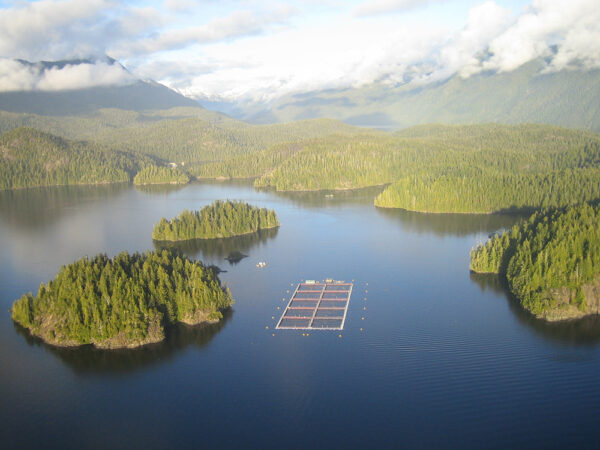
An international review warns that Canada’s move to ban ocean-based salmon farms in British Columbia (BC) overlooks decades of scientific research, could undermine coastal economies and is unlikely to boost wild salmon populations significantly.
The paper, published in Reviews in Aquaculture and authored by researchers from the United States, Australia, Sweden and several universities, identifies British Columbia as a prominent example of aquaculture policy shaped more by political pressures than by scientific evidence.
“Aquaculture has made significant progress toward reducing impacts on wild species while feeding a growing population, supported by decades of science and efforts aligned with EAA and OneHealth,” the researchers wrote in the paper.
The review states that the federal decision to end ocean-based salmon farming by 2029 is rooted in outdated assumptions and does not account for technological and environmental improvements within the sector. The authors contend that governance challenges, rather than farm-level science, have guided the transition.
![Ad for [BSP]](https://www.globalseafood.org/wp-content/uploads/2025/07/BSP_B2B_2025_1050x125.jpg)
They also note that Canada has increased imports of farmed salmon from regions with weaker regulatory frameworks and higher associated emissions while reducing domestic production.
The researchers point to decades of studies in the province reporting minimal or neutral effects of pathogens and sea lice on wild salmon. They argue that these findings have been overshadowed in public debate, where amplified activist claims have contributed to elevated perceptions of risk. According to the authors, this dynamic helped set the stage for the federal phaseout of marine Atlantic salmon farming in the Pacific.
Researchers conclude B.C. salmon farms pose minimal risk to wild salmon populations
The paper emphasizes that all food production has environmental impacts, arguing that eliminating BC’s regulated salmon-farming sector would shift those impacts to other producing regions rather than eliminating them.
A study funded by Dalhousie University’s Agri-Food Analytics Lab found that federal farm closures have increased Canada’s reliance on higher-emission imports and contributed to rising retail prices. It projects salmon could exceed $13.60 per pound by 2026 and reports that Canada imported about 22,000 additional U.S. short tons of salmon in 2021–2022 compared with pre-closure years, generating an estimated 10.9 million U.S. short tons of carbon dioxide – the equivalent of putting more than 2.1 million cars on the road.
The authors also highlight improvements in aquaculture feeds, declining use of forage fish and growing reliance on byproducts in salmon diets. Combined with regulatory oversight, they describe as “more stringent than any other food-production sector in North America, by orders of magnitude,” they argue that closing BC farms removes one of the region’s most heavily regulated protein sources.
Now that you've reached the end of the article ...
… please consider supporting GSA’s mission to advance responsible seafood practices through education, advocacy and third-party assurances. The Advocate aims to document the evolution of responsible seafood practices and share the expansive knowledge of our vast network of contributors.
By becoming a Global Seafood Alliance member, you’re ensuring that all of the pre-competitive work we do through member benefits, resources and events can continue. Individual membership costs just $50 a year.
Not a GSA member? Join us.
Author

Related Posts
Intelligence
Eight-year study finds no clear link with B.C. salmon farms and sea lice
Study finds no consistent drop in sea lice on wild salmon after B.C. closures, challenging claims about aquaculture impacts.
Responsibility
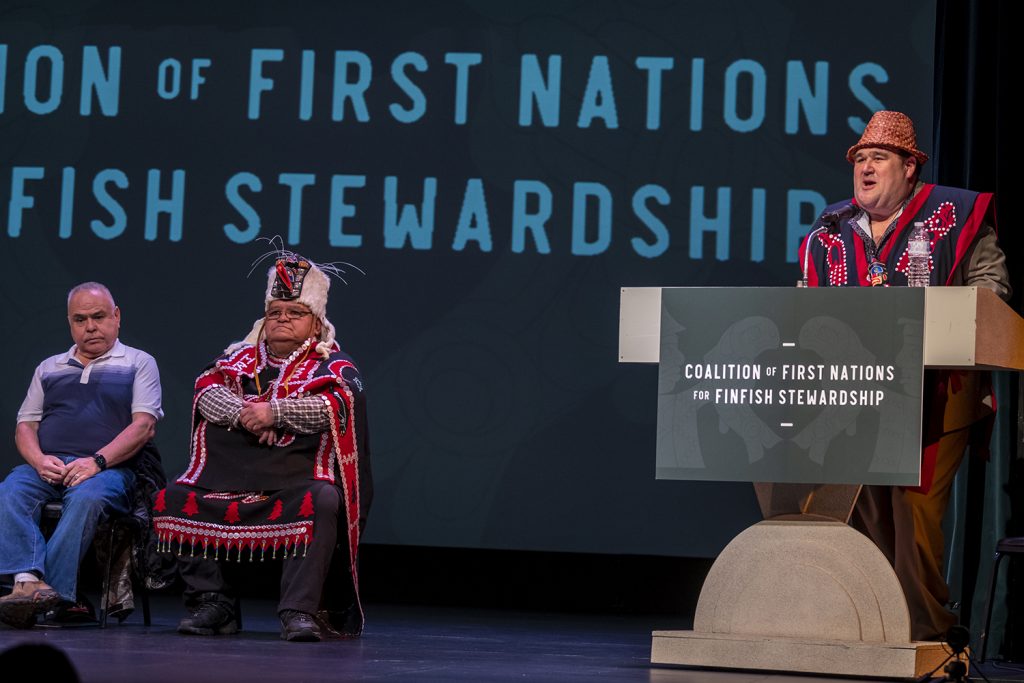
First Nations coalition unveils plan for salmon farming in British Columbia waters
The Coalition of First Nations for Finfish Stewardship releases a “responsible, realistic and achievable” plan for an Indigenous-led blue economy.
Intelligence
Aquaculture sector reacts to Canadian government’s ‘devastating decision’ to close Discovery Islands salmon farms
A salmon producers' association and a coalition of First Nations say the move ignores scientific evidence and Indigenous rights and title.
Intelligence
Federal Court rejects Canadian government’s plan to phase out BC salmon farms
The Federal Court has rejected the Canadian federal government's plan to phase out BC salmon farms in the Discovery Islands.