


For many island fish farmers, aquafeed sourcing and costs requires new thinking

In remote regions like the Caribbean and Japan, producers focus on local resources, novel feed ingredients and byproducts
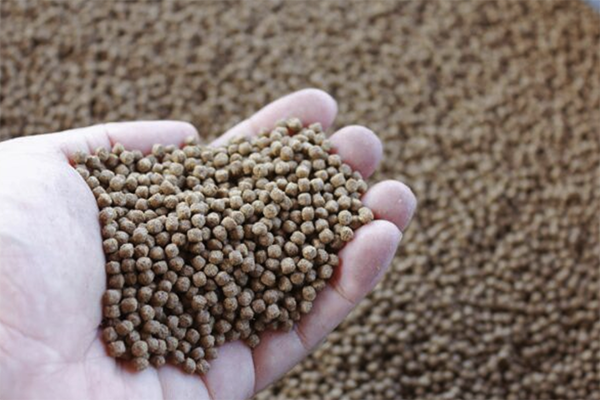
Novel feed ingredients are urgently needed to meet rising global demand for animal products. While aquaculture has significantly reduced fishmeal and fish oil in feed over recent years, continued growth in fish consumption means that reliance on marine-based ingredients remains a major challenge. Novel ingredients could offer a reliable alternative, with recent research in feed formulations highlighting strong potential to further advance some innovative solutions.
In the Caribbean, aquaculture is expanding rapidly, but growth is constrained primarily by limited access to affordable, high-quality feed. Tilapia dominates Caribbean aquaculture, followed by shrimp, crayfish and ornamental fish, yet feed is largely imported, expensive and subject to additional tax burdens. Feed prices range from U.S. $75–$95 for each 50-pound (23 kg) bag, prompting strong interest among farmers in locally produced alternatives.
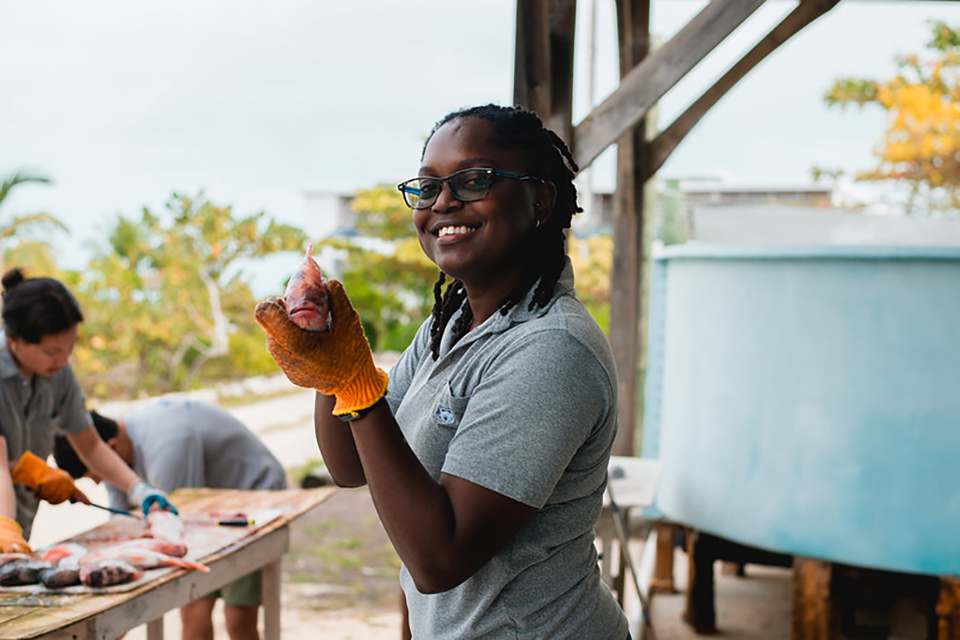
Mia Avril of the University of Plymouth in the UK and the Cape Eleuthera Institute in the Bahamas are researching feed solutions to make responsible aquaculture more accessible in the Caribbean region. Avril, who previously consulted with the Food and Agriculture Organization of the United Nations (FAO) in the Dominican Republic, focuses her research on locally sourced ingredients, with the aim of developing feed options that are not only accessible but also affordable.
“During my work as an aquaculture consultant, it became clear that access to suitable feed was a major challenge, with farmers often relying on chicken feed, fish scraps, crop leaves and other agricultural byproducts,” Avril told the Advocate. “Even on islands like Saint Lucia, where feed pellets can be produced locally, key inputs – including corn, wheat, coconut and fish – are imported. This prompted me to explore whether locally available materials could replace imported ingredients. Our research is applicable across the Caribbean, as the proposed ingredients are widely available regionally.”
![Ad for [Aquademia]](https://www.globalseafood.org/wp-content/uploads/2025/07/aquademia_web2025_1050x125.gif)
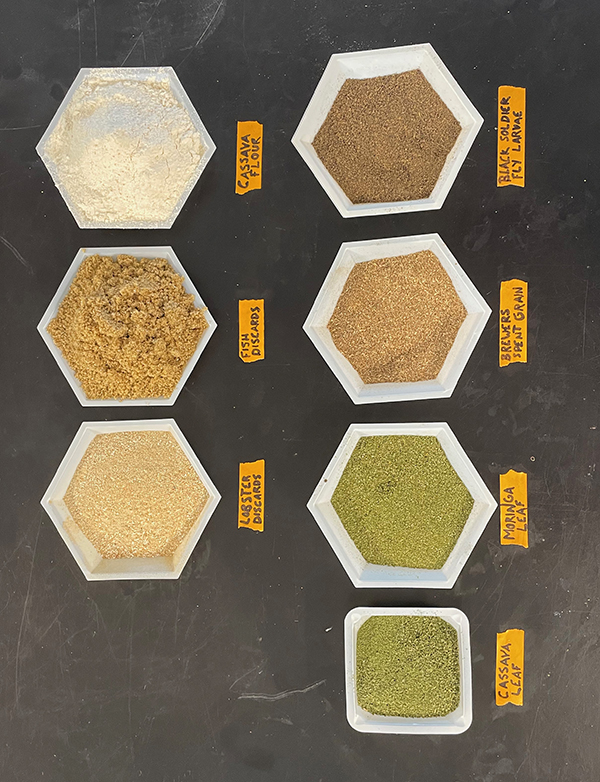
Avril and her team are investigating a range of ingredients, including breadfruit, cassava, brewer’s spent grain, Irish moss, finfish viscera (primarily from reef species such as snapper, grouper and grunt), lobster heads, conch discards and coconut oil. Although many are not native to the Caribbean, they are widely consumed and embedded in the region’s landscape, culture and diet.
Several ingredients – particularly fisheries discards – show promise as substitutes for imported fishmeal. Others appear suitable but are awaiting validation through proximate analysis.
“Preliminary feed formulations show a higher per-unit cost for local feed due to energy and labor costs, but their advantages are significant,” said Avril. “Local feed reduces environmental impacts by easing pressure on wild stocks, as fishmeal substitutes can be sourced from seafood discards already caught for human consumption. Producing feed locally also reduces feed imports and, by boosting local production, lowers imports of aquaculture products. Finally, repurposing fish viscera helps reduce any ecosystem disruption that could occur from these waste streams.”
Japan is also researching the use of locally sourced ingredients in aquafeeds. In Okinawa, in southern Japan, where the main farmed species include mozuku seaweed (Cladosiphon okamuranus), kuruma shrimp (Marsupenaeus japonicus), sea grapes and finfish such as cobia, Malabar grouper and red sea bream, Dr. Taekyoung Seong of the University of the Ryukyus is researching underutilized local resources as potential feed ingredients.
His work examines regional food processing byproducts and circular feed approaches involving insects, microalgae and other resources. Ingredients under study include rendered pork and chicken byproducts, locally produced fishmeal from fisheries processing waste (heads, frames, viscera and trimmings) and other sidestreams like distillery byproducts, tofu and soy processing residues, as well as the eri silkworm (Samia ricini).
From a circular economy perspective, Seong sees strong long-term potential in integrating local waste streams, insect production and insect-derived ingredients into feed.
“Sustainable ingredient adoption is not a single-issue problem,” he said. “It requires balancing nutritional value – essential amino acids and fatty acids – cost competitiveness, consistent supply, quality, safety, processing performance and real-world farm outcomes,” he said. “One of the most effective strategies is building sustainability through regional ingredient systems. Okinawa’s distance from Japan’s main islands make imported feed expensive, and limited local feed production forces farmers to rely on shipments from outside the prefecture, which can hinder aquaculture development. That’s why locally produced feeds, based on local resources, are vital for Okinawa’s aquaculture growth.”
Seong and his team are developing a prototype feed that relies on local resources to reduce Okinawa’s dependence on imported ingredients. Animal byproducts are particularly promising, providing protein that fish utilize effectively and a relatively stable supply from human food systems. Using these regionally reduces logistics burdens, strengthens local circularity and offers high protein density and often good digestibility.
With proper formulation to address amino acid limitations, these feeds can support strong growth and feed efficiency, potentially lowering reliance on costly imported proteins and enabling more cost-effective diets.
Back in the Caribbean, Avril highlights other broader benefits of producing feed from local ingredients. Regional agricultural processing often generates byproducts that are currently discarded but could add value to feed and create opportunities for small subsistence farmers in rural areas.
Avril’s research also aims to utilize waste from restaurants and hotels, potentially increasing demand for workers to collect and process raw materials for centralized feed plants. However, a major challenge is securing sufficient volumes to produce feed locally and at costs comparable to imports. Avril hopes that governments, regional institutions and other organizations in the Caribbean will show their support to the development of new feeds.
“They could invest in research on local ingredients, fund pilot feed trials, and strengthen laboratory capacity for nutritional, safety and quality testing,” she said. “Regional organizations can foster collaboration between universities, feed companies and farmers, harmonize standards and promote knowledge sharing. Public-private partnerships are especially crucial to turn research into commercially viable feeds and make them more mainstream.”
“For a truly novel ingredient to become mainstream, it must offer clear, practical value to farmers and the feed industry,” said Seong. “Key factors include cost competitiveness, stable supply at scale, and consistent quality – scientific interest alone isn’t enough. Safety, regulatory compliance and evidence from real-world feeding trials are also essential. The ingredient must support growth, feed efficiency and health, fit within existing manufacturing systems and ultimately help the industry produce seafood more efficiently, reliably and sustainably.”
Japan has strong capabilities in food processing, fermentation, quality control, and manufacturing, which are highly relevant for the development of safe, standardized feed ingredients from diverse resources. Many regions also generate unique byproduct streams that could be converted into feed materials if there are robust evaluation and processing systems in place. However, Okinawa’s geography highlights the challenges of feed logistics and sourcing, thus giving the University of the Ryukyus a strong incentive to develop practical, cost-conscious regional feed solutions.
How can the fishing industry address forced labor, with the scope more in focus?
Seong and his team are establishing an integrated approach to screen local resources, assess nutritional value and safety, and link promising ingredients to formulation and feeding trials. Having shown the potential of a prototype feed based on Okinawan resources, they now aim to expand the ingredient range while maintaining performance, refining formulations, improving nutritional balance, palatability, processing and standardizing quality across batches.
“We are also focused on aligning feed development with the growth of land-based aquaculture,” said Seong. “As these systems expand, feed must support growth and health while managing water quality and waste. Developing locally sourced, land-optimized feeds is central to our future work. Novel ingredients can boost aquaculture’s flexibility and resilience, diversify sources and strengthen regional supply chains – reducing vulnerability to global price spikes and supply disruptions as aquaculture grows and competition for conventional ingredients rises.”
“I am excited that some of the ingredients we are researching could prove superior to conventional ones, potentially transforming how we produce the food we consume,” said Avril. “Our next step is to begin feeding trials with tilapia and other regional species, such as freshwater prawns. We also intend to investigate the feasibility of this feed while assessing the availability of the proposed ingredients and the costs associated with producing the feed.”
Now that you've reached the end of the article ...
… please consider supporting GSA’s mission to advance responsible seafood practices through education, advocacy and third-party assurances. The Advocate aims to document the evolution of responsible seafood practices and share the expansive knowledge of our vast network of contributors.
By becoming a Global Seafood Alliance member, you’re ensuring that all of the pre-competitive work we do through member benefits, resources and events can continue. Individual membership costs just $50 a year.
Not a GSA member? Join us.
Author
-

Correspondent Bonnie Waycott became interested in marine life after learning to snorkel on the Sea of Japan coast near her mother’s hometown. She specializes in aquaculture and fisheries with a particular focus on Japan, and has a keen interest in Tohoku’s aquaculture recovery following the 2011 Great East Japan Earthquake and Tsunami.
Related Posts
Aquafeeds
A singular focus: Making single-cell proteins a fixture on the aquaculture feed ingredient menu
Fish nutrition expert Louise Buttle of dsm-firmenich talks about the potential of adding nutrition-packed single-cell proteins to aquafeeds.
Innovation & Investment
Better together: Partnerships drive innovation at leading labs
Laboratories with industry partnerships are making aquaculture more innovative, efficient and responsible. These collaborations offer access to expertise, facilities and funding to further the industry and improve global food security.
Innovation & Investment
Responsible Seafood Innovation Award finalist: How FAU’s mobile hatcheries could save the Caribbean queen conch – one trailer at a time
FAU’s mobile hatcheries help restore queen conch, protect Caribbean ecosystems and support local communities through sustainable aquaculture.
Responsibility
BioMar backs initiative to advance women in aquaculture and develop blue foods in the Caribbean
BioMar is supporting Women in Caribbean Aquaculture and the Caribbean Aquaculture Network (CAN) to responsibly expand blue food.