
Deep learning tool identifies wild and farmed salmon with 95% accuracy

A recent study shows that deep learning technology can reliably distinguish between wild and farmed Atlantic salmon. Researchers say the tool could help Norway better track escapees and protect its declining wild salmon populations.
“Farmed salmon differ genetically from wild populations and interbreeding between escaped farmed salmon and wild salmon leads to genetic changes that make wild salmon less fit to adapt to environmental changes or address threats around them,” the researchers wrote in a press release. “Genetic analysis shows that approximately two-thirds of wild salmon in Norway carry genetic signatures that indicate interbreeding with farmed salmon.”
Scientists typically identify escaped farmed salmon through genetic testing and by examining fish scales. Scale analysis works because salmon scales grow in concentric rings that reflect the fish’s growth pattern, but reading these patterns by hand is both time-consuming and costly.
“Like with tree rings, the number and spacing of these rings correspond to the growth of the fish,” the researchers wrote. “Farmed salmon have scales that represent rapid and steady growth, resulting in regularly spaced scales with limited seasonal markers. In contrast, wild salmon experience pronounced seasonal variation in growth driven by inconsistent temperatures, prey availability and migration.”
To expand this monitoring capacity, the research team trained a new convolutional neural network using nearly 90,000 Atlantic salmon scale images from the Norwegian Veterinary Institute and the Norwegian Institute for Nature Research. The images span hundreds of rivers across Norway and date back to the early 1930s. About 8.5 percent of the dataset consisted of farmed salmon.
The researchers developed a standardized processing pipeline and tested the model against human-scale readers and salmon of known origin. They found that the system could process images quickly and provide predictions with confidence estimates.
“The model performed exceptionally well and was able to differentiate farmed from wild salmon across most salmon rivers in Norway from 2009 to 2023 with 95 percent accuracy,” the researchers wrote.
Machine learning model tracks decline in ocean oxygen, highlighting climate change impact
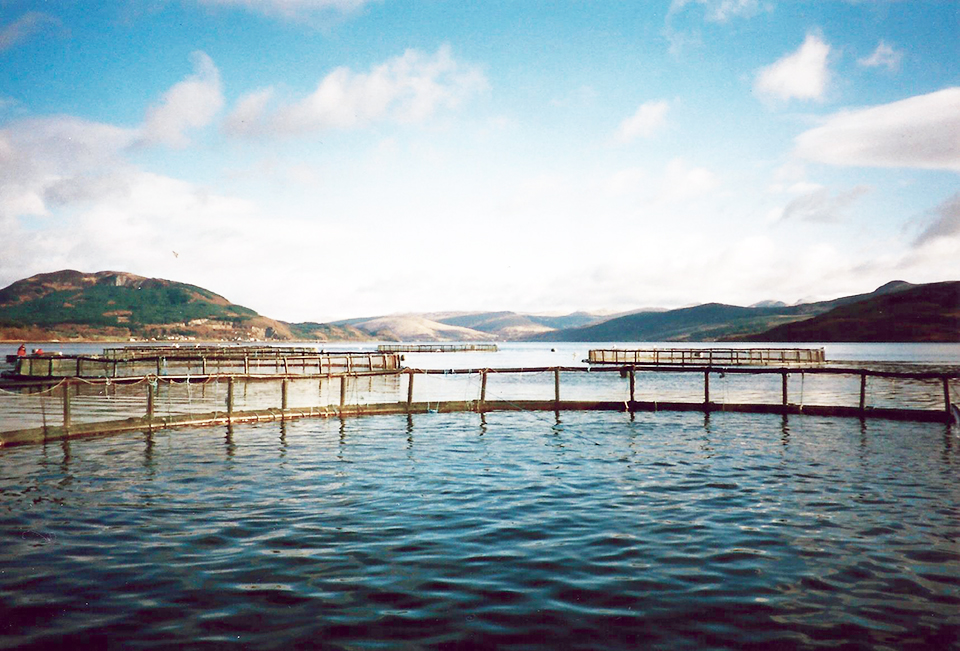
Norway is home to the world’s largest remaining wild Atlantic salmon populations and is also the largest producer of farmed salmon. Wild salmon abundance in the country has declined by more than 50 percent since the 1980s and is now at record lows. An estimated 300,000 farmed salmon escape into the wild each year from an industry that produces more than 1.5 million metric tons annually.
“Escaped salmon are a substantial ecological and genetic threat to wild populations since they increase competition for limited resources, such as food and spawning habitats, potentially displacing wild salmon or reducing their reproductive success,” the researchers wrote. “Farmed salmon also introduce pathogens and parasites such as sea lice, worsening pressures on wild salmon populations already vulnerable due to climate change and habitat degradation.”
Now that you've reached the end of the article ...
… please consider supporting GSA’s mission to advance responsible seafood practices through education, advocacy and third-party assurances. The Advocate aims to document the evolution of responsible seafood practices and share the expansive knowledge of our vast network of contributors.
By becoming a Global Seafood Alliance member, you’re ensuring that all of the pre-competitive work we do through member benefits, resources and events can continue. Individual membership costs just $50 a year.
Not a GSA member? Join us.
Author

-
Responsible Seafood Advocate
[103,114,111,46,100,111,111,102,97,101,115,108,97,98,111,108,103,64,114,111,116,105,100,101]
Tagged With
Related Posts
Health & Welfare
Reporting of fish escapes, causes crucial step in developing better controls
Escapes of fish from farm facilities can lead to interbreeding and competition for mating opportunities with wild fish. Escapees may also transmit diseases and parasites, as well as compete for feed and space.
Fisheries
A deep learning model for short- and medium-term predictions of spatiotemporal distribution of marine fishing effort
A deep learning model to predict fishing effort can simultaneously interpret and integrate fishing intensity and environmental factors.
Fisheries
‘Here to stay and evolving fast’: How GreenFish’s AI-powered fish-forecasting tech is modernizing commercial fisheries
GreenFish uses AI and datasets to predict fishing hotspots, helping commercial fisheries save fuel, time and maximize catch value.
Innovation & Investment
Leveraging AI to detect and retrieve ghost fishing gear: ‘It’s a global problem’
An initiative launched in Germany to deploy AI to find ghost fishing gear uses existing high-resolution sonar data from the seabed.
![Ad for [Aquademia]](https://www.globalseafood.org/wp-content/uploads/2025/07/aquademia_web2025_1050x125.gif)