


Chinese scientists tour University of Stirling’s research hub to explore aquaculture innovation

Delegation explores how the University of Stirling’s new research hub can help advance sustainable aquaculture
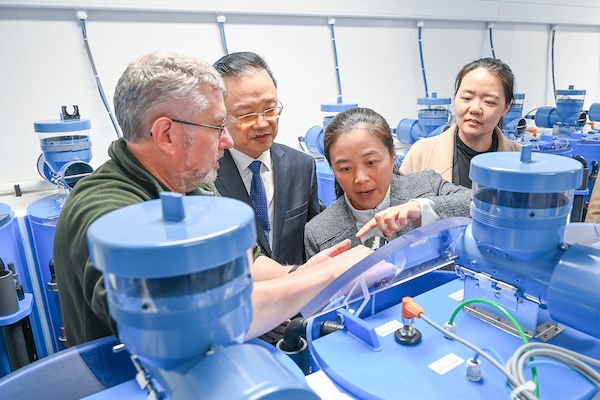
A delegation of senior scientists from the Chinese Academy of Fishery Sciences (CAFS) visited the University of Stirling in Scotland to examine how new research infrastructure could inform best practices in China’s rapidly expanding sustainable aquaculture.
The group toured the university’s National Aquaculture Technology and Innovation Hub (NATIH) – a £21 million (U.S. $27 million) facility designed to support advanced research and commercial trials aimed at addressing emerging challenges in global fish farming.
“The visit from the Chinese Academy of Fishery Scientists was a valuable opportunity to explore shared areas of interest, and to highlight how the Institute of Aquaculture’s new National Aquaculture Technology and Innovation Hub can help to support this thriving global marketplace,” said Professor Trevor Telfer, Acting Head of the Institute of Aquaculture at the University of Stirling.
China has been the world’s largest producer of aquaculture products since 2002, cultivating over 800 species and accounting for nearly two-thirds of global production. But that expansion has brought new pressures – from climate change and disease outbreaks to shifting consumer expectations. As the research arm of China’s Ministry of Agriculture and Rural Affairs, the Chinese Academy of Fishery Sciences has become central to shaping how the country’s aquaculture sector responds to these growing challenges.
![Ad for [BSP]](https://www.globalseafood.org/wp-content/uploads/2025/07/BSP_B2B_2025_1050x125.jpg)
“China is a major player in the global aquaculture industry, and its growth trajectory is set to continue,” said Telfer. “By working collaboratively to fully utilize the combined strengths of our knowledge and facilities, we can play a critical role in ensuring that the sector is informed by the latest research and development. This will ensure that growth is sustainable and offers the best outcomes for producers, consumers and the environment.”
New UK aquaculture hub aims to drive industry innovation and sustainability
The NATIH provides extensive research capacity and technical facilities designed to support studies across a wide range of aquatic environments. The site can replicate freshwater conditions found in different parts of the world, enabling controlled experiments on fish health, nutrition and environmental resilience. Researchers can adjust the gaseous composition of water and regulate temperatures between 6 and 28 degrees-C (43 to 82 degrees-F) to study how species respond to changing environmental factors.
“We firmly believe that this collaboration will enable us to achieve mutually beneficial outcomes in both research and innovation,” said Professor Yu Shuzhou, Head of Discipline Inspection Group at the CAFS.
Now that you've reached the end of the article ...
… please consider supporting GSA’s mission to advance responsible seafood practices through education, advocacy and third-party assurances. The Advocate aims to document the evolution of responsible seafood practices and share the expansive knowledge of our vast network of contributors.
By becoming a Global Seafood Alliance member, you’re ensuring that all of the pre-competitive work we do through member benefits, resources and events can continue. Individual membership costs just $50 a year.
Not a GSA member? Join us.
Author

Related Posts
Health & Welfare
University of Stirling’s new grant aims to advance fish welfare and responsible aquaculture in Southeast Asia
The University of Stirling has received $2.6M to improve fish welfare in Southeast Asia and promote responsible aquaculture practices.
Innovation & Investment
University of Stirling leads sustainable aquaculture project in Vietnam’s Mekong Delta
The AquaSoS project uses digital tools to boost sustainable aquaculture in Vietnam, addressing disease, climate change and pollution.
Health & Welfare
Aquaculture research project secures funding to improve farmed fish welfare in Thailand and Vietnam
The University of Stirling has secured funding to improve farmed fish welfare in Thailand and Vietnam, with the aim to enhance fish quality.

Innovation & Investment
Stirling Council OKs plans for National Aquaculture Technology and Innovation Hub
The University of Stirling’s plans for a world-class aquaculture research and innovation facility are a step closer to reality.