


Researchers use environmental RNA to detect fish stress and disease in aquaculture

New eRNA tests could help detect fish stress and disease early by analyzing water, reducing losses and improving fish health
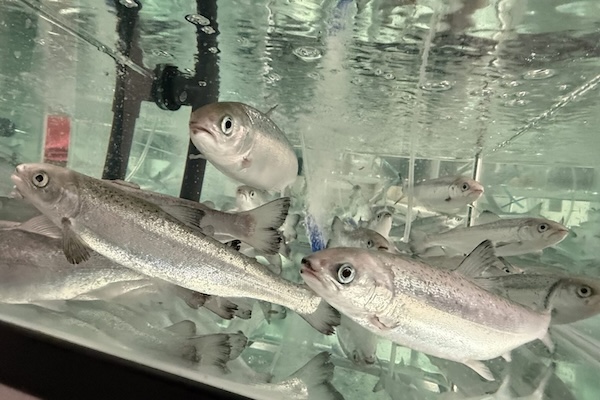
Detecting fish stress and disease remains a persistent challenge for aquaculture, where early signs are often difficult to identify without handling animals.
An international team of researchers led by the University of Maine is working to address that gap by developing rapid, non-invasive tests that analyze the water fish live in rather than the fish themselves.
The project, involving scientists from the University of Maine, Dublin City University and Queen’s University Belfast, will use environmental RNA (eRNA) to detect signs of stress and disease, with the goal of giving farmers a faster and less invasive way to monitor fish health.
“The goal is to get a window into the physiology of the organisms, their health in particular,” said Michael Kinnison, UMaine professor of evolutionary applications and director of the Maine Center for Genetics in the Environment. “By looking at what RNA is being shed from their tissues into the environment, eRNA can give us insights into what the fish are doing as biological machines.”
![Ad for [membership]](https://www.globalseafood.org/wp-content/uploads/2025/07/membership_web2025_1050x125.gif)
Central to the approach is the difference between environmental DNA (eDNA) and RNA. DNA remains largely unchanged throughout an organism’s life, acting as a stable genetic blueprint. RNA, by contrast, reflects what is happening inside the body at a given moment, changing in response to factors such as stress, disease and environmental conditions.
When fish shed cells into the water, both DNA and RNA are released into the surrounding environment. While DNA can persist for longer periods, RNA breaks down more quickly. That makes it harder to detect, but also means it can provide a more immediate picture of an animal’s condition.
A key challenge is linking specific eRNA signals to particular stressors, though early research suggests it is possible. In one example, researchers in Japan used eRNA to detect stress in medaka fish.
“This hasn’t been done for salmon yet, and it’s just exciting because it means that if we could use these RNAs, we wouldn’t have to kill fish to biopsy them,” said Erin Grey, UMaine assistant professor of aquatic genetics. “We might be able to figure out and treat disease before it gets really bad.”
In addition to identifying eRNA signals linked to stress and disease, the team will use CRISPR-Cas technology to develop rapid diagnostic tests. Similar to a COVID-style test, the approach would allow farmers to sample water and quickly detect potential issues. Earlier detection could support more targeted treatment and reduce losses, which can reach hundreds of millions of dollars annually in salmon farming.
The project will begin in controlled tank systems before expanding to open-water environments, such as net pens. Sampling will take place in Maine and Scotland, with an initial focus on heat stress and furunculosis, two common challenges in salmon farming.
Researchers are working with industry and fish health diagnostics providers to identify additional stressors and pathogens for future study. While eRNA technology is still in early development, the project aims to accelerate its application for use on farms.
“Environmental RNA technology is still at an early stage of development, but its potential is significant,” said Paulo Prodöhl, professor of population and evolutionary genetics from the School of Biological Sciences at Queen’s University Belfast. “We will apply advanced genomics and bioinformatics approaches to identify the molecular signatures of stress and disease in salmon. By working closely with colleagues at DCU and UMaine, we aim to ensure that this technology moves from proof-of-concept to practical application for the aquaculture industry.”
Now that you've reached the end of the article ...
… please consider supporting GSA’s mission to advance responsible seafood practices through education, advocacy and third-party assurances. The Advocate aims to document the evolution of responsible seafood practices and share the expansive knowledge of our vast network of contributors.
By becoming a Global Seafood Alliance member, you’re ensuring that all of the pre-competitive work we do through member benefits, resources and events can continue. Individual membership costs just $50 a year.
Not a GSA member? Join us.
Author

Related Posts
Fisheries
Trawl surveys, environmental DNA analysis and scientific echo sounder techniques to analyze the East China Sea fisheries resources
The complementary strengths of each method of fisheries analysis support the understanding of spatiotemporal dynamics of fish communities.
Fisheries
Environmental DNA can help understand the distribution, abundance and Health of Atlantic and Pacific salmon species
Through development and refinement, eDNA approaches will become increasingly available to managers of Atlantic and Pacific salmon fisheries.
Intelligence
Can environmental DNA combat deadly parasites threatening Canada’s oysters?
A new environmental DNA tool under development aims to advance early detection and tracking of deadly MSX and Dermo oyster parasites.
Innovation & Investment
Can environmental DNA transform seabed monitoring in Scottish salmon farms?
New environmental DNA method may enable faster, cheaper seabed monitoring, shifting how salmon farms and regulators assess ecological impact.