

FAO to support countries in implementing the BBNJ treaty, citing its role in fisheries management, data and capacity building

The Food and Agriculture Organization (FAO) of the United Nations has welcomed the entry into force of a new treaty to protect marine biodiversity in international waters – a step it described as strengthening global ocean governance.
In a statement, FAO said it intends to support implementation of the BBNJ Agreement under the United Nations Convention on the Law of the Sea, citing its experience in fisheries governance and marine genetic resources.
The BBNJ Agreement entered into force on Jan. 17, 2026, after more than 20 years of negotiations. The legally binding treaty, which has 145 signatories and 81 Parties, is designed to protect and sustainably manage biodiversity in ocean areas beyond national jurisdiction (or ABNJ), often referred to as the high seas.
The agreement focuses on four main areas: marine genetic resources, tools to manage and protect ocean spaces, environmental impact assessments and support for capacity building and technology transfer. It calls for the coordinated management of activities such as fishing, shipping, mining and scientific research in international waters and sets out rules to ensure that benefits from marine genetic resources – used in products like medicines, supplements and cosmetics – are shared fairly.
“The BBNJ Agreement is an important next step in addressing critical gaps in the governance of areas beyond national jurisdiction,” said Manuel Barange, FAO Assistant Director-General and Director of Fisheries and Aquaculture. “FAO is equipped with the know-how to assist parties and institutions to implement the Agreement, and has expertise, data and systems that will be critical to achieve its goals.”
Global fight against IUU fishing reaches a ‘new milestone’ with Port State Measures Agreement
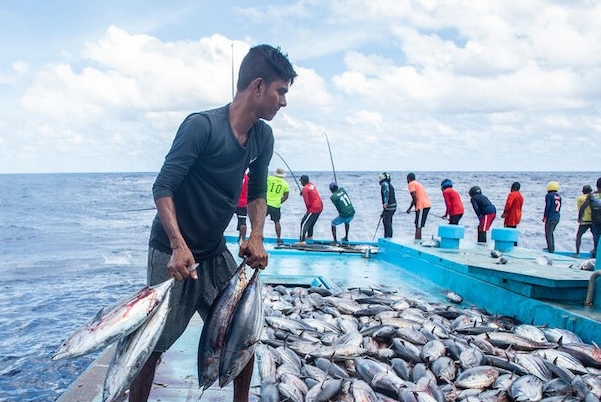
ABNJ cover about two-thirds of the world’s oceans and nearly half of the planet’s living space. About 11 million tons of aquatic animals are caught each year in these waters, primarily tunas, bonitos, billfishes and elasmobranchs, under a system of international rules and regional fisheries management organizations that vary by region.
Regional fisheries management organizations establish binding measures in many of these areas, including monitoring requirements, catch limits, bycatch rules and closures. Their role in managing fisheries, collecting data and supporting science-based decision-making is expected to be relevant to the implementation of the BBNJ Agreement, according to FAO officials.
“Just as healthy and biodiverse ecosystems are the foundations of sustainable fisheries, the institutions designed to govern the latter can contribute greatly to ensuring human use can coexist with and support biodiversity,” Barange said.
Data will be central to implementing the BBNJ Agreement, with FAO pointing to its fisheries statistics, stock assessments and tools such as the Fisheries and Resources Monitoring System as key resources for decision-making.
FAO also highlighted its role in capacity building, citing past work supporting countries on compliance with international fisheries agreements and the use of monitoring tools. Through long-standing collaboration with regional fisheries bodies and initiatives such as the Common Oceans Program, the FAO stated that its data systems, technical expertise and networks are expected to support countries as details of the treaty’s implementation are finalized.
“Marine biodiversity underpins sustainable fisheries and global food security,” Barange said. “The BBNJ Agreement presents a unique opportunity to enhance global oceans governance and improve outcomes for everyone.”
Now that you've reached the end of the article ...
… please consider supporting GSA’s mission to advance responsible seafood practices through education, advocacy and third-party assurances. The Advocate aims to document the evolution of responsible seafood practices and share the expansive knowledge of our vast network of contributors.
By becoming a Global Seafood Alliance member, you’re ensuring that all of the pre-competitive work we do through member benefits, resources and events can continue. Individual membership costs just $50 a year.
Not a GSA member? Join us.
Author

-
Responsible Seafood Advocate
[103,114,111,46,100,111,111,102,97,101,115,108,97,98,111,108,103,64,114,111,116,105,100,101]
Tagged With
Related Posts
Fisheries
FAO: Overfishing at 10-year low in Mediterranean and Black Sea
Overfishing in the Mediterranean and Black seas reaches a 10-year low, underscoring aquaculture’s growing role as demand for seafood rises.
Fisheries
FAO: 64.5% of global stocks are sustainably fished, but overfishing persists without management
FAO’s most detailed fishery review shows 64.5 percent of stocks are fished sustainably, but regional gaps and overfishing trends persist.

Fisheries
RFMOs are falling short of high-seas mandates, Duke University analysis finds
Analysis finds high seas fisheries management is not meeting mandates, with 56 percent of fish stocks overexploited or in decline.

Fisheries
Paper calls for permanent ban on high seas exploitation, including commercial fishing
Leading scientists say banning deep-sea mining, oil drilling and commercial fishing on high seas will safeguard ocean ecosystems
![Ad for [membership]](https://www.globalseafood.org/wp-content/uploads/2025/07/membership_web2025_1050x125.gif)