


How gillnet mesh sizes impact catch efficiency of Greenlandic lumpfish

Reducing the mesh size from 135 to 120 mm resulted in a 32 percent increase in the catch of female lumpfish, enhancing roe production
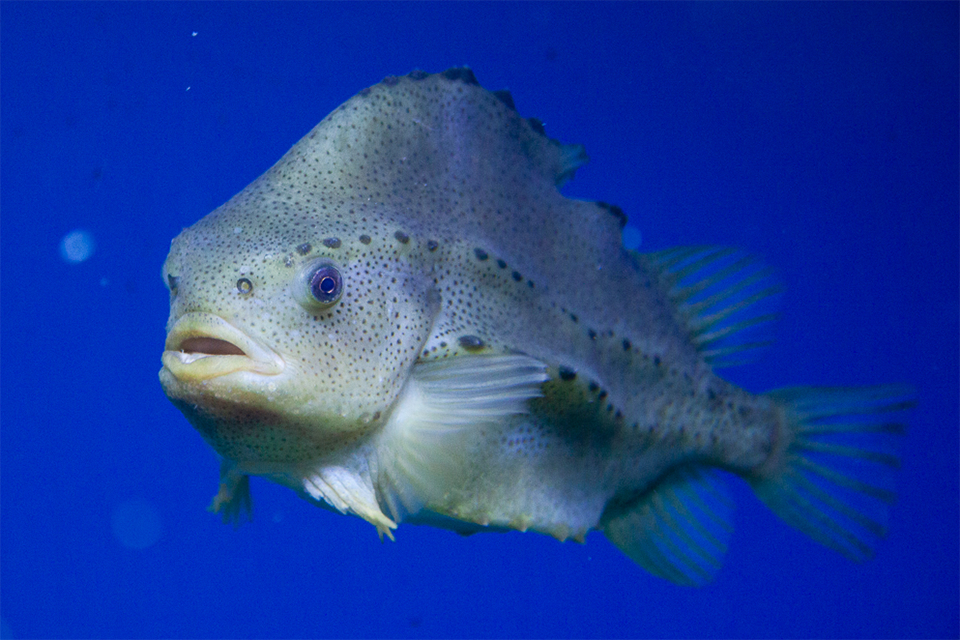
The Greenlandic lumpfish (Cyclopterus lumpus) is widely abundant in the North Atlantic and found both offshore and near the coast, where they spawn at shallow depths. Lumpfish are fished by several nations, including Iceland and Greenland, who account for the majority of landings. Lumpfish females are highly valued for their roe, which is processed into a globally demand caviar-like product. In Greenland, the fish are caught along the coast during their spring and early summer spawning migration by local fishers using gillnets set from smaller vessels.
Despite its economic benefits, the fishery faces challenges, particularly concerning seabird bycatch, which has become a growing concern. This has led to investigations into whether modified fishing gear, such as bottom-modified gillnets and nets fitted with LEDs, could reduce bycatch while maintaining target catch rates. However, neither of these attempts has successfully achieved both aims, prompting the need for alternative solutions.
Current regulations for the Greenland lumpfish fishery mandate that the fishing season for female lumpfish lasts for sixty consecutive days or until the quota is reached. Regulations mandate the use of gillnets with a minimum mesh size of 260 mm full mesh, corresponding to 130 mm half mesh, which hereafter is used when referring to mesh size. The aim of this mesh size regulation is to balance capture efficiency and bycatch reduction. However, there is currently no scientific documentation on how the gillnet mesh size affects capture efficiency for both target and bycatch species or how mesh size influences the species composition of the catch.
This article – summarized from the original publication (Olesen, M.K.A. et al. 2025. Effect of gillnet mesh size on catch efficiency and bycatch in the Greenlandic lumpfish (Cyclopterus lumpus) fishery. Estuarine, Coastal and Shelf Science Volume 326, November 2025, 109534) – reports on a study that examined the impact of three different gillnet mesh sizes on the catch efficiency of lumpfish and non-target species.

Three different gillnet mesh sizes were tested by fishing them simultaneously in a fleet configuration. Two fleets consisting of this configuration were deployed during fishing trials. Gillnets with half mesh sizes of 120 mm, 135 mm, and 150 mm (nominal value) were used in the sea trials, referred to as M120, M135, and M150, respectively. Sea trials were conducted in March, April and May 2024, near Nuuk (Greenland) at two different, traditional fishing sites. For detailed information on the experimental design, sea trials and gear used, and data collection and analysis, refer to the original publication.
Extensive wrasse use keys up ‘cleaner fish’ conservation questions
Results and discussion
To our knowledge, this is the first study that investigates catch efficiency and catch composition in the Greenlandic lumpfish fishery using different mesh sizes. Altering the mesh size resulted in a notable effect on the fishing efficiency and could potentially have a large effect on the fishery if implemented. The main finding was that altering the mesh size resulted in a substantial effect on the fishing efficiency for the lumpfish.
Specifically reducing the mesh size from 135 mm which is mesh size currently used in the Greenlandic lumpfish fishery targeting female and male lumpfish, the 120 mm, increases the capture probability of female lumpfish by 32 percent (30 percent based on gonad weight) and male lumpfish by 240 percent. Contrary if mesh size was increased to M150 the capture probability of female lumpfish would be reduced by 77 percent (30 percent based on gonad weight) and 94 percent for male lumpfish. Thus, the results of this study imply that if legislation is changed to allow the use of the smaller mesh size, the fishers could reduce their effort substantially to reach their quota limit for female lumpfish.
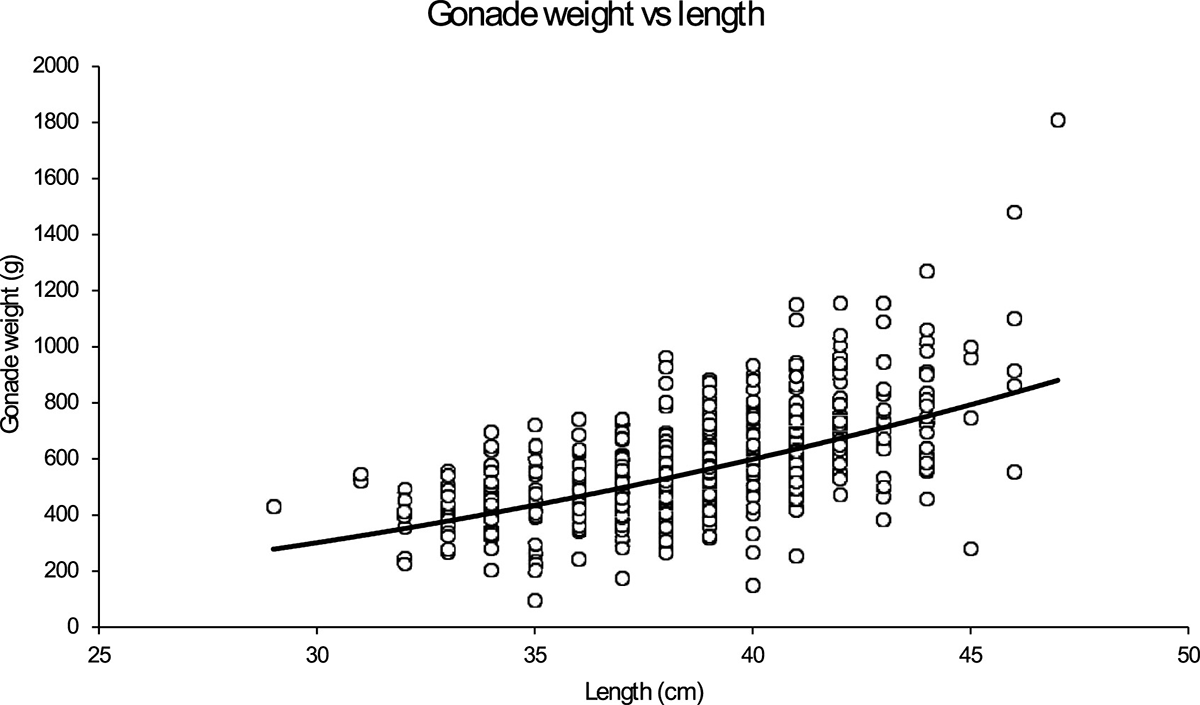
Regarding the male lumpfish there is currently only a limited local market, with most kept for personal consumption or within families; once this demand is met, males are often considered unwanted bycatch. Thus, from a fisher’s perspective, an increase in male catch rates may not be seen as beneficial, during peak roe season, where the focus is on females as they are more profitable. Nevertheless, in the male specific fishery permitted in February and March lowering the mesh size from 135 mm to 120 mm could substantially improve male lumpfish catch efficiency. However, the impact of increased male catches on the overall lumpfish population remains unclear and necessitates careful consideration before legalizing the usage of the M120 mesh size.
Our results indicate that the ratio between capture of seabirds to female lumpfish would increase if mesh size was lowered indicating a negative development. However, our results in this respect are inconclusive due to very wide confidence bands caused by low numbers of seabirds captured during the trials. Therefore, given that the current fishery has already been shown to impact the common eider (Somateria mollissima) population in Greenland, we cannot – based on the current data – recommend legalizing smaller mesh sizes for this fishery despite the proved increased catch efficiency for the lumpfish. New research could focus on providing better data on effect of gillnet mesh on the trade-off between capture of seabirds and female lumpfish.
Ideally, this study would have been conducted with identical materials for the three different gillnets. However, due to availability issues this was not possible for this study, which introduced two potential confounders factors in addition to mesh size: gillnet color and twine thickness. Nevertheless, we assume this had little impact on the results in the present study.
The observed difference in catch efficiency between the three gillnets (M120, M135, M150) were strongly dependent on fish length, with the effect being most profound for the smaller female lumpfish (Fig. 2). Specifically, the M120 captured by far the largest fraction of female lumpfish at sizes between 30 and 40 cm, while the M150 captured almost none. However, for sizes around 45 cm in length it is estimated that the three gillnets have similar catch efficiency. If difference in gillnet color should cause the observed difference in catch efficiency between nets, there would be no clear explanation for the observed length dependency.

Conversely, mesh size provides a plausible explanation: the match between fish cross-sectional circumference and mesh circumference is best for the M120, particularly for smaller lumpfish. It could be speculated that especially the biggest mesh (M150) has a mesh circumference that is far too big to efficiently hinder especially the smallest female lumpfish from just passing through the meshes whereas the smallest mesh (M120) would have a better match with the fish cross sectional circumference.
In this comparison, we accounted for the fact that the tubercles on lumpfish prevent the mesh from taking the shortest path around the fish’s circumference when attempting to pass through. Indeed, the speculative comparison described in supplementary material A showed that differences in mesh circumference could potentially explain the observed length dependent difference in female lumpfish catch efficiency between the gillnets. Based on these results, we conclude that mesh size differences, rather than gillnet color or twine thickness, are the primary cause of the observed differences in gillnet catch efficiency between the M120, M135 and M150 gillnets. For male lumpfish, we assume that the specimens caught during the experiment where generally too small for any significant capture in any other of the nets than the M120.
Perspectives
The Greenlandic lumpfish fishery, one of the world’s largest, primarily targets female lumpfish for their valuable roe, using gillnets as the main fishing method. Research into the impact of gillnet mesh sizes on catch efficiency revealed significant findings. Reducing the mesh size from 135 mm to 120 mm resulted in a 32 percent increase in the catch of female lumpfish, enhancing the fishery’s ability to meet demand for roe. However, this adjustment also led to a substantial 240 percent increase in the capture of male lumpfish, which are less commercially desirable.
These outcomes highlight a trade-off in the fishery: smaller mesh sizes boost overall catch efficiency, particularly for the targeted females, but also significantly increase bycatch of males, potentially affecting the fishery’s sustainability and economic efficiency. New research could focus on providing better data on effect of gillnet mesh on the trade-off between capture of seabirds and female lumpfish.
Now that you've reached the end of the article ...
… please consider supporting GSA’s mission to advance responsible seafood practices through education, advocacy and third-party assurances. The Advocate aims to document the evolution of responsible seafood practices and share the expansive knowledge of our vast network of contributors.
By becoming a Global Seafood Alliance member, you’re ensuring that all of the pre-competitive work we do through member benefits, resources and events can continue. Individual membership costs just $50 a year.
Not a GSA member? Join us.
Authors
-

Corresponding author
DTU Aqua, Technical University of Denmark, 9850, Hirtshals, Denmark -
Technical University of Denmark, Lyngby, Denmark
-
DTU Aqua, Technical University of Denmark, 9850, Hirtshals, Denmark
-
Aarhus Universitet, Aarhus, Denmark
-
Has Green Academy, Onderwijsboulevard 221, 5223 DE, 's-Hertogenbosch, the Netherlands
-
Greenland Institute of Natural Resources, Nuuk, 3900, Greenland
Related Posts
Intelligence
All the way back and then some: The Faroe Islands’ salmon comeback story
Faroe Islands producers say geography, research and efforts to improve environmental sustainability make it ideal for salmon farming.
Health & Welfare
Lumpfish production in RAS with various water treatments
This study investigated the effect of various RAS water treatment designs on water and biofilm microbiota, survival, growth and gill health of lumpfish.
Aquafeeds
Can leftover lumpfish be used to feed small king crabs?
A Nofima trial explores whether whole or processed lumpfish can boost the appetite and feed intake in small king crabs.
Health & Welfare
‘Concerning’ farmed salmon parasite in Norway sparks collaborative effort
The SpiroFri project seeks to gain increased knowledge about the Spironucleus salmonicida fish parasite to prevent infection.