


Using broadband hydroacoustics to identify Atlantic cod, polar cod and northern shrimp

In situ mesocosm experiments demonstrate clear differences, with machine learning classifiers showing strong performance
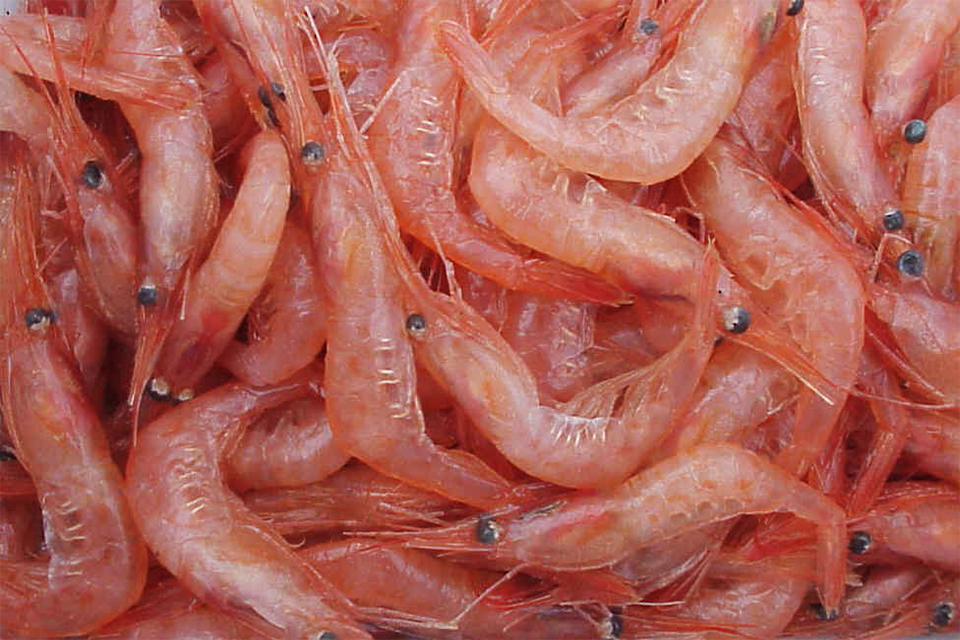
The northern shrimp (Pandalus borealis) fishery is one of the most economically valuable fisheries in the Northwest Atlantic, the eastern Canadian Arctic, and the Barents Sea. It generates 90 percent of Greenland’s export value and is the most valuable invertebrate fishery in the Barents Sea. However, shrimp fisheries are associated with bycatch issues, in particular from juvenile gadoids, such as Atlantic cod (Gadus morhua) and polar cod (Boreogadus saida). Moreover, polar cod has a circumpolar distribution, can account for 95 percent of the pelagic fish assemblage in the Arctic, and has a pivotal role in the Arctic food web as a key forage fish species.
The ecology and stock abundance of all three species is monitored through trawl or acoustic-trawl surveys. However, sampling in ice-covered waters is generally impossible. There is a need to develop a method to validate and classify their acoustic signal using solely acoustics to improve assessment surveys, evaluation of bycatch risks, and ultimately forecasts in stock dynamics at high latitudes. The classification of coincident species could help assess the bycatch risk prior to setting the trawls or to inform policy and models on ecosystem distribution patterns and biomass attributions. Remote target classification with broadband acoustics could also benefit stock assessment surveys and estimates by increasing spatial resolution, access to remote areas, and sustainability by reducing survey time and costs related to trawling and sorting of catch.
A protocol to process and classify broadband acoustics is not only required in the Arctic but would also improve hydroacoustic surveys globally. Hydroacoustic surveys are widely used to monitor pelagic fish stocks. They provide high spatio-temporal resolution of fish abundance and distribution and are less invasive than traditional net monitoring.
This article – summarized from the original publication (Dunn, M. et al. 2025. Broadband acoustic classification of Atlantic cod, polar cod, and northern shrimp in in situ mesocosm experiments. Fisheries Research Volume 286, June 2025, 107388) – reports on a study that used a series of single-species mesocosm experiments with broadband hydroacoustics to classify the acoustic backscatter from three sympatric (species or populations in the same or overlapping geographical areas) species: Atlantic cod, polar cod, and northern shrimp, and provided a protocol to measure target spectra of pelagic organisms, not only from the Arctic, but globally.
![Ad for [membership]](https://www.globalseafood.org/wp-content/uploads/2025/07/membership_web2025_1050x125.gif)
Study setup
As a step towards automatic in situ classification, we conducted a series of single-species mesocosm experiments for broadband target strength spectra measurements of Atlantic cod, polar cod and northern shrimp. Atlantic cod, polar cod, and northern shrimp were collected from a research vessel pelagic and bottom trawls in three fjords in Svalbard (Billefjorden, Krossfjorden, and Konsgsfjorden in Norway.
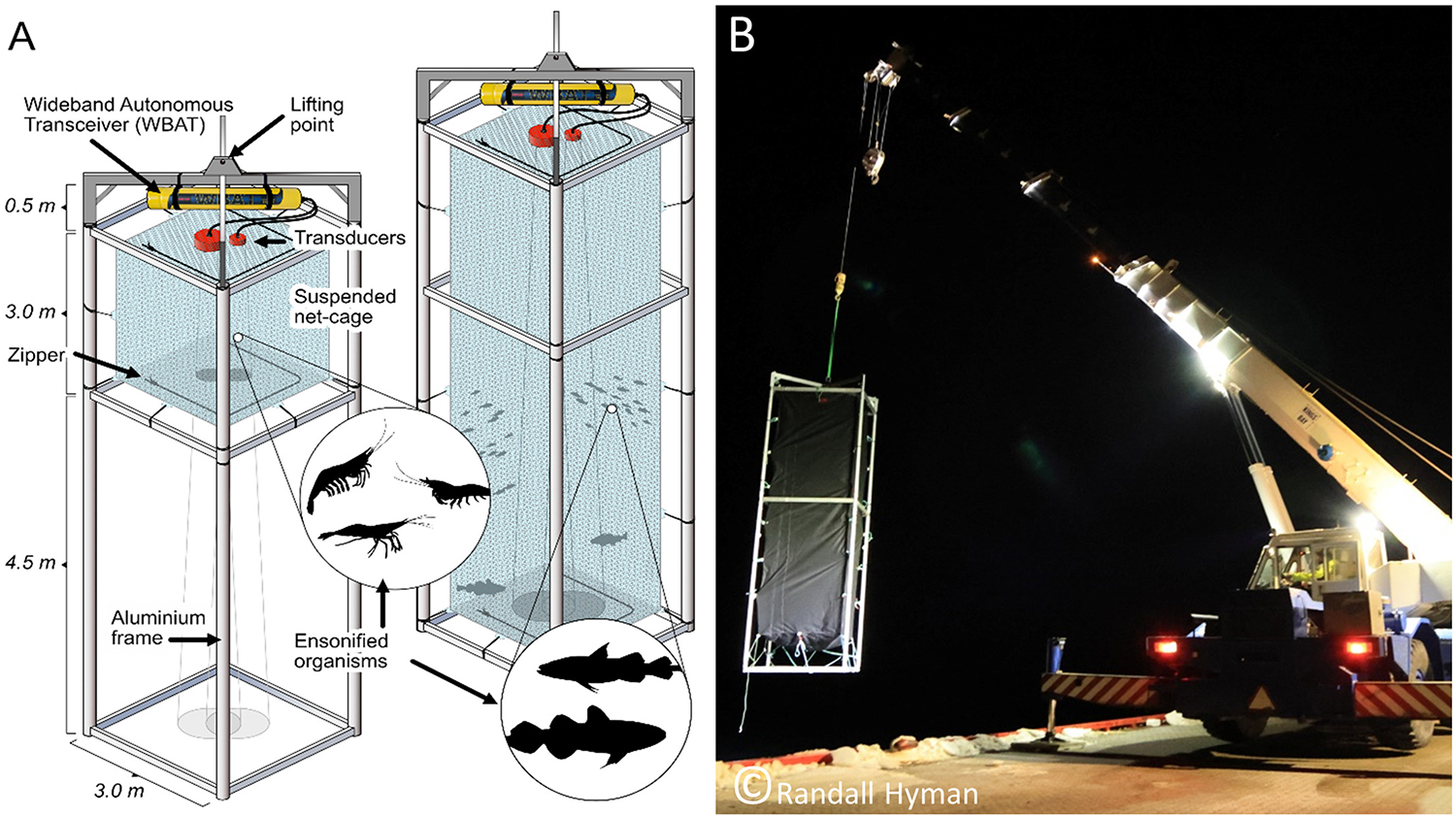
Mesocosm experiments were completed with a Wideband Autonomous Transceiver (WBAT) and collected individual target strength spectra, TS(f), between 90–170 kHz and 185–255 kHz. Hundreds of TS(f) were extracted for each species and used to train machine-learning classification algorithms (i.e. classifiers).
For detailed information on the experimental design, equipment used, and sample and data collections and analyses, refer to the original publication.
Results and discussion
The high classification performance for the three sympatric marine species is a promising result for spectral-based classification of targets from broadband echosounders. The results show that Atlantic cod, polar cod, and northern shrimp can be differentiated using their target spectra with a single 200 kHz transducer. Presumably, the range of target spectra complexity and morphological differences of the three species ensured the high performance of the classifiers.
Atlantic cod’s target spectra were found to be the most complex, with the greatest total variation in the target spectra. The multiple scattering features (constructive and destructive interference) within the individual Atlantic cod targets must have originated from the backscatter of different organs interfering with each other. We thus expect that discriminating and classifying between several morphologically complex species, such as Atlantic cod, will be more challenging, especially in aggregations.
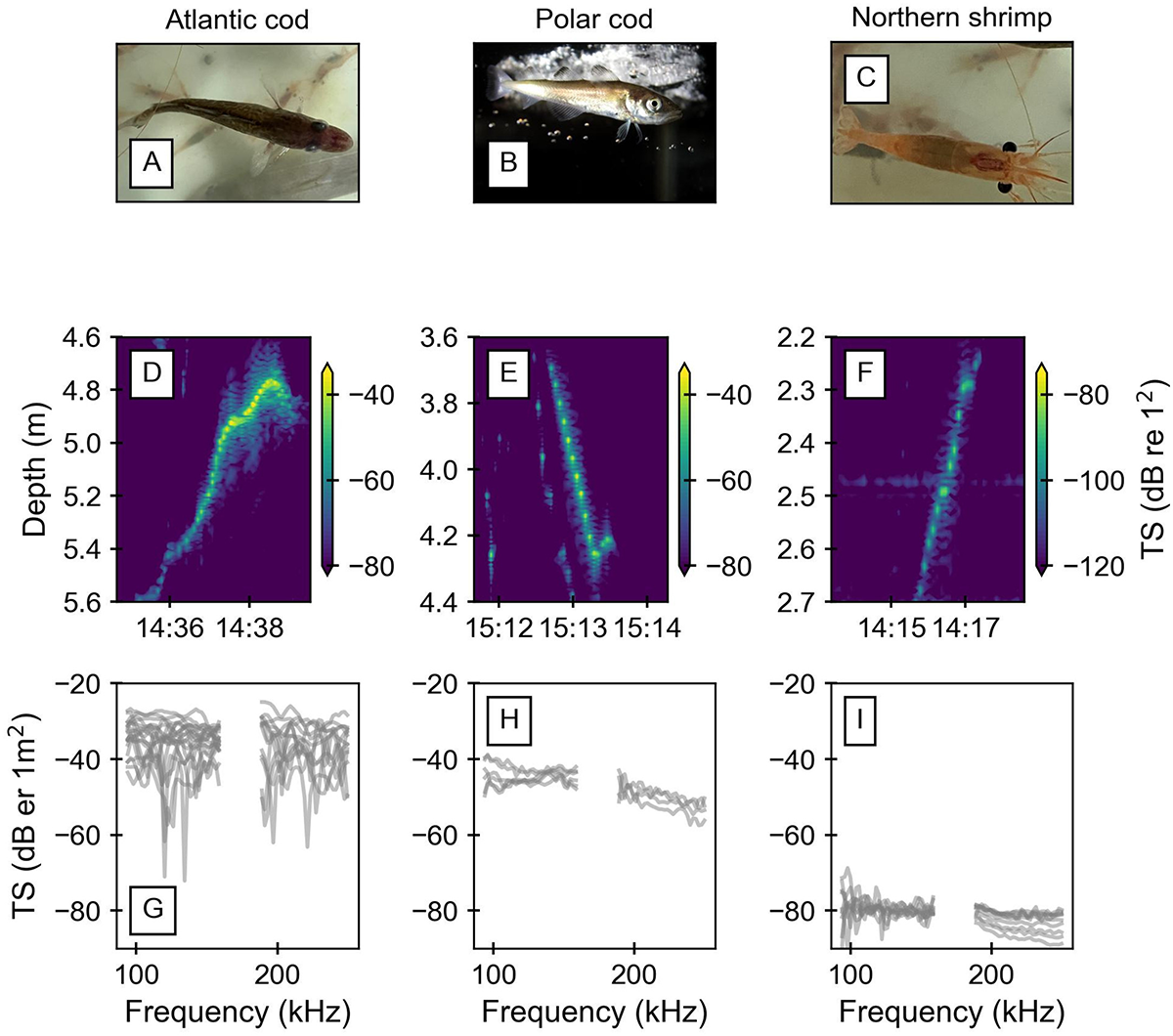
In contrast, polar cod target spectra had an intermediate spectral complexity with some ripples and a relatively consistent slope across the spectra. During the target selection of polar cod, results
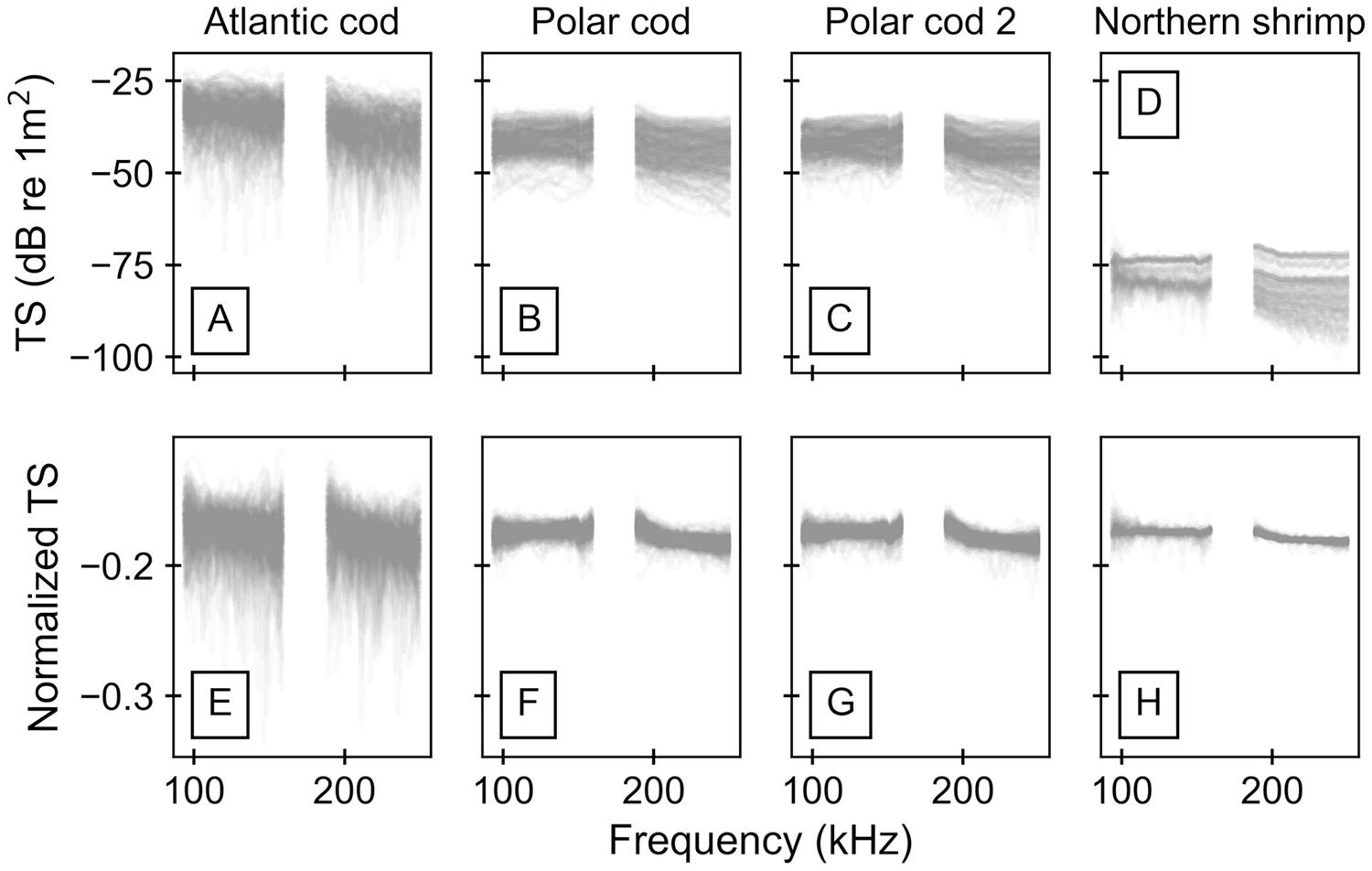
suggested each individual had a single dominant scattering feature (i.e., the swim bladder) and explained the absence of large nulls and peaks (Fig. 2H). The northern shrimp had the lowest total variation in the target spectra with some ripples in the 94–158 kHz bandwidth but predominantly flat normalized target spectra, especially in the 189–249 kHz bandwidth (Fig. 3D). The finer temporal resolution from the wider bandwidth may have revealed finer-scale scattering features, which are typically only discernible with higher frequencies.
Target spectra amplitude and slope were used by Cotter et al. to classify target spectra into four classes based on selected scattering models (i.e., above, at, or below resonance for gas-bearing organisms or fluid-like organisms). These categories were used to classify mesopelagic fish into size classes. Similarly, Roa et al. developed a taxonomical classification of reef fish with broadband backscattering models and machine learning approaches, and reported that the nodes or “ripples,” typically found at higher frequencies, were the prominent source of discriminating information. Based on previous studies and the results from this study, we conclude that selecting classification groups that have different levels of spectral complexity, or average total variation, can positively impact classification performance.
Broadband acoustic backscattering signals exhibit large unexplained variability between detections of a single target. Our results show that this variability can be used to discriminate between different pelagic organisms. We observed a comparable maximum variation in target strength of 33 dB re 1 m at 200 kHz within an Atlantic cod track. However, polar cod and northern shrimp exhibited a smaller variation of target strength per track. A mesocosm experiment, similar to this study but with fewer individuals with a larger measurement range and optical verification, could develop a better understanding of broadband acoustic target strength variability.
The role of sex and maturity stages in assessing trawl size selectivity in Antarctic krill
In the classification process, the normalizing preprocessing algorithm removes the intensity component of the target spectra (Fig. 3I–L). Normalizing the target spectra had the largest effect on the within-spectra variability of northern shrimp. Though northern shrimp had the smallest maximum variability per track, 7 dB re 1 m at 120 kHz and 8 dB re 1 m at 200 kHz, the intensity between individuals varied greatly, especially over the 189–249 kHz bandwidth (Fig. 3D). The normalized shrimp target spectra reduced variance, which showed that the northern shrimp had the most consistent target spectra pattern despite the large variability in target strength intensity.
The high performance of the classifiers in a controlled experiment is an important step towards in situ target classification. However, fundamental challenges should be addressed before in situ target classification can be achieved with mesocosm-trained classifiers. One method to validate the classifiers would be to repeat the lowered acoustic probe experiments in an enclosed region, such as a lake or smaller fjord, dominated by a single species to assess the error for that species.
Single species-dominated regions are commonly used in fisheries acoustics to associate the backscatter with a single species. A more widespread method to use mesocosm-trained classifiers would be to have broader classes and to group species based on morphological features and expected backscattering. Alternatively, mesocosm measurements could be used to validate and improve broadband sound scattering models to improve on model-informed classification. However, better knowledge of the impact of multiple scattering features and their contribution to target spectra complexity will also be necessary to successfully classify in situ broadband acoustic signals.
Further mesocosm experiments with populations from different fjords could improve our understanding of the interspecies variability of target spectra and limit pseudoreplication. The individual detections were used for the study because target spectra were variable within a track, and the spectral complexity factors from the target spectra would be flattened by averaging multiple detections from a track. Yet even though challenges remain before applying classification algorithms to in situ targets, this study demonstrates: (1) that pelagic organisms can be discriminated based on the complexity of their target spectra shape using a single transducer, and (2) that machine learning algorithms can efficiently identify these target spectra.
Perspectives
Three sympatric species – Atlantic cod, polar cod, and northern shrimp – were found to have distinct enough target spectra relative to each other in monospecific mesocosm experiments. Machine learning classifiers achieved high performance, especially the LightGBM and SVM classifiers. We speculate the variability in the level of complexity from the target spectra shape of the different species leads to the high performance of the classifiers on the normalized target spectra. The within channel target spectra variability was distinct enough demonstrating that a classification can be conducted with a single-channel transducer centered at 200 kHz. Further studies should consider including target strength intensity in classification by not normalizing the target spectra to account for important target strength information.
Based on a case study from Arctic species, this study advances the knowledge towards automating spectral classification for in situ classification from a lowered acoustic probes or autonomous underwater vehicles with payloads limited to a broadband echosounder and a single transducer. Further mesocosm studies could help determine the taxonomic resolution to which mesocosm-trained classifiers can be used for in situ classification, either by adding new classes of additional spatially coinciding species, such as herring and capelin, or by joining new classes in the existing ones based on their target spectra complexity.
An important application of spectral classification is real-time warnings of bycatch risks to reduce cost and trawling impact. In Arctic regions, forecasting bycatch risks could greatly impact the shrimp fishery because excessive retention of non-regulated bycatch can increase fuel costs, loss of revenue, and practical problems of onboard with sorting the catch. Finally, automated acoustic classification methods could increase our ability to monitor pelagic fish stocks using acoustic surveys.
Now that you've reached the end of the article ...
… please consider supporting GSA’s mission to advance responsible seafood practices through education, advocacy and third-party assurances. The Advocate aims to document the evolution of responsible seafood practices and share the expansive knowledge of our vast network of contributors.
By becoming a Global Seafood Alliance member, you’re ensuring that all of the pre-competitive work we do through member benefits, resources and events can continue. Individual membership costs just $50 a year.
Not a GSA member? Join us.
Authors
-

Corresponding author
SINTEF Ocean AS, 7010 Trondheim, Norway -
Institute for Marine Research, Acoustic and Observation Methodologies, 5005 Bergen, Norway
-
Department of Arctic and Marine Biology, UiT The Arctic University of Norway, 9019 Tromsø, Norway
-
Department of Arctic and Marine Biology, UiT The Arctic University of Norway, 9019 Tromsø, Norway
-
Department of Arctic and Marine Biology, UiT The Arctic University of Norway, 9019 Tromsø, Norway
-
Department of Arctic and Marine Biology, UiT The Arctic University of Norway, 9019 Tromsø, Norway
-
Department of Arctic and Marine Biology, UiT The Arctic University of Norway, 9019 Tromsø, Norway
-
Department of Biological Sciences, University of Bergen, 5020 Bergen, Norway
-
Akvaplan-niva AS, Fram Centre, Postbox 6606, Stakkevollan, 9296 Tromsø, Norway
-
Akvaplan-niva AS, Fram Centre, Postbox 6606, Stakkevollan, 9296 Tromsø, Norway
-
Centre for Fisheries Ecosystems Research, Fisheries and Marine Institute of Memorial University of Newfoundland, St. John’s, A1C 5R3, NL, Canada
Related Posts

Aquafeeds
Will krill fulfill its promise as an aquaculture feed ingredient?
Krill has been shown to augment aquafeeds but utilizing and protecting the resource demands specialized equipment and a patient, collaborative approach.
Fisheries
Can automatic measuring replace humans when evaluating a shrimp fishery?
A use-case approach can be applied for fisheries management when evaluating whether a new measuring technology can replace an existing one.
Fisheries
Evaluating the catch efficiency for common sole with the mandatory trawl gear used in the Kattegat Sea
Regulation outside of gear specifications is needed for this common sole fishery with no additional selective device that will increase retention.
Fisheries
Developing a full-scale shaking codend to reduce the capture of small fish
A shaking codend could stimulate fish movement and increase contact probability, both of which could increase the escape chances for small redfish.