


Multi-species assessment of the economic feasibility of implementing electrical stunning for farmed fish in the EU

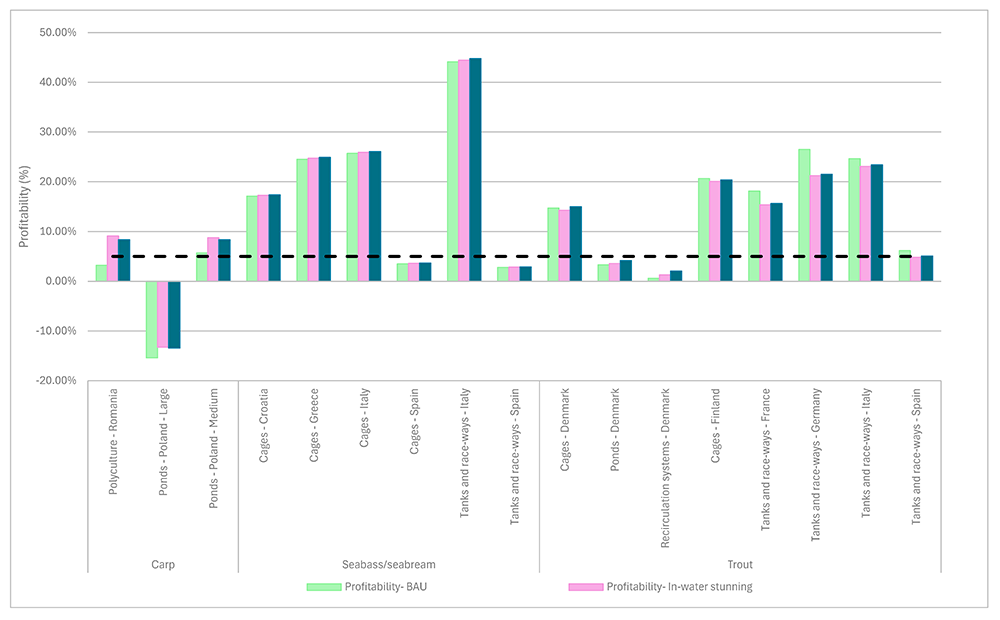
Although stunning adds some extra cost, most farms would still remain profitable
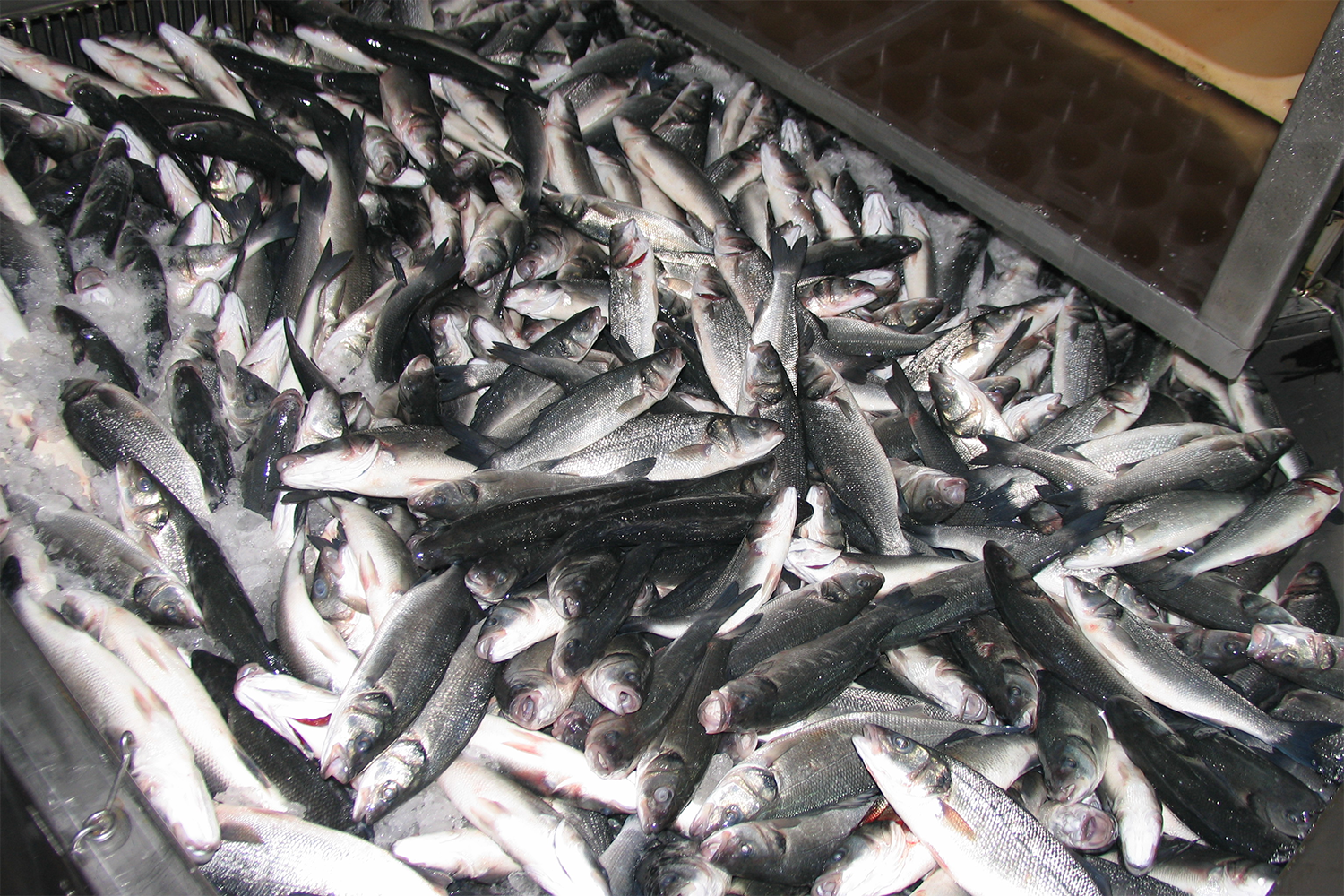
Stunning is widely recognized as a fundamental requirement for the slaughter of vertebrate animals, both legally and in terms of public expectation. It ensures that animals are rendered unconscious before death, preventing unnecessary pain and suffering. While stunning is standard practice for terrestrial vertebrates, fish remain largely overlooked, as there is no regulatory requirement for stunning in the EU. Consequently, its application is uncommon in aquaculture and wild-capture fisheries, and fish are handled and slaughtered while conscious, resulting in suffering. Furthermore, the slaughter methods commonly employed for fish – such as asphyxiation in air, ice, ice slurry, or carbon dioxide with or without live chilling – are typically slow and not instantaneous, resulting in suffering for the fish.
Despite several findings reported for animal welfare practices in European aquaculture for the transport and slaughter of farmed fish, stunning mechanisms are still not commonly used in European aquaculture, and cost is still perceived as a significant barrier by some.
This article – summarized from the original publication (Carpenter, G. et al. 2025. Economic Feasibility of Implementing Stunning for Farmed Fish in the EU: A Multi-Species Assessment. Animals 2025, 15(19), 2812) – discusses a study to assess the economic feasibility of implementing stunning mechanisms for the four main species in EU fish aquaculture, which are currently not routinely stunned prior to slaughter.
Study setup
This study assessed the economic feasibility of implementing electrical stunning for four species where it is not currently routine: carp, trout, sea bass, and sea bream. Using a granular cost model across 17 country-species-system combinations, and cost data from 2018 to 2020, the impact of introducing in-water and dry electrical stunning systems under various cost pass-through and sensitivity scenarios was evaluated.
![Ad for [BSP]](https://www.globalseafood.org/wp-content/uploads/2025/07/BSP_B2B_2025_1050x125.jpg)
A partial budget analysis was used to analyze the economic change before and after pre-slaughter stunning is implemented. This approach focused specifically on the costs and benefits that change as a result of introducing pre-slaughter stunning in aquaculture. Furthermore, the targeted approach allowed for a clear assessment of the economic feasibility without requiring a full enterprise analysis, making it highly suited to this specific application.
For detailed information on the study setup, data collection and analysis, refer to the original publication.
Results and discussion
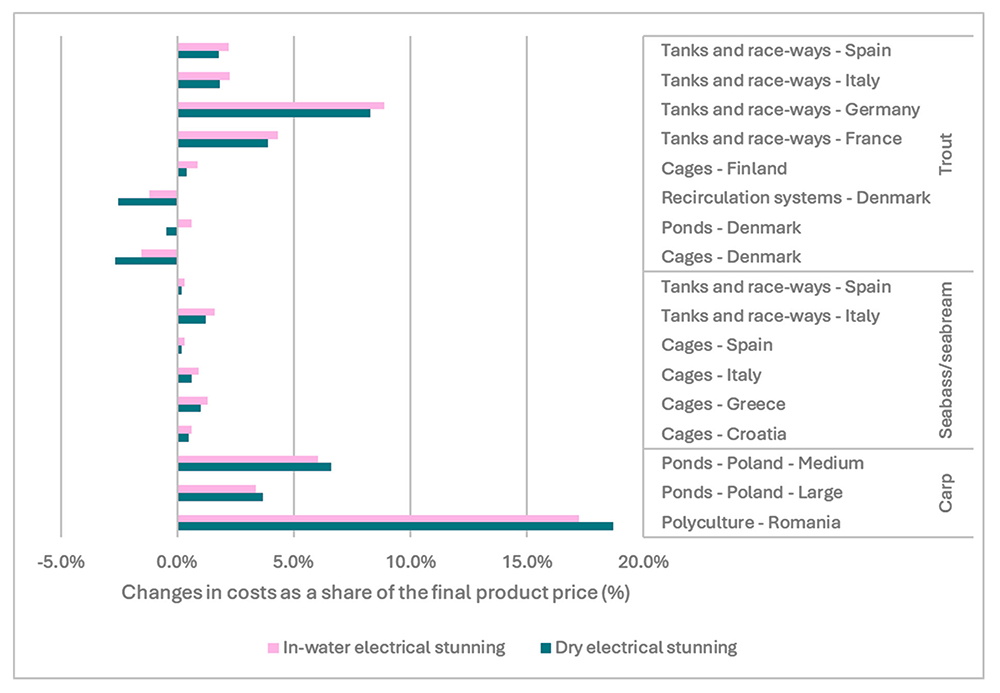
This study aimed to assess the economic feasibility of implementing stunning at slaughter for four of the main finfish species in EU aquaculture. Implementing electrical stunning in aquaculture generally results in increased costs, although these are modest for most systems. In fact, profitability remains robust across the majority of segments, even under the highest-cost assumptions, including a 20 percent increase in additional costs and a zero-cost pass-through scenario. Some segments even benefit from net cost savings due to reduced labor requirements. Overall, the carp sector showed the greatest vulnerability, due mostly to its current precarious economic status, and the trout sector shows the highest variability, with several segments seeking to gain considerably from introducing stunning.
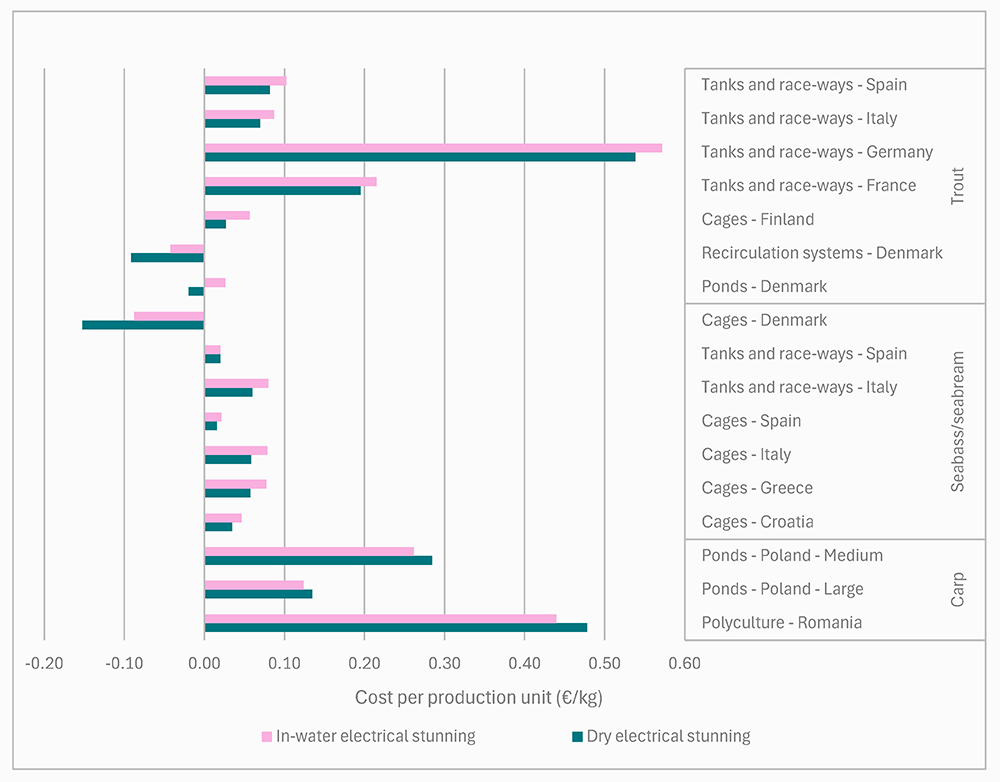
Building on earlier economic assessments of stunning in European aquaculture by using recent data and detailed modeling, the results show that the costs of implementing stunning for finfish in EU aquaculture are generally low for most species and systems. However, there are significant variations, especially for trout and carp, depending on the production systems, cost structures, and profitability. This research used actual wage data for more accurate assessments, revealing net cost reductions from electrical stunning in sectors with high labor demands. These savings are more pronounced in systems requiring extensive manual handling or in countries with higher labor costs.
Carp is identified as the highest-cost sector due to low production scales and narrow price margins. In contrast, sea bass and sea bream have the lowest cost impacts thanks to higher production volumes. Trout costs vary widely across studies, reflecting the diversity in trout production systems.
The study incorporated several key methodological assumptions that are critical for assessing the economic feasibility of stunning practices in aquaculture. First, it assumed that a portion of the additional costs associated with stunning will be passed on to consumers. This assumption is grounded in the understanding of market dynamics within the aquaculture sector. The analysis explored two extreme scenarios – 0 and 100 percent cost pass-through – and finds that a 0 percent pass-through is unlikely, supporting the notion that consumers would bear at least some of the increased costs.
A second assumption was that the average enterprise in the industry reflects typical operational conditions, which is a common approach in similar studies. While aquaculture operations vary widely – particularly in carp farming, where smaller enterprises may not align with broader industry trends – this assumption holds for more intensive systems like trout and sea bass farming, where the data from average enterprises are deemed to provide an accurate representation of costs and profitability.
The study model also assumed that enterprises do not currently utilize stunning equipment, a view supported by other reports that show low adoption rates in species such as carp and trout. Notably, salmon, which typically uses stunning, was excluded from this study. Additionally, it assumed that equipment purchases are made individually by each enterprise. However, this may not reflect reality, as shared equipment or rental models could help lower costs. These conservative assumptions were incorporated to assess the worst-case economic scenario, with the understanding that costs may be lower if equipment sharing were common.
The study also assumed that financing for equipment purchases would be at a 5 percent interest rate, which is typical for commercial lending. This assumption provides a reasonable baseline, though it does not consider potentially lower rates available to larger enterprises. Similarly, the model assumed that product quality and pricing will remain unchanged following the introduction of stunning practices, without accounting for potential improvements in fish welfare or product quality. Regarding energy costs, the model assumed minimal changes, a stance supported by previous research. However, sensitivity analyses were conducted to examine potential fluctuations in energy expenses.
These assumptions were designed to provide realistic and conservative estimates of the economic feasibility of implementing stunning in finfish aquaculture. While the study’s findings reflect cautious estimates, they also suggest that real-world outcomes could be more favorable, reinforcing the potential for policy decisions that would enhance fish welfare in aquaculture. Overall, these results form a solid basis for policy recommendations aimed at improving the welfare of the hundreds of millions of fish slaughtered annually within the European Union.
Study results have clear implications for ongoing policy discussions around the revision of EU animal welfare legislation. The recognition of the need to improve welfare practices for fish has seen considerable uptake globally in recent years. While recognizing the limitations of electrical stunning methods, this study provides timely and granular evidence to support the implementation of such regulations, as introducing stunning is economically feasible in the vast majority of the EU’s finfish aquaculture sector. In particular, even under the highest cost assumptions, most of the country-species-system segments remained profitable.
Regulatory reform that mandates stunning in this sector can be implemented with limited economic disruption. Continued research and development are needed to ensure that this area continues to strive to find more effective solutions for stunning in aquaculture, and so these insights provide a foundation for shaping policy measures that not only mandate stunning but also promote continuous improvements in welfare practices across the sector.
Several policy instruments could support the adoption of stunning in aquaculture systems, especially for the more vulnerable segments. For instance, financial incentives such as capital subsidies, and others. Such initiatives would not only reduce the economic burden of mandating stunning on lower-margin producers, but they would also help to accelerate and ensure widespread compliance with the new legislation.
The model used in this study provided more detail than earlier studies but relied on average data that may overlook variations within the sector. This limitation is common due to data availability and the need for general relevance. The model also failed to consider market dynamics, such as changes in consumer demand and production costs, although multiple scenarios were tested for cost pass-through. Moreover, indirect benefits like better product quality were not included but could offset additional costs long-term. While stunning animals can reduce stress at slaughter, it doesn’t ensure full welfare improvement for all species, highlighting the need for further research on effective methods.
While this study offers robust evidence of economic feasibility, tested through several sensitivity analyses, further research can support the uptake and implementation of stunning in EU aquaculture. In addition, to provide greater clarity on the potential for implementation, similar assessments should be undertaken regarding other prospective methods when suitable data become available. There is a clear need for the development and commercial testing of stunning methods, including the use of percussive methods on a wider range of species, to address the issues associated with electrical stunning and to improve welfare outcomes for farmed fish.
Lambert, electrical stunning, Table 1
| Parameter | BAU | In-Water Electrical Stunning | Change from BAU – In-Water | Dry Electrical Stunning | Change from BAU – Dry | |
|---|---|---|---|---|---|---|
| Profit per enterprise (EUR) | ||||||
| Mean | 472,419 | 468,680 | −3739 | 480,676 | 8257 | |
| SD | 661,737 | 700,782 | - | 727,095 | - | |
| Median | 246,005 | 232,361 | −13,644 | 235,092 | −10,913 | |
| IQR | 716,845 | 705,006 | - | 700,069 | - | |
| Range | −26,600 to 2,618,856 | −73,928 to 2,796,509 | - | −75,096 to 2,926,773 | - | |
| Profitability (%) | ||||||
| Mean | 15.68 | 13.35 | −2.33 | 13.53 | −2.15 | |
| SD | 12.6 | 13.09 | 13.16 | |||
| Median | 17.54 | 14.24 | −3.30 | 14.97 | −2.57 | |
| IQR | 20.73 | 17.57 | 17.31 | |||
| Range | −4.86 to 45.73 | −13.26 to 44.44 | −13.54 to 44.77 | |||
Perspectives
To date, this study provides the most detailed and comprehensive economic analysis of implementing electrical stunning for farmed finfish in the EU. By using updated cost data and granular modeling across 17 country-species-system segments, the results show that while stunning does result in additional costs, these are generally modest and can be absorbed or passed through without significantly impacting profitability. Even under the highest cost assumptions, including full cost absorption, no price premiums, individual equipment ownership, and no financial support, the majority of segments remain economically robust, with some even experiencing cost savings through improved labor efficiency.
These findings offer timely, evidence-based support for developing species-specific slaughter provisions under the ongoing EU animal welfare legislation revision. While current electrical stunning methods are not ideal in terms of welfare outcomes, this assessment demonstrates that, contrary to common perceptions, introducing stunning is economically feasible. This removes a major barrier to implementing effective stunning systems and supports continued research and development on improving stunning systems. Overall, the results show that stunning is economically feasible in most aquaculture contexts, aligning ethical progress with commercial feasibility.
Now that you've reached the end of the article ...
… please consider supporting GSA’s mission to advance responsible seafood practices through education, advocacy and third-party assurances. The Advocate aims to document the evolution of responsible seafood practices and share the expansive knowledge of our vast network of contributors.
By becoming a Global Seafood Alliance member, you’re ensuring that all of the pre-competitive work we do through member benefits, resources and events can continue. Individual membership costs just $50 a year.
Not a GSA member? Join us.
Authors
-

Independent Researcher, 1050 Brussels, Belgium
-
Eurogroup for Animals, 1000 Brussels, Belgium
-
Corresponding author
Animal Welfare Consultancy, Kingsteignton, Devon TQ12 3BW, UK
Related Posts
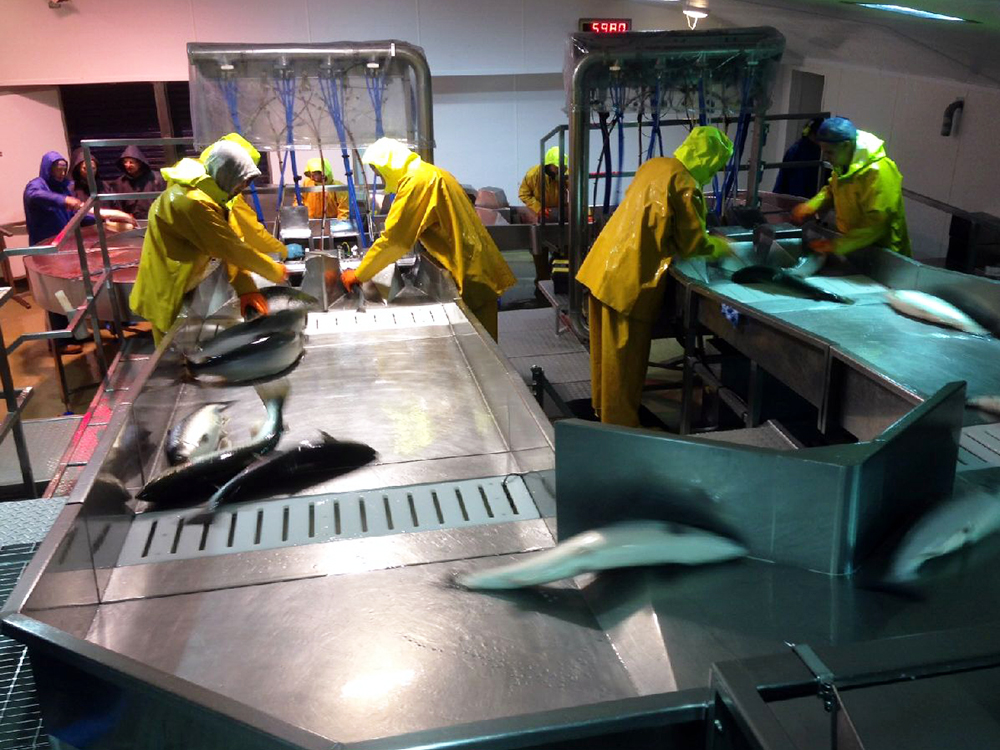
Health & Welfare
Fish producers benefit from humane slaughter techniques
EU legislation requires farmed fish be spared unnecessary pain, distress or suffering at slaughter, and efficient manual and automated systems have been developed to help achieve this goal. What’s more, longer shelf life and improved flesh quality have been reported.
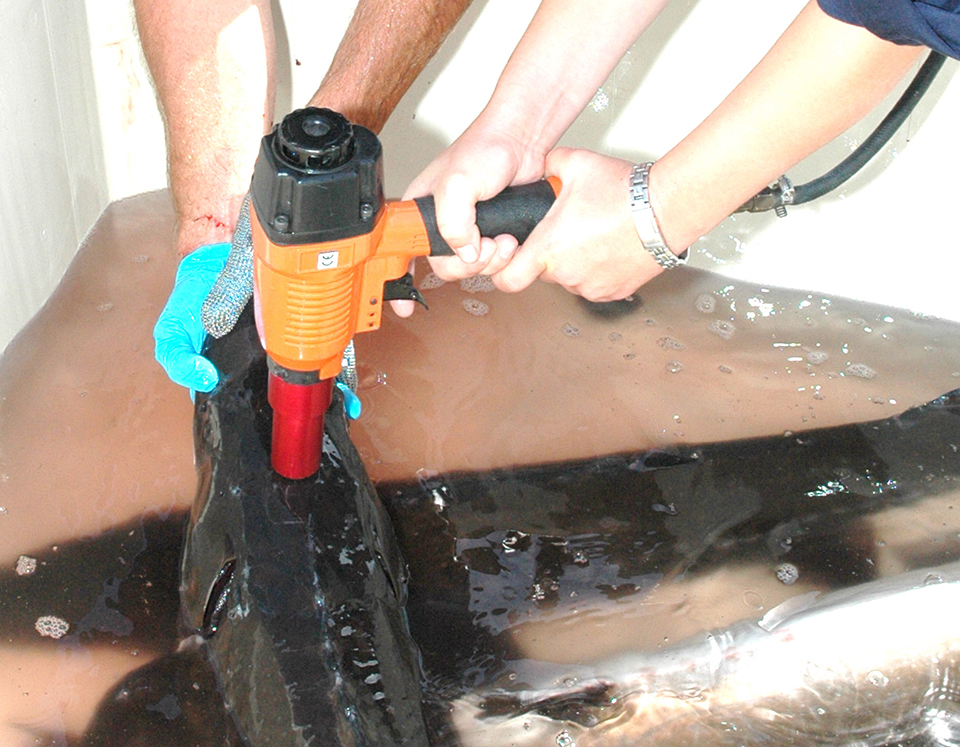
Health & Welfare
Animal welfare: Growing factor in international aquaculture
Although concerns for the animal welfare of food animals are currently highest in the United Kingdom and European Union, they are also growing in other parts of the world.
Health & Welfare
Ace Aquatec and Shrimp Welfare Project team up to promote humane stunning
Ace Aquatec and the Shrimp Welfare Project working together to improve shrimp welfare through humane stunning methods.
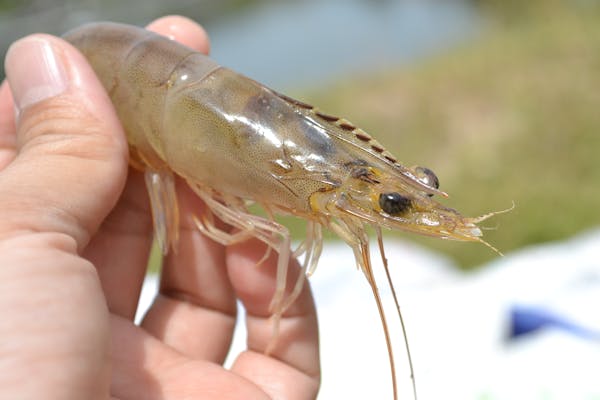
Health & Welfare
Another UK supermarket chain makes shrimp sourcing commitments regarding eyestalk ablation and electrical stunning
Co-op says that by 2027 its shrimp sourcing policy will forbid eyestalk ablation and require electrical stunning pre-slaughter.